Wind Uplift Resistance: Class F vs Class H Shingles for Austin
What Does Wind Resistance Mean for a Shingle?
A shingle’s wind rating is not a guess. It comes from a lab test where technicians mount a roof section in a wind tunnel, run air across it at a fixed speed for two hours, and watch whether the tabs lift, crease, or peel. If the shingles hold, they pass that wind class. If even one tab fails, they do not.
That number on the wrapper, whether it reads 110 mph or 150 mph, describes the sealed, properly fastened product under controlled conditions. It is a ceiling, not a promise. A roof installed with too few nails, or with the nails driven through the wrong part of the shingle, will fail far below its rated speed. This is why the conversation about wind resistance shingles always comes back to two things at once: the product class and the quality of the crew that installs it.
There is a second rating people confuse with wind resistance. Impact resistance, graded Class 1 through Class 4 under UL 2218, measures how a shingle survives hail, not wind. In the Central Texas hail belt both ratings matter, but they are separate tests. A Class 4 impact shingle is not automatically a high wind shingle, and the reverse is also true.
Class F vs Class H: The Two Standards Explained
The reason “Class F vs Class H” sounds confusing is that the two letters come from two different testing standards. They are not steps on a single ladder.
- Class F belongs to ASTM D3161, the older fan-based wind test. Its top tier, Class F, is rated to 110 mph.
- Class H belongs to ASTM D7158, a newer test that better models real uplift forces. Its top tier, Class H, is rated to 150 mph.
ASTM D3161 runs from Class A (60 mph) to Class D (90 mph) to Class F (110 mph). ASTM D7158 runs from Class D (90 mph) to Class G (120 mph) to Class H (150 mph). So when a manufacturer prints both a Class F and a Class H rating, it is reporting results from two test methods, with Class H representing the higher real-world ceiling.
Rating | Standard | Rated wind speed | Typical use |
Class A | ASTM D3161 | 60 mph | Entry-level 3-tab |
Class D | ASTM D3161 / D7158 | 90 mph | Builder-grade shingles |
Class F | ASTM D3161 | 110 mph | Mid-tier architectural |
Class G | ASTM D7158 | 120 mph | Upgraded architectural |
Class H | ASTM D7158 | 150 mph | Premium high-wind shingles |
For an Austin homeowner, the practical takeaway is simple. A Class F shingle is a solid mid-tier product. A Class H shingle is the highest wind class commonly sold for residential asphalt roofing.
Why Wind Ratings Matter for Austin and Cedar Park Roofs
Central Texas does not see hurricanes, but it sees violent thunderstorms, downbursts, and straight-line winds that regularly clock 60 to 80 mph. Severe outflow events have pushed gusts past 90 mph more than once in the Austin metro over the past decade. Add the open, exposed lots common in newer Cedar Park and Leander subdivisions, where there are few mature trees to break the wind, and the load on a roof edge climbs quickly.
Wind does the most damage at the perimeter: eaves, rakes, ridges, and any spot where the field of shingles transitions to an edge. Those are the zones that lift first. A roof rated only to 90 mph leaves very little margin during a strong spring storm. Stepping up to wind resistance shingles in the Class F or Class H range gives the edges a buffer when the gusts arrive sideways. Our Cedar Park roofing crews see the difference firsthand after every major storm season.
How Shingles Actually Fail in High Wind
Shingles rarely tear off in one clean sheet. The failure sequence is more gradual, and understanding it explains why ratings matter.
- Seal breaks. Wind works under the leading edge of a tab and breaks the factory adhesive strip.
- Tab flutters. Once unsealed, the tab flaps with each gust, fatiguing the asphalt.
- Nail tears through. The flapping shingle pulls against its nails until the heads tear through the mat.
- Cascade begins. With one course gone, the next course up loses its overlap protection and follows.
A higher wind class survives the first step longer because the adhesive, mat reinforcement, and nailing zone are all engineered for greater uplift. That is the whole point of paying for Class H over Class F: a wider safety margin before step one ever happens.
Do You Need Class H Shingles in Central Texas?
Not every home does. Here is an honest framework.
Class F is usually enough if:
- Your home sits in an established neighborhood with mature tree cover.
- Your roof pitch is moderate and the eaves are partially shielded.
- You want strong protection without paying for the top tier.
Class H is worth the upgrade if:
- You are on an exposed lot, a hilltop, or a new-build subdivision with open sightlines.
- You want the highest manufacturer wind-warranty tier available. If a premium credit is the goal, ask about a Class 4 impact rating as well, because that is the rating Texas insurers must offer a discount for.
- You are already replacing the roof and the cost difference is marginal over a 25-year horizon.
Many homeowners in Lakeway and west Austin, where ridgelines catch more wind, lean toward Class H for the extra cushion. If you are unsure which class fits your exposure, our roofing services team will assess the site rather than guess from the curb.
Installation Quality Beats the Rating on the Wrapper
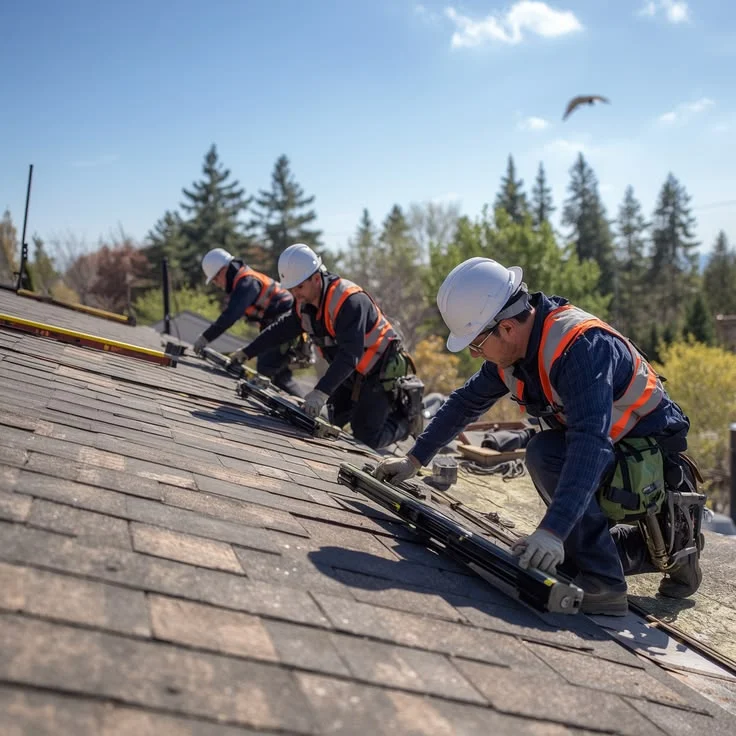
Here is the uncomfortable truth most ads skip: a Class H shingle installed with four nails in the wrong position performs worse than a Class F shingle nailed correctly with six. The rating assumes a specific nailing pattern, and shortcuts erase it.
What actually protects an Austin roof in wind:
- Six nails per shingle, not four, on every high-wind installation.
- Nails in the manufacturer’s marked zone, not high (which misses the underlying course) or low (which exposes the head).
- Starter strips at eaves and rakes with their own sealant bead, since the perimeter fails first.
- Hand-sealing in cooler installs when the sun has not yet activated the adhesive.
As a GAF Master Elite contractor certified since 2005, this is the part of the job that earns the wind rating. The shingle is only half the system. The nailing pattern, starter course, and edge detailing are the other half, and they are where corners get cut on cheap bids.
Watch: The Six-Nail Detail That Earns the Wind Rating
The 6-Nail Detail Most Homeowners Never See. Real footage from an Austin-area roof replacement, showing an installer fastening each shingle with six nails rather than four. This is the step that decides whether the number printed on the wrapper means anything on your roof.
Questions to Ask a Roofer About Wind Rating and Fastening
Wind rating is one of the few roofing specs a homeowner can verify in writing before work starts. Five questions that separate a real high-wind installation from a shingle upgrade on paper:
- Which standard is that rating from, D3161 or D7158? A bid that just says “high wind” is not an answer. Class F is ASTM D3161 at 110 mph. Class H is ASTM D7158 at 150 mph. Ask which test the printed number comes from.
- How many nails per shingle, and where? Six is the high-wind pattern. Ask the crew to confirm six nails in the manufacturer’s marked nailing zone, and put it in the written scope, not just the conversation.
- What starter strip is being used at the eaves and rakes? Cut-up field shingles used as starter have no factory sealant bead at the edge. A proper starter product does. The perimeter is where wind damage begins.
- Will the shingles be hand-sealed if we install in cool weather? The adhesive strip needs sun and warmth to bond. A roof installed on a cold, overcast week can sit unsealed for weeks unless the crew hand-seals it.
- Does the manufacturer’s wind warranty match the rating? The wrapper rating and the warranty are not always the same number, and the enhanced warranty usually requires a certified installer plus specific accessories. Ask for the warranty tier in writing.
If a contractor cannot answer these without checking, the wind rating on the proposal is a product number rather than an installation commitment.
Cost Comparison: Class F vs Class H Shingles
Pricing varies by roof size, pitch, and complexity, but the relative gap between classes is consistent. The figures below are typical installed ranges for a standard Central Texas single-family roof.
Item | Class F shingles | Class H shingles |
Material cost per square | $115 to $150 | $150 to $210 |
Typical installed cost (2,000 sq ft roof) | $9,000 to $13,000 | $11,000 to $16,000 |
Rated wind speed | 110 mph | 150 mph |
Manufacturer wind warranty | 110 to 130 mph | up to 150 mph |
Texas insurance credit | Not tied to wind class | Not tied to wind class; impact-resistance credits follow UL 2218 Class 4 ratings |
The upgrade from Class F to Class H usually adds 10 to 20 percent to material cost, which often lands in the $1,500 to $2,500 range on a typical home. Spread across a roof you expect to keep for 25 years, that is a small annual premium for a 40 mph wider safety margin. For a full estimate on your specific roof, contact us for an on-site measurement.
FAQ: Wind-Resistant Shingles in Austin
Is Class H always better than Class F?
Class H carries a higher rated wind speed (150 mph vs 110 mph), so on paper it is stronger. Whether it is better for you depends on your exposure. An open, hilltop, or new-build lot benefits more than a sheltered home in a mature neighborhood.
Do wind resistance shingles lower my insurance?
Not because of the wind class. Per the Texas Department of Insurance, roofing that has been tested for impact resistance may be eligible for an insurance discount, and the amount for each class is set by each insurance company on a company-by-company basis. That credit follows the UL 2218 impact classification, which is a hail rating rather than a wind rating, and Class 4 receives the highest credit. The Texas Windstorm Insurance Association does offer credits for impact-resistant roofing, subject to the UL label and TDI form PC068. Nothing in Texas rules sets a credit for a Class F or Class H wind rating, so any wind-based reduction is the carrier’s own decision. Ask your agent which rating your carrier credits, and get it in writing, before you buy.
What wind speed do Austin storms actually reach?
Most thunderstorm gusts fall in the 50 to 80 mph range, but severe downbursts and straight-line wind events in the metro have exceeded 90 mph. A Class F or Class H rating builds in margin above those numbers.
Can I get Class H shingles that also resist hail?
Yes. Several premium lines carry both a Class H wind rating and a Class 4 impact rating, which is a smart pairing for the Central Texas hail belt. Confirm both ratings on the product data sheet.
Does the rating still apply on an old roof deck?
Only if the deck and fasteners can hold. A rotted or thin deck will not let any shingle reach its rated uplift. A proper installation inspects the decking first and replaces what cannot hold a nail.
The shingle class you choose sets the ceiling, but the crew you hire decides whether your roof ever reaches it. If you want a straight answer about whether Class F or Class H makes sense for your exposure, talk to an Austin roofing company that measures your site before quoting, and review the full range of roofing services we offer across the metro.

Author: Driftwood Builders Roofing
Driftwood Builders Roofing is a family-owned residential roofing company headquartered in Manchaca, Texas, serving Austin and the surrounding Hill Country since 2005. The company has delivered 3,700 full roof replacements and 783 repairs across 3,559 different customers over 20 years in business, with 97 years of combined construction experience across the leadership team and 74 years specifically inside Driftwood Builders. The company holds the highest contractor certifications offered by the major shingle manufacturers, including GAF Master Elite Contractor (the top 3% of GAF contractors nationally), GAF Certified Green Roofer, Owens Corning certified, TAMKO Pro Certified Contractor, and a Berridge Roof Installation Seminar Certificate for standing-seam metal roofs. Driftwood is an NRCA member, holds an Angie's List Super Service Award, is BBB Accredited, and is a GuildQuality member for verified customer satisfaction data. James Hardie certification covers the siding side of the business. Services include residential roof replacement, leak and storm-damage repair, tile roof repair, metal roofing, TPO commercial roofing, roof inspections, hail and storm damage inspections with insurance claim assistance, gutter work, and James Hardie siding. The customer-protection policy is straightforward: Only Pay Upon Completion. The company serves 22 cities across the Hill Country and Greater Austin and holds a 5-star rating across Google, GuildQuality, Angi, Nextdoor, Facebook, Thumbtack, and Yelp.
