HOA-Friendly Roofing: Working with Austin Communities
What Does HOA Approved Roofing Actually Mean?
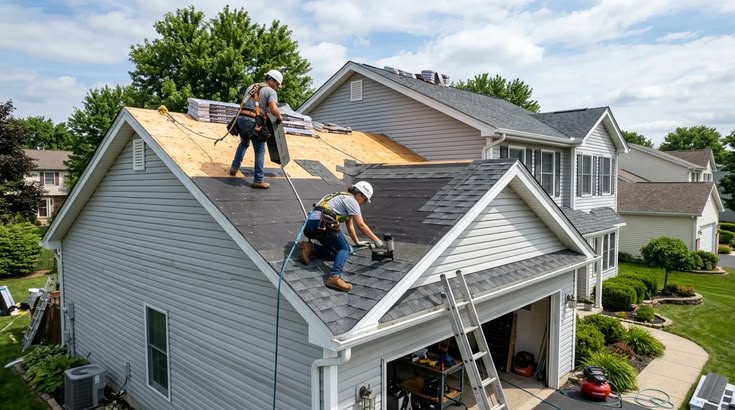
In most Austin-area subdivisions, your roof is not just your decision. If you live in a community governed by a homeowners association, the covenants you agreed to at closing give the HOA authority over how the exterior of your home looks, and the roof is one of the largest visible surfaces on any house. HOA approved roofing simply means a roof system the association has signed off on in writing before installation, confirming the material, color, and style fit the neighborhood’s published design standards.
The reason associations care is consistency. A uniform streetscape protects property values across the community, and roofs that clash, think a bright blue metal panel next to twenty homes with brown architectural shingles, can drag down comparable sale prices. That is why nearly every planned development in Cedar Park, Round Rock, Leander, and the surrounding hill country writes roofing rules into its covenants, conditions, and restrictions (CCRs).
Skipping approval is a real risk. Homeowners who replace a roof without ARC sign-off can face fines, a formal demand to remove and redo the work, or a lien if penalties go unpaid. Getting it right the first time is almost always cheaper than fighting it after the fact.
The Austin HOA Roof Approval Process, Step by Step
Every association runs its own committee, but the workflow across Central Texas is remarkably similar. Here is the typical path from decision to dumpster.
- Request the current guidelines.Ask your HOA management company for the roofing section of the CCRs and any approved-products list. Rules change, so use the latest version, not the binder from your closing.
- Pick a compliant system.Choose a material and color that match the guidelines. A roofing contractor who works your area can usually tell you in minutes whether a product is a safe bet.
- Complete the ARC application.This architectural modification form asks for the manufacturer, product line, color name, and your contractor’s information.
- Attach supporting documents.Most committees want a shingle sample or color chart, a manufacturer spec sheet, and a written estimate or contract.
- Submit and wait.The committee reviews on a set schedule, often monthly, and issues a written decision.
- Install after written approval.Keep the approval letter; you may need it when you sell.
Working with a contractor who handles these submissions regularly removes most of the friction. Our team builds the documentation package as part of every replacement, which you can read about on our roofing services page.
Which Roofing Materials Do Austin HOAs Approve?
The single most approved category in the Austin market is the architectural (also called dimensional or laminate) asphalt shingle. It mimics the depth of wood shake, carries strong wind and impact ratings, and comes in the muted color families HOAs prefer. Standing-seam metal and concrete or clay tile are approved in many communities too, especially newer hill-country developments, but they draw more scrutiny.
Material | Typical HOA Approval | Installed Cost (per sq ft) | Notes | |
Architectural asphalt shingle | Almost always | $4.50 to $8.00 | 25 to 30 years | Class 4 impact options ideal for the hail belt |
Standing-seam metal | Often, color-restricted | $10.00 to $16.00 | 40 to 50 years | Reflectivity and panel profile reviewed closely |
Concrete or clay tile | Common in tile neighborhoods | $11.00 to $20.00 | 40 to 50+ years | Must match existing tile communities |
Synthetic slate or shake | Case by case | $9.00 to $14.00 | 30 to 50 years | Approval depends on realistic appearance |
Three-tab asphalt shingle | Frequently restricted | $3.50 to $5.50 | 15 to 20 years | Many HOAs now prohibit as too flat |
A note on impact resistance: because Central Texas sits squarely in the hail belt, a Class 4 impact-rated shingle is worth the small upcharge. It survives hail better and often earns an insurance premium discount. Homeowners in established tile communities should review our guide to tile roof repair in Austin before assuming a switch to asphalt is allowed.
Colors, Profiles, and the Details HOAs Scrutinize
Material is only half the review. Committees look just as hard at color and profile, the visual fingerprint of the roof.
Color
Earth tones dominate approved palettes: weathered wood, driftwood, charcoal, slate gray, and various browns. Bright or high-contrast colors are usually denied. If your neighbors all run a brown-gray blend, a stark black roof may be rejected even if the material is identical.
Profile and texture
HOAs increasingly favor the dimensional look of architectural shingles over flat three-tab products. Some communities specify a minimum profile depth or require shadow lines that read like real shake from the street.
Accessories
Do not overlook the small stuff. Ridge vents, drip edge color, pipe-boot paint, and even the visibility of solar attic fans can all appear in the guidelines. A complete submission addresses these so the committee has no reason to send it back.
How Hail Damage and Insurance Claims Fit In
When a hailstorm rolls through and you file an insurance claim, the HOA process and the claims process run on two separate clocks, and they need to stay in sync. Your insurer pays for a roof of “like kind and quality,” but the HOA decides what is allowed on your street. Occasionally those collide, for example, when an old three-tab roof is no longer permitted and the association now requires architectural shingles.
The practical move is to start the ARC application the moment your claim is approved, not after. Share the adjuster’s scope with your contractor so the proposed product matches both the payout and the guidelines. An experienced storm-restoration contractor coordinates the two, which is one reason homeowners across the region rely on a seasoned Austin roofing company rather than a storm-chasing crew that disappears after the check clears.
How Long Does HOA Roof Approval Take?
Plan for 2 to 4 weeks in most Austin-area associations, though it ranges widely:
- Fast track (3 to 7 days):Communities with a property manager empowered to approve products already on a pre-approved list.
- Standard (2 to 4 weeks):Committees that meet monthly and review applications in a batch.
- Slow (4 to 8 weeks):Self-managed HOAs run by volunteers, or submissions that arrive incomplete and bounce back.
The biggest controllable delay is a missing document. A package without a spec sheet or color sample almost always gets tabled until the next meeting. After a major hailstorm, volume spikes and timelines stretch, so submit early. If your roof is actively leaking, ask the HOA about emergency or temporary repair provisions; most allow a tarp or patch while approval is pending.
Choosing a Contractor Who Knows HOA Submissions
A contractor who installs in your neighborhood regularly is worth more than the lowest bid, because they already know what your committee approves. When you interview roofers, ask:
- Have you completed roofs in this subdivision or a comparable HOA nearby?
- Will you prepare the ARC documentation package, including samples and spec sheets?
- Are you GAF certified, and do you offer Class 4 impact-rated shingles for hail country?
- Do you carry current liability insurance and a Texas business presence I can verify?
Driftwood Builders has been GAF Master Elite certified since 2005, a credential held by a small fraction of contractors nationwide, and we install across Cedar Park and the greater Austin metro. That local track record means fewer surprises with your association and a roof that clears review the first time.
FAQ: HOA Approved Roofing in Austin
Do I really need HOA approval to replace my roof?
If your home is in an HOA with architectural covenants, yes. Replacing a roof without written ARC approval can trigger fines, a forced redo, or a lien, even when the new roof looks similar to the old one.
Can my HOA make me use a more expensive roof than insurance pays for?
It can require a material your payout does not fully cover, such as architectural shingles when your old roof was three-tab. Some policies include code or ordinance upgrade coverage that helps close the gap, so review your policy and adjuster scope together.
What roof color is most likely to get approved?
Muted earth tones, weathered wood, driftwood, charcoal, and slate gray, are approved most often. Match the dominant blend already on your street and you reduce the odds of denial.
How long is an HOA roof approval valid?
Most approval letters are valid for a set window, often 6 to 12 months. If your project slips past that date, you may need to resubmit, so confirm the expiration when you receive the letter.
Can a roofing contractor submit the HOA application for me?
Many do. A contractor experienced with local associations will assemble the samples, spec sheets, and estimate, and some submit on your behalf, which speeds approval and lowers the chance of a bounce-back.
Navigating an HOA does not have to slow your roof replacement to a crawl. With the right material, a complete application, and a contractor who knows your community, most Austin homeowners move from decision to installation in under a month. If you are ready to start, explore our full roofing services or contact us for a free inspection and an ARC-ready documentation package built for your neighborhood.
Author: Driftwood Builders Roofing
Driftwood Builders Roofing is a family-owned residential roofing company headquartered in Manchaca, Texas, serving Austin and the surrounding Hill Country since 2005. The company has delivered 3,700 full roof replacements and 783 repairs across 3,559 different customers over 20 years in business, with 97 years of combined construction experience across the leadership team and 74 years specifically inside Driftwood Builders. The company holds the highest contractor certifications offered by the major shingle manufacturers, including GAF Master Elite Contractor (the top 3% of GAF contractors nationally), GAF Certified Green Roofer, Owens Corning certified, TAMKO Pro Certified Contractor, and a Berridge Roof Installation Seminar Certificate for standing-seam metal roofs. Driftwood is an NRCA member, holds an Angie's List Super Service Award, is BBB Accredited, and is a GuildQuality member for verified customer satisfaction data. James Hardie certification covers the siding side of the business. Services include residential roof replacement, leak and storm-damage repair, tile roof repair, metal roofing, TPO commercial roofing, roof inspections, hail and storm damage inspections with insurance claim assistance, gutter work, and James Hardie siding. The customer-protection policy is straightforward: Only Pay Upon Completion. The company serves 22 cities across the Hill Country and Greater Austin and holds a 5-star rating across Google, GuildQuality, Angi, Nextdoor, Facebook, Thumbtack, and Yelp.
