Cricket Flashing: What It Is and When Your Roof Needs It
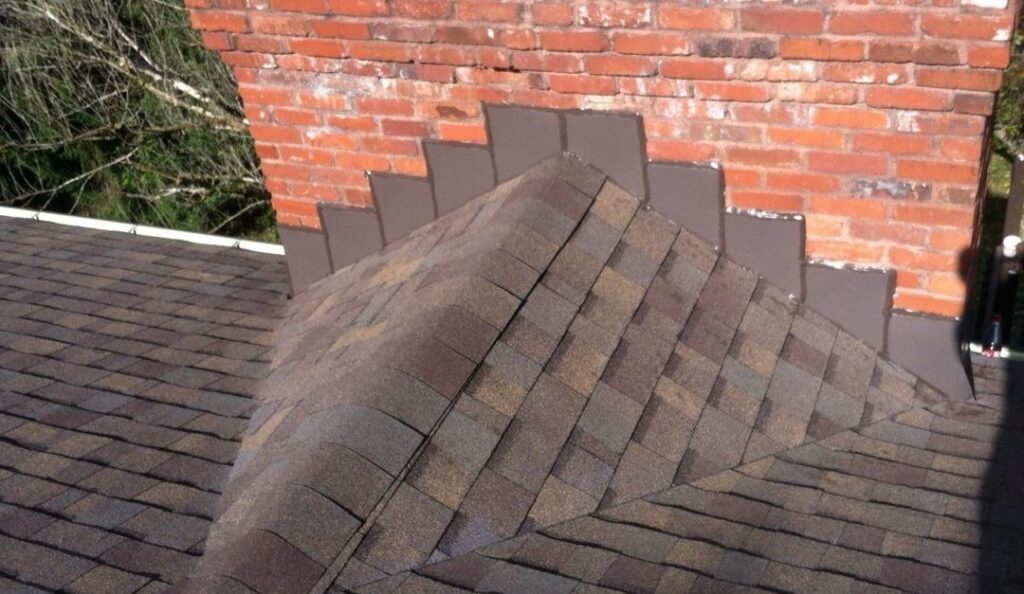
What Cricket Flashing Actually Does
Without a cricket, water and debris collect against the uphill face of the obstacle. On a chimney, that pooled water sits against the masonry, soaks the step flashing, and eventually finds its way through the smallest gap in the counterflashing. On a tile or asphalt roof exposed to Central Texas storms, that failure point becomes obvious within three to five years.
Cricket flashing is most commonly installed against:
- Chimneys
- Skylight curbs wider than 30 inches
- Parapet walls
- Dormers
- HVAC curbs on low-slope sections
The geometry is simple, but the execution determines whether it works for 20 years or fails in two.
When Code Requires Cricket Flashing
The 2021 International Residential Code section R1003.20 states that crickets are required when a chimney is more than 30 inches wide on the side facing up the slope. Texas builds to this version of the IRC with local amendments, and the City of Austin, Cedar Park, and Round Rock all enforce the 30-inch trigger on new construction and reroofs.
A few practical notes:
- The 30-inch measurement runs perpendicular to the roof slope, not along the chimney face.
- Steeper roofs (8/12 and up) can sometimes use alternative diversion methods if approved by the local inspector.
- Insurance carriers in Texas increasingly require documented cricket flashing on any chimney over 24 inches, even when code does not, because of the high incidence of chimney-leak claims.
If you bought a home built before 2010 and the chimney is wider than 30 inches, there is a meaningful chance the cricket is missing, undersized, or improperly flashed.
How a Proper Cricket Is Built
A correctly built cricket has four layers that work together. Skipping or shortcutting any one of them is what causes early failure.
- Two triangular plywood or OSB panels meet at a ridge, supported by a 2×4 frame. The ridge height is set at roughly half the chimney width to deliver enough slope for fast drainage.
- Self-adhered ice and water shield (or peel-and-stick membrane) covers the entire cricket and laps onto the field of the roof by at least 6 inches on all sides.
- Metal pan flashing. A pre-bent galvanized or painted aluminum pan covers the cricket itself. The pan should be one continuous piece on each face, with the seam at the ridge sealed and the lower edge tucked under the field shingles or tiles.
- Step flashing and counterflashing. Individual step flashings interweave with each course of shingles up the side of the chimney. A counterflashing piece is then let into a saw-cut reglet in the masonry and bent down to cover the step flashing.
The single biggest mistake is sealing counterflashing to brick with surface caulk only. Caulk fails in 3 to 5 years under Texas UV. A reglet-cut counterflashing lasts 25 years or more.
Signs Your Cricket Is Failing
You do not need to climb on the roof to suspect a problem. The interior gives you most of the signal.
- Brown staining on the ceiling within 24 inches of the chimney chase
- Damp drywall on the wall directly below the chimney on an upper floor
- Efflorescence (white powdery streaks) on the chimney exterior brick
- Rust streaks visible on the flashing from the ground
- Mortar joints crumbling on the uphill side of the chimney
From the roof itself, you would look for ponding stains on the uphill chimney face, lifted shingles within 18 inches of the cricket, and any visible separation between the counterflashing and the masonry.
If you see any of these signs after a hail or wind event, document the area with photos before calling for a free roof inspection. Insurance carriers in Texas have tightened claim windows, and pre-event photos help.
Cricket Flashing Costs in Central Texas
Pricing varies with chimney width, roof slope, accessibility, and material. Here is a realistic 2026 range for Cedar Park, Lakeway, and the broader Austin metro:
Cricket Width | Roof Type | Typical Cost (Repair) | Typical Cost (Full Reroof Build) |
30 to 36 inches | Asphalt shingle | $450 to $700 | $300 to $500 |
36 to 48 inches | Asphalt shingle | $650 to $950 | $450 to $700 |
48 inches and up | Asphalt shingle | $850 to $1,200 | $600 to $900 |
Any width | Concrete or clay tile | $900 to $1,800 | $700 to $1,300 |
Any width | Standing seam metal | $750 to $1,400 | $550 to $1,000 |
Standalone cricket repairs cost more than crickets installed during a full reroof because of mobilization, tear-off scope, and shingle weaving. If your roof is within 3 years of replacement anyway, bundling the cricket into that project saves 30 to 40 percent.
Cricket Flashing vs Other Chimney Flashing
People often confuse cricket flashing with other components in the chimney flashing system. They are not interchangeable.
- Apron flashing sits on the downhill face of the chimney and directs water onto the field of the roof. Required on every chimney.
- Step flashing runs up both sides of the chimney, interwoven with each shingle course. Required on every chimney.
- Counterflashing caps the step flashing and is let into the masonry. Required on every chimney.
- Cricket flashing sits on the uphill face and is only required when the chimney is wide enough to dam water.
A complete chimney flashing system on a 36-inch chimney includes all four. If any one of them is missing, leaks are a question of when, not if. Our Austin roofing company sees roughly 6 out of 10 service calls on chimneys originate from a missing or failed cricket, not the better-known step flashing.
Why Hail Belt Homes Need Extra Attention
Central Texas sits inside the southern hail belt, and Williamson and Travis Counties average 4 to 6 hail-producing storm days per year. Hail damage to cricket flashing is different from damage to the field of the roof.
- The pan flashing is the most exposed metal component on the entire roof and takes direct hits at the ridge.
- Dents in the pan create micro-low spots that hold water, then the water finds the seam.
- Counterflashing on the uphill chimney face is hit edge-on by wind-driven rain after a storm passes.
After any hail event over 1 inch, the cricket should be inspected separately from the field of the roof. Carriers will sometimes pay for cricket replacement on a hail claim even when the rest of the roof is borderline. Our commercial roofing and residential crews handle this evaluation as a standard part of post-storm inspection in Cedar Park and Lakeway.
For tile roofs in particular, cricket repairs require careful matching of underlayment thickness and pan profile. See our tile roof repair in Austin TX page for tile-specific notes.
FAQ: Cricket Flashing
Is cricket flashing the same as a chimney saddle?
Yes. “Saddle” is the older trade term, “cricket” is the modern code term. Both refer to the same wedge-shaped structure on the uphill side of an obstacle.
Can I add a cricket to my existing roof without replacing the whole roof?
Yes, but a clean cricket retrofit requires removing shingles or tile in a roughly 4-foot radius around the chimney, installing the cricket framing and flashing, and weaving new material back in. Expect $450 to $1,200 depending on roof type.
How long does cricket flashing last?
A properly installed cricket with reglet-cut counterflashing lasts 25 to 30 years on asphalt and 40-plus years on tile or metal. Caulk-sealed counterflashing fails in 3 to 5 years.
Does insurance cover cricket flashing repairs?
Hail or wind damage to cricket flashing is typically covered under a standard Texas HO-3 policy. Slow leaks from a missing or undersized cricket are usually classified as maintenance and are not covered.
Do I need a cricket on a 24-inch chimney?
Code does not require one under 30 inches, but in heavy-rainfall regions or on shallow-slope roofs, a small cricket is still a smart upgrade. Cost on a chimney that narrow runs $300 to $500.
A missing cricket is the kind of small detail that turns into a $14,000 interior repair after a single bad storm. If your chimney is wider than 30 inches and your roof is more than 10 years old, get the flashing system evaluated as part of your next inspection. For Cedar Park, Austin, and Lakeway homeowners, our team offers free chimney flashing inspections through our services page.

Author: Driftwood Builders Roofing
Driftwood Builders Roofing is a family-owned residential roofing company headquartered in Manchaca, Texas, serving Austin and the surrounding Hill Country since 2005. The company has delivered 3,700 full roof replacements and 783 repairs across 3,559 different customers over 20 years in business, with 97 years of combined construction experience across the leadership team and 74 years specifically inside Driftwood Builders. The company holds the highest contractor certifications offered by the major shingle manufacturers, including GAF Master Elite Contractor (the top 3% of GAF contractors nationally), GAF Certified Green Roofer, Owens Corning certified, TAMKO Pro Certified Contractor, and a Berridge Roof Installation Seminar Certificate for standing-seam metal roofs. Driftwood is an NRCA member, holds an Angie's List Super Service Award, is BBB Accredited, and is a GuildQuality member for verified customer satisfaction data. James Hardie certification covers the siding side of the business. Services include residential roof replacement, leak and storm-damage repair, tile roof repair, metal roofing, TPO commercial roofing, roof inspections, hail and storm damage inspections with insurance claim assistance, gutter work, and James Hardie siding. The customer-protection policy is straightforward: Only Pay Upon Completion. The company serves 22 cities across the Hill Country and Greater Austin and holds a 5-star rating across Google, GuildQuality, Angi, Nextdoor, Facebook, Thumbtack, and Yelp.
