Dimensional vs Three-Tab Shingles: Which Is Right for a Texas Roof?
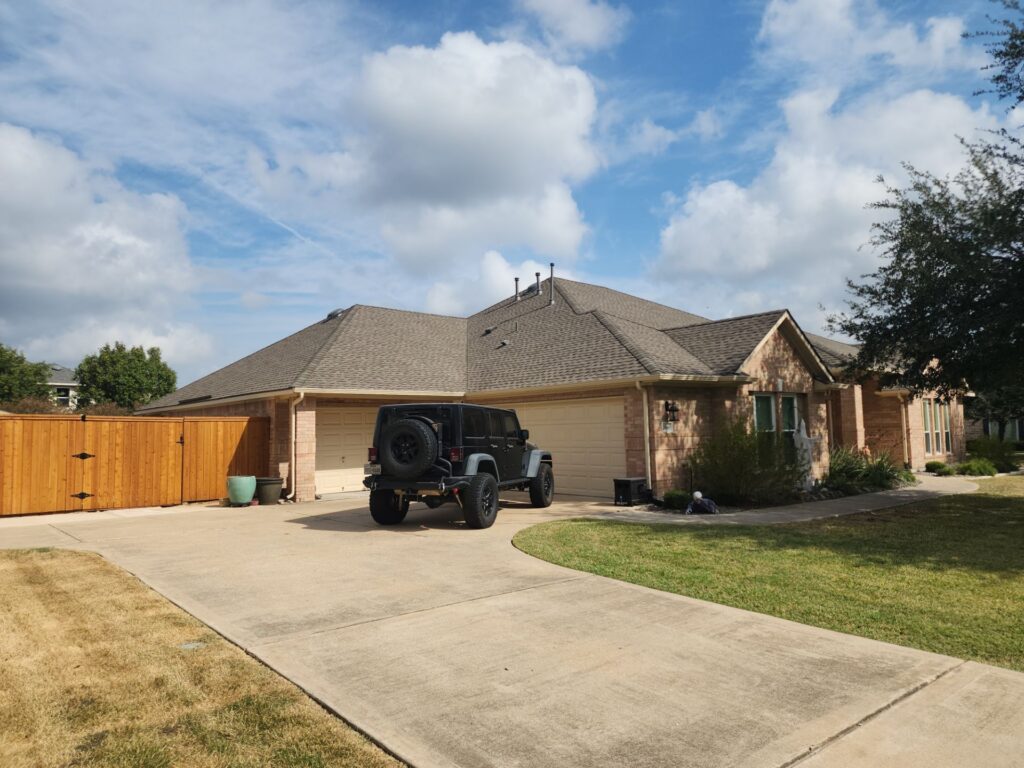
Watch the Video
What is the difference between dimensional and three-tab shingles?
The difference is construction, and everything else follows from it.
Three-tab shingles are a single flat layer of asphalt mat with two slots cut into the bottom edge, creating three visible tabs per strip. Every shingle is identical, the roof surface is flat and uniform, and the pattern is regular and obvious.
Dimensional shingles, also sold as architectural or laminate shingles, are made by bonding two layers of material together. The upper layer is cut in an irregular pattern and laminated onto a solid base, creating varied thickness and a shadowed, textured appearance.
That extra layer produces several practical differences:
- Weight. Dimensional shingles are considerably heavier, which contributes directly to wind resistance.
- Thickness. More material between weather and your decking.
- Appearance. The layered profile creates depth and shadow lines that mimic wood shake or slate, rather than the flat uniform look of three-tab.
- Wind rating. Dimensional shingles typically carry substantially higher wind ratings.
- Warranty. Manufacturers generally offer longer coverage on dimensional products.
Both are asphalt shingles and both work on the same principle, relying on granules to protect the asphalt from UV and on overlap to shed water. The dimensional version simply has more of everything.
How do they compare on cost and lifespan?
Three-tab is cheaper up front. Dimensional lasts longer. In Central Texas specifically, that trade tends to favor dimensional more than it would in a milder climate.
| Factor | Three-tab | Dimensional |
|---|---|---|
| Up-front cost | Lowest asphalt option | Moderate increase |
| Weight and thickness | Single layer | Two bonded layers |
| Wind resistance | Lower rating | Substantially higher |
| Expected lifespan | Shorter | Longer |
| Manufacturer warranty | Shorter coverage | Longer coverage |
| Appearance | Flat, uniform | Layered, textured |
The reason climate matters so much here is how asphalt shingles fail. They rely on oils to stay flexible, and sustained temperatures above 100 degrees drive those oils out, making the shingle brittle so it curls and cracks. A thicker shingle with more material has more margin against that process.
Hail is the second factor. Central Texas sits in an active hail corridor, and hail damages shingles by knocking off the protective granules, exposing the asphalt to UV and shortening the roof’s life even when no leak appears. Again, more material means more margin.
The cost difference between the two is modest relative to the total project, because a large share of any roofing job is labor, tear-off, disposal, underlayment, flashing, and decking. Upgrading the shingle affects only one line of that.
Which shingle is better for Austin homes?
For most Austin homes, dimensional is the better value, and it is what we recommend by default.
The reasoning is specific to conditions here:
- Sustained heat. Long stretches above 100 degrees age asphalt faster than in most of the country, and thicker shingles have more margin.
- Hail exposure. More material means more resistance to granule loss on impact.
- Storm winds. Higher wind ratings matter when storm fronts move through, since wind lifts shingle edges and breaks seal strips.
- Resale. Dimensional shingles look better and buyers increasingly notice roof quality.
As a GAF Master Elite contractor, the product we most often install is the Class 3 GAF Timberline HDZ, an architectural shingle that holds up well in this climate. Master Elite certification is held by a small share of roofers nationally and allows us to offer enhanced manufacturer warranties that most contractors cannot.
Three-tab still has legitimate uses: rental properties where up-front cost governs, outbuildings and detached garages, matching an existing three-tab roof on a partial replacement, and situations where budget is genuinely the binding constraint. It is a functional product, not a defective one.
What matters more than either choice is that the roof is installed correctly with adequate ventilation. A premium shingle on a poorly ventilated attic will fail early regardless of what it cost, and inadequate ventilation voids some manufacturer warranties. Our guide covers why shingles curl and buckle, which is usually a ventilation story.
Can you tell which shingles are on your roof?
Usually yes, from the ground, and it is worth knowing before you get quotes.
Look for three-tab if: the roof surface looks flat and uniform, you can see an obvious repeating pattern of evenly spaced slots, there are no visible shadow lines, and the whole surface sits at one plane.
Look for dimensional if: the surface has visible depth and texture, the pattern is irregular rather than repeating, you can see shadow lines where the upper layer overlaps, and the roof reads as having variation across it.
The simplest test is to stand back and look at the roof edge, particularly at a rake. Three-tab presents a thin, single-thickness edge. Dimensional shows a visibly thicker, layered edge.
Why it matters practically:
- For repairs, because matching matters. Dimensional and three-tab cannot be mixed on the same slope without it being obvious.
- For insurance claims, since the shingle type affects replacement value.
- For comparing quotes, so you can confirm each contractor is quoting the same class of product. This is a common source of price differences between bids.
If you are collecting replacement quotes, ask each contractor to name the specific shingle line, not just the category. Two quotes both saying architectural shingle may be quoting quite different products with different warranties.
What else matters more than the shingle you choose?
This is worth saying plainly, because homeowners often focus on the shingle brand while the decisions that actually determine roof life go unexamined.
These matter more:
- Ventilation. An attic without balanced intake and exhaust cooks the shingles from underneath. This is among the most common underlying problems we find on roofs that failed early, and it voids some warranties.
- Full tear-off rather than layering. Installing new shingles over old traps heat, adds weight, and means nobody inspects the decking.
- New flashing rather than reused. Flashing causes a large share of leaks, and old flashing under a new roof is a scheduled future problem.
- New pipe boots. The rubber collars degrade under UV faster than almost anything else on a roof.
- Correct nail placement. Nails must land in a specific zone. Too high and the shingle is not secured, too low and the head is exposed.
- Exactly one layer of felt paper. We have inspected competitor roofs carrying as many as four stacked layers.
- Decking condition, assessed and repaired at 100 dollars per sheet, photographed.
A mid-range shingle installed properly on a well-ventilated roof will outlast a premium shingle installed badly.
Driftwood Builders Roofing is family-owned, headquartered in Manchaca, and has served Austin and the Hill Country for 20 years with 3,559 customers. Estimates are free and detailed with no deposit required. See our roof replacement page, our Austin roofing company overview, or request a free estimate.
Related Videos
Metal Roof Replacement Cost vs. Shingles: Is Metal Worth the Extra Cost? | Complete Cost Comparison
Frequently Asked Questions
What is the difference between dimensional and three-tab shingles?
Three-tab shingles are a single flat layer with two slots cut into the bottom edge, creating a uniform look. Dimensional shingles, also called architectural or laminate, bond two layers together, making them thicker, heavier, and textured. That extra layer gives higher wind ratings, longer lifespan, and longer manufacturer warranties.
Are dimensional shingles worth the extra cost in Texas?
For most Austin homes, yes. Asphalt shingles fail when sustained heat drives the oils out and they become brittle, and hail knocks off the protective granules. More material means more margin against both. The cost difference is also modest relative to the total project, since labor, tear-off, underlayment, and flashing dominate the bill.
How can I tell which shingles are on my roof?
Look at the roof from the ground. Three-tab appears flat and uniform with an obvious repeating pattern of evenly spaced slots and no shadow lines. Dimensional has visible depth, an irregular pattern, and shadow lines. The simplest test is the roof edge at a rake, where three-tab is thin and dimensional is visibly layered.
When do three-tab shingles still make sense?
On rental properties where up-front cost governs, on outbuildings and detached garages, when matching an existing three-tab roof on a partial replacement, and where budget is genuinely the binding constraint. Three-tab is a functional product, simply with less margin against heat, hail, and wind than dimensional.
Does the shingle brand matter more than the installation?
No. Ventilation, full tear-off rather than layering, new flashing and pipe boots, correct nail placement, exactly one layer of felt paper, and proper decking repair all matter more. A mid-range shingle installed properly on a well-ventilated roof will outlast a premium shingle installed badly.

Author: Driftwood Builders Roofing
Driftwood Builders Roofing is a family-owned residential roofing company headquartered in Manchaca, Texas, serving Austin and the surrounding Hill Country since 2005. The company has delivered 3,700 full roof replacements and 783 repairs across 3,559 different customers over 20 years in business, with 97 years of combined construction experience across the leadership team and 74 years specifically inside Driftwood Builders. The company holds the highest contractor certifications offered by the major shingle manufacturers, including GAF Master Elite Contractor (the top 3% of GAF contractors nationally), GAF Certified Green Roofer, Owens Corning certified, TAMKO Pro Certified Contractor, and a Berridge Roof Installation Seminar Certificate for standing-seam metal roofs. Driftwood is an NRCA member, holds an Angie's List Super Service Award, is BBB Accredited, and is a GuildQuality member for verified customer satisfaction data. James Hardie certification covers the siding side of the business. Services include residential roof replacement, leak and storm-damage repair, tile roof repair, metal roofing, TPO commercial roofing, roof inspections, hail and storm damage inspections with insurance claim assistance, gutter work, and James Hardie siding. The customer-protection policy is straightforward: Only Pay Upon Completion. The company serves 22 cities across the Hill Country and Greater Austin and holds a 5-star rating across Google, GuildQuality, Angi, Nextdoor, Facebook, Thumbtack, and Yelp.
