
Gutter Installation and Replacement in Austin, TX
Austin rain arrives fast and heavy. We size, place and install gutter systems that carry it away from your fascia, siding and foundation, and we inspect the roof edge feeding them.
- Home
- /
- GUTTER INSTALLATION & REPLACEMENT
AN AUSTIN EXTERIOR CONTRACTOR WHO READS THE WHOLE ROOFLINE
What Austin homeowners get with Driftwood:
- Locally owned and serving Central Texas since 2005
- 3,700+ total projects completed
- GAF Master Elite Contractor
- BBB A+ rated
- 5.0 stars based on 500+ displayed customer reviews
- Insured, with multiple financing options available
- Free, no-pressure estimates
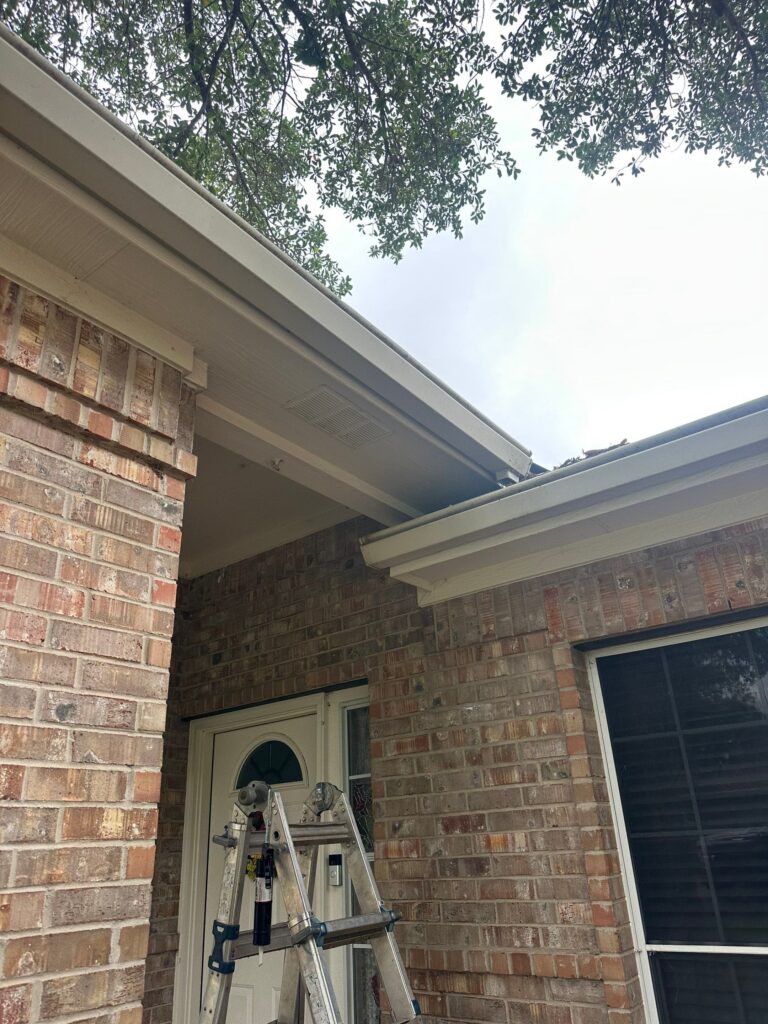
WHY AUSTIN HOMES NEED AN EFFECTIVE GUTTER SYSTEM
Central Texas rain tends to arrive in short, intense bursts rather than steady drizzle. A roof can shed thousands of gallons during a single storm, and all of it has to land somewhere. Where it lands is what a gutter system decides.
Concentrated roof runoff. Valleys and long roof planes funnel water into a few feet of gutter. When that section cannot keep up, water sheets over the front edge in exactly the same place every storm.
Soil movement and foundation exposure. Many Austin-area lots sit on soils that expand and contract as moisture changes. Repeatedly soaking the ground in one spot next to the slab, while the rest stays dry, is the pattern homeowners are usually trying to avoid.
Erosion and landscaping damage. Uncontrolled runoff carves channels in beds, washes out mulch and decomposed granite, and undermines walkways and patios.
Fascia and soffit deterioration. Water that backs up behind a gutter, or overflows against the eave, sits on the fascia board. Over time that shows up as staining, softening and rot, which is also what loosens the gutter fasteners holding the system in place.
None of this means every home needs a bigger gutter. It means the system should be matched to the roof feeding it. That is what we look at first.
OUR GUTTER SERVICES IN AUSTIN AND CENTRAL TEXAS
Gutter installation. New gutter systems for homes that have never had them, and for additions, dormers, porches and patio covers that were never tied into the original layout.
Gutter replacement. Full replacement when a system is undersized, corroded, repeatedly pulling loose, or was installed with too few downspouts to keep up.
Downspouts, extensions and drainage corrections. Adding downspouts is often the single most effective fix for a gutter that overflows in one spot. Splitting the flow across more exit points, and carrying discharge further from the house, solves a lot of problems that look like gutter failure.
Fascia and soffit repair. A gutter is only as sound as the board it hangs on. We repair or replace damaged fascia and soffit before hanging a new system, so the fasteners land in solid wood. See our guide to soffit and fascia repair costs, or read more about repairing and replacing soffit and fascia as its own project.
Storm and hail damage evaluation. Gutters, downspouts and gutter screens are among the first places we check after a storm, because dents and collateral damage there often corroborate what happened to the roof. If it turns into a claim, our storm damage and insurance claim team handles that side.
Roof and gutter project coordination. If the roof is being replaced, the gutters, drip edge and fascia are all accessible at the same time. Sequencing them together avoids paying twice for the same access.
Gutter repair. Leaking seams and corners, re-securing runs that have pulled loose, correcting sections that hold water instead of draining, and replacing damaged lengths rather than the whole system where that is the right call.
Gutter guards are an option we walk through during the assessment. See whether gutter guards are worth it below.

SIGNS YOUR GUTTERS MAY NEED REPLACING
Worth having someone look if you notice:
- Dripping, staining or rust streaks at seams and corners
- Gutters sagging, tilting, or visibly pulling away from the fascia
- Overflow in the same spot during every heavy rain
- Rust, corrosion, splitting or holes along the trough
- Fascia behind the gutter that looks stained, soft or rotted
- Erosion, washed-out mulch or standing water near the foundation
- Peeling paint or water tracks on siding directly below a gutter run
- Gutters or downspouts that look small for the roof area draining into them

REPAIR OR REPLACE YOUR GUTTERS? WHAT WE CHECK
Plenty of gutter problems are repairs, not replacements. On an assessment we check:
- Seams and corners. Leaks at a few joints can usually be resealed. Leaks along the whole run usually mean the system is near the end of its life.
- Pitch and standing water. Sections that hold water can often be re-hung to the right slope.
- Hangers and fasteners. Runs pulling away from the house can usually be re-secured, unless the fascia behind them has rotted.
- Fascia condition. Soft or rotted fascia has to be repaired before any gutter can hold, so we check it before recommending anything.
- Downspout capacity. Overflow at one corner is often an undersized or badly placed downspout rather than a bad gutter.
- Damage and age. Dents from hail or ladders, rust on steel gutters, and runs that have been patched again and again point toward replacement.
If repairs will do the job, we will tell you. When several of these show up on the same house, replacing the system is usually better value than chasing leaks one at a time.
5-INCH VERSUS 6-INCH GUTTERS: WHICH ONE YOUR HOME ACTUALLY NEEDS
Five-inch K-style is the standard residential size and it is the right answer on a lot of Austin homes. Six-inch moves noticeably more water and is normally paired with larger 3×4 downspouts instead of the common 2×3. Bigger is not automatically better, though. It costs more, it looks heavier on a modest eave, and on a small simple roof it solves a problem you do not have.
What actually drives the decision:
- Drainage area. Not the size of the house, but how many square feet of roof drain into one gutter run. A single long run collecting two large planes is the classic case for 6-inch.
- Roof pitch. Steeper roofs deliver water to the edge faster and with more momentum, which raises both the volume arriving at once and the chance of water overshooting the gutter.
- Valleys. A valley dumping into a short section of gutter concentrates flow far beyond what the linear footage suggests. This is the most commonly missed factor.
- Rainfall intensity. Sizing is driven by peak intensity, not annual totals. Central Texas storms are intense, which is why marginal systems here overflow even though they would be fine elsewhere.
- Downspout capacity and placement. A 6-inch gutter still backs up if it drains through too few, or too small, downspouts. Sometimes the better fix is more downspouts on a 5-inch system.
In practice the honest answer for most homes is mixed: 5-inch where the roof area is modest, and 6-inch with upsized downspouts on the specific runs handling valleys or large planes. Anyone who tells you every Austin home needs 6-inch gutters before looking at your roof is selling, not measuring.
We work this out on site, run by run, and show you which sections drove the recommendation.

MATERIALS, PROFILES AND OPTIONS
Most residential gutters in the Austin market are formed aluminum in a K-style profile, in 5-inch or 6-inch widths, with 2×3 or 3×4 downspouts. Aluminum is the common choice because it does not rust, it is light enough to hang without heavy bracing, and it comes in a range of factory finishes.
Other materials exist. Galvanized steel is stronger and more dent-resistant but can corrode where the coating is compromised. Copper is a premium architectural choice with a very different cost profile. Half-round profiles show up on older and period-style homes, including some of the box gutter systems found on older Austin houses.
Rather than list a catalogue here, we confirm the exact profiles, gauges, colors and downspout sizes available for your project when we quote it, along with what we would recommend and why. That keeps the conversation about your roofline instead of a brochure.

ARE GUTTER GUARDS WORTH IT IN AUSTIN?
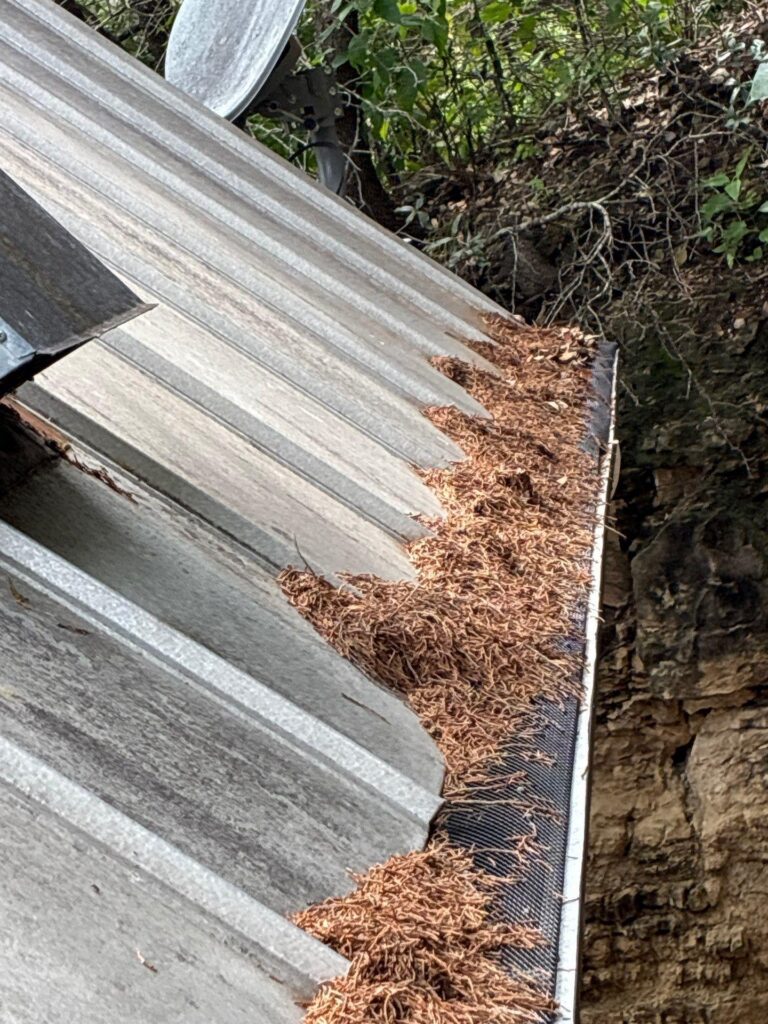
They are worth it if trees hang over your roof, and usually not if they do not. Guards cut down how much debris settles in the gutter, but no guard makes a gutter maintenance-free. In Austin, fine oak pollen and grit still get through or pile on top.
What decides it is the tree cover over your roofline. Live oaks drop leaves, catkins and pollen most of the year, and that is where guards earn their cost. On a house with little overhanging canopy, a cleaning once or twice a year is usually cheaper than guards.
The main types, and how they behave here:
- Micro-mesh: a fine stainless or aluminum mesh. Stops the most debris, but fine grit and oak pollen can mat on top and need brushing off.
- Perforated screens and grates: cheaper and keep leaves out. Smaller debris passes through and still needs flushing.
- Reverse-curve (surface tension) covers: water follows the curve into the gutter while leaves slide off. In a hard Central Texas downpour, water can overshoot the curve.
- Foam and brush inserts: inexpensive, but they hold debris and stay wet, so we rarely recommend them.
Two things to know before you buy. Guards do not fix a gutter that is the wrong size or pitched badly: if water overflows because a run is undersized or holds standing water, a guard can make it worse. And hail and ladders are hard on cheap guards; thin plastic screens crack and sag.
During the assessment we look at your tree cover, roof pitch and existing gutters, and tell you whether guards will pay for themselves on your house. If they will not, we will say so.
OUR GUTTER INSTALLATION PROCESS
01
PROPERTY AND DRAINAGE ASSESSMENT
We walk the roofline and the ground. Where does water currently land, where is it eroding, which runs collect valleys, and what condition is the fascia in?
02
MEASUREMENTS AND RECOMMENDATIONS
Run-by-run measurements, gutter sizing, downspout count and placement, and any fascia or soffit repair that needs to happen first.
03
WRITTEN PROPOSAL
A written scope and price covering materials, linear footage, downspouts and any carpentry, so you can compare it line for line against other bids.
04
REMOVAL AND PREPARATION
Existing gutters come down, fasteners are pulled, and damaged fascia or soffit is repaired so the new system mounts to sound material.
05
INSTALLATION AND WATER-FLOW PLANNING
Gutters are hung to a deliberate slope toward the downspouts, with hangers spaced for Texas storm loads and discharge directed away from the foundation.
06
CLEANUP AND FINAL WALKTHROUGH
We magnet-sweep for fasteners, clear debris, and walk the system with you so you know where every downspout discharges.
GUTTERS, ROOFS, FASCIA AND SOFFITS ARE ONE SYSTEM
Most gutter problems we get called out for are not really gutter problems. They are edge-of-roof problems that show up at the gutter, which is why a gutter-only crew and a roofing contractor can look at the same house and see two different jobs.
The roof edge decides where water enters the gutter. Drip edge that is missing, short, or installed behind the gutter lets water track back onto the fascia instead of into the trough. Drip edge is a detail worth getting right.
Fascia carries the load. Every gutter hanger is anchored to fascia. Once that board softens, the gutter starts to sag and pull away, which is why gutters pulling away from the fascia is usually a wood problem rather than a bracket problem.
Soffits show the history. Staining, peeling or daylight at the soffit tells us water has been getting behind the system for a while, and often points to where.
Walls and siding are downstream. Where a roof meets a wall, a missing or failed kickout can send water behind the siding instead of into the gutter. That is the mechanism behind kickout flashing and hidden siding rot.
Because we also handle roof replacement, roof and leak repair and siding installation and repair, we can tell you when a gutter is genuinely the problem and when it is the symptom. Sometimes that means we talk you out of new gutters. If you are wondering whether cleaning would do it instead, that is a fair question too: here is when cleaning is enough.
Gutter Service Areas Across the Austin Metro
Trusted South Austin roofing experts providing quality repairs, replacements, and storm damage solutions with skilled crews, fair pricing, and fast service.
South Austin Roofing
Trusted Lakeway roofing experts delivering quality repairs, replacements, and storm damage solutions with fast service, skilled crews, and dependable customer care.
Lakeway Roofing
Trusted Round Rock roofing specialists delivering quality repairs, replacements, and storm damage solutions with reliable crews, fast service, and customer-focused care.
Round Rock Roofing
Trusted Georgetown roofing experts providing quality repairs, replacements, and storm damage solutions with reliable crews, fast service, and exceptional customer care.
Georgetown Roofing
Trusted Salado roofing professionals offering quality repairs, replacements, and storm damage solutions with dependable crews, fast service, and exceptional customer support.
Salado Roofing
Serving Jarrell with trusted roofing solutions, we provide durable repairs, quality replacements, and reliable protection designed for the community’s unique Texas conditions.
Jarrell Roofing
Serving Marble Falls with trusted roofing solutions, we provide durable repairs, quality replacements, and long-lasting protection designed for the Hill Country community.
Marble Falls Roofing
Serving Spicewood with trusted roofing expertise, we provide durable repairs, quality replacements, and reliable protection built for the community’s Hill Country lakeside homes.
Spicewood Roofing
Serving Driftwood with trusted roofing expertise, we deliver durable repairs, quality replacements, and long-lasting protection tailored for Hill Country ranch and countryside homes.
Driftwood Roofing
Serving Dripping Springs with trusted roofing expertise, we provide durable repairs, quality replacements, and long-lasting protection designed for Hill Country homes and communities.
Dripping Springs Roofing
Serving Bee Cave with trusted roofing expertise, we deliver durable repairs, quality replacements, and lasting protection tailored for upscale Hill Country homes.
Bee Cave Roofing
Serving WestLake with trusted roofing expertise, we deliver durable repairs, quality replacements, and lasting protection tailored for upscale Hill Country homes.
Westlake Roofing
Serving Manchaca with trusted roofing expertise, we provide durable repairs, quality replacements, and long-lasting protection tailored for this historic South Austin community.
Manchaca Roofing
Serving Buda with trusted roofing expertise, we deliver durable repairs, quality replacements, and long-lasting protection tailored for this growing, family-focused Central Texas community.
Buda Roofing
Serving Kyle with trusted roofing expertise, we provide durable repairs, quality replacements, and long-lasting protection tailored for this fast-growing Central Texas community.
Kyle Roofing
Serving San Marcos with reliable roofing solutions, we provide expert repairs, quality replacements, and long-lasting protection for homes along the San Marcos River.
San Marcos Roofing
Serving Lockhart with trusted roofing solutions, we provide expert repairs, quality replacements, and long-lasting protection for homes in Caldwell County.
Lockhart Roofing
Serving Del Valle with trusted roofing services, we provide expert repairs, quality replacements, and durable protection for homes in Travis County.
Del Valle Roofing
Serving Leander with expert roofing services, we provide reliable repairs, quality replacements, and durable protection for homes in Williamson and Travis Counties.
Leander Roofing
Serving Cedar Park with expert roofing services, we provide reliable repairs, quality replacements, and durable protection for homes in Williamson County.
Cedar Park Roofing
Serving Circle C Ranch with trusted roofing services, we provide expert repairs, reliable replacements, and durable protection for homes in southwest Austin.
Cicrle C Ranch Roofing
Serving Bastrop with expert roofing services, Driftwood Builders provides reliable repairs, roof replacements, and durable protection for homes in historic Central Texas.
Bastrop Roofing
Serving Steiner Ranch with expert roofing services, Driftwood Builders provides reliable repairs, roof replacements, and durable protection for homes in historic Central Texas.
Steiner Ranch Roofing
Serving Tarrytown with expert roofing services, Driftwood Builders provides reliable repairs, roof replacements, and durable protection for homes throughout historic Central Texas.
Tarrytown Roofing
GOT QUESTIONS
ABOUT YOUR GUTTERS?
Whether one corner overflows every storm or you are planning gutters alongside a new roof, here is what Austin homeowners ask us most.
How much does gutter installation cost in Austin?
Cost is driven by linear footage, gutter size (5-inch versus 6-inch), the number and size of downspouts, how high and how accessible the runs are, and whether any fascia has to be repaired first. Because those vary so much house to house, we measure and give you a written per-project price rather than quoting a per-foot figure that changes once we are on site. The estimate is free and there is no pressure attached to it.
Are 5-inch or 6-inch gutters better?
Neither is better in general. Six-inch gutters carry more water and pair with larger 3×4 downspouts, which helps when a lot of roof drains into one run, when valleys concentrate flow, or when the roof is steep. Five-inch is perfectly adequate on many Austin homes and looks more proportionate on a modest eave. Plenty of homes are best served by a mix. We size it run by run and explain what drove the call.
When should gutters be replaced instead of repaired?
Isolated problems are usually repairable, and gutter repair is work we do: a leaking seam, one loose section, a failed hanger, or a run that needs re-pitching. Replacement makes more sense when the trough is corroded or splitting in multiple places, when the system is undersized for the roof, when it has been re-fastened repeatedly into failing fascia, or when so many sections need attention that repairs approach the cost of a new system. We will tell you which situation you are in rather than defaulting to the bigger job.
Can gutters be installed during a roof replacement?
Yes, and it is often the most sensible time. The roof edge, drip edge and fascia are all exposed and accessible while the roof is off, so damaged fascia can be corrected before new gutters go up and the drip edge can be integrated with the gutter properly. Coordinating both also means one mobilisation instead of two.
Do I need gutter guards?
It depends on what is landing on your roof. Under heavy oak or pine cover, guards can meaningfully reduce how often a system clogs. They are not maintenance-free, though: fine debris such as pine needles and shingle granules can build up on top of a screen and still restrict flow, which is exactly what we have photographed on Austin-area roofs. If you have little overhanging tree cover, guards may not earn their cost. We treat them as an option to discuss during the assessment rather than a default add-on, and we will give you a straight answer for your property.
How many downspouts does my home need?
It depends on the roof area draining into each run, the gutter size and the roof pitch, not on a fixed number per house. The practical test is whether any single run is asked to carry more water than it can move to an exit point. Where a gutter overflows in one predictable spot, adding a downspout to split the flow is frequently a more effective and less expensive fix than replacing the gutter. We have solved leaks that way instead of selling a bigger system.
Can damaged fascia be repaired before gutter installation?
It should be. Gutter hangers fasten into the fascia board, so hanging a new system on soft or rotted wood puts the whole run at risk of sagging or pulling loose again. We assess fascia and soffit condition as part of the gutter assessment and include any repair or replacement in the written proposal so there are no surprises mid-job.
How long does gutter installation take?
Many straightforward residential gutter projects are completed in a single day. Larger or more complex rooflines, multi-story access, or projects that include fascia and soffit repair can run longer. We give you a realistic timeframe with the written proposal, and if the job is tied to a roof replacement we sequence it so the two do not collide.
Get a Free Gutter Assessment in Austin, TX
We will look at the whole drainage path, roof edge, gutters, downspouts, fascia and where the water ends up, then tell you what actually needs doing. Free, no pressure, and if repair beats replacement we will say so.