Flat Roofing in Central Texas: Materials, Drainage, and Maintenance
Watch the Video
How does a flat roof actually work?
The first thing to understand is that a flat roof is not flat. Building codes require a minimum slope, typically around a quarter inch of fall per foot, so water moves toward drains rather than sitting. What people call flat is more accurately low-slope.
That slope is small enough that a flat roof cannot work the way a pitched roof does. A shingle roof relies on gravity and overlap: water runs down over each shingle to the one below, and speed does most of the work. On a low-slope roof water moves slowly, so overlapping pieces would leak at every seam.
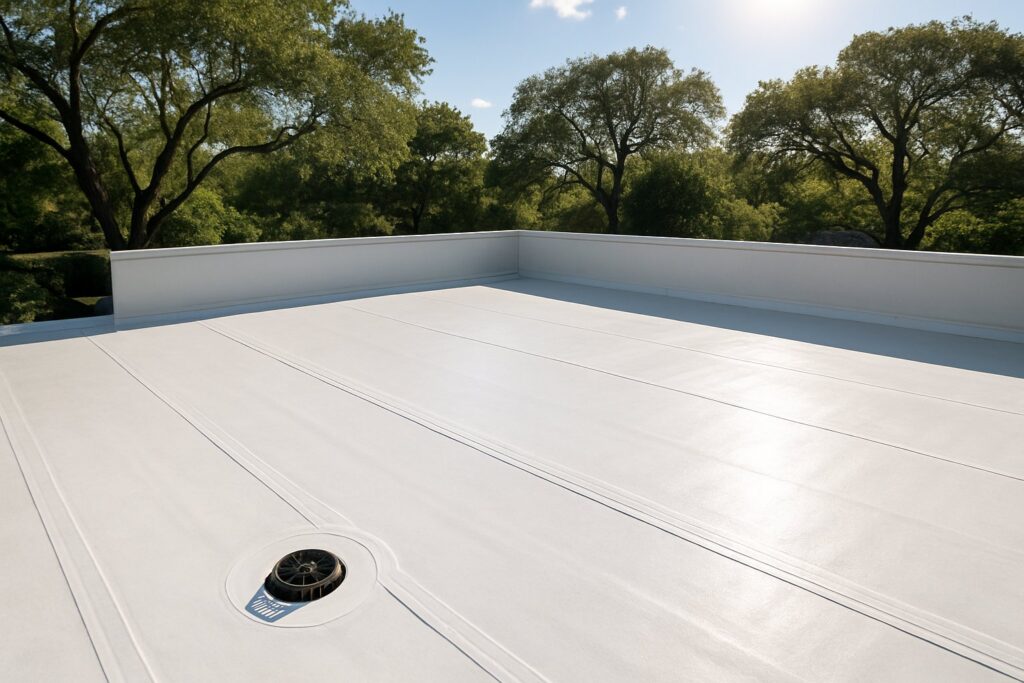
Instead, flat roofs use a continuous membrane. The surface is a single waterproof layer, either sheets heat-welded or adhered together at the seams, or layers built up in place. There are no shingles and no gaps by design, because the entire surface has to hold water rather than shed it quickly.
This changes what matters:
- Seams are everything. On a membrane roof, nearly every failure starts at a seam or a penetration.
- Drainage decides lifespan. Water that cannot leave will find a way in eventually.
- Penetrations are higher risk, since HVAC units, vents, and drains all sit in the middle of the waterproof surface rather than at its edges.
- Foot traffic matters, because equipment on the roof means people walking on the membrane.
Flat roofs are common on Austin commercial buildings, modern residential architecture, and additions such as porches and carports. See our flat roofing page for the systems we install.
What are the main flat roofing materials?
Three systems cover most flat roofs in this region, and they behave differently enough that the choice matters.
| System | How it is installed | Best suited to |
|---|---|---|
| TPO | Single-ply sheets, seams heat-welded | Commercial buildings, hot climates, reflective white surface |
| Modified bitumen | Rolled asphalt sheets, torch or adhesive applied | Smaller residential flat sections, porches, additions |
| EPDM | Single-ply rubber, seams adhered | Simple layouts, proven longevity, typically black |
TPO is the most common choice on newer commercial work in Austin, largely because the white surface reflects heat. In a climate with sustained temperatures above 100 degrees, that reflectivity has a real effect on cooling load. Its heat-welded seams are also genuinely strong, effectively fusing sheets into one surface.
Because TPO dominates local commercial roofing, hail damage to TPO is a distinct and expensive subject worth understanding on its own, covered in our guide to hail damage on a TPO roof.
Modified bitumen is essentially an evolved version of traditional built-up roofing, reinforced with polymers for flexibility. It handles foot traffic well and suits the smaller flat areas common on residential properties.
EPDM is a synthetic rubber membrane with a long track record. Its usual drawback in Texas is that standard EPDM is black, which absorbs heat rather than reflecting it.
Why is drainage the main issue on flat roofs?
Because on a low-slope roof, water that does not leave stays. Ponding water is the single most damaging condition a flat roof faces, and it causes most of the failures we are called to.
Ponding is generally defined as water remaining on the roof more than 48 hours after rain stops. What it does:
- Adds weight. Water is heavy, and standing water deflects the deck slightly, which deepens the depression and collects more water. The problem accelerates itself.
- Degrades the membrane. Prolonged saturation breaks down seams and adhesives faster than exposure to weather alone.
- Amplifies UV damage. The combination of standing water and intense sun is harder on a membrane than either individually.
- Grows vegetation and algae, which holds more moisture and can work into seams.
- Finds every weakness. A pinhole that would never leak on a sloped roof will leak steadily under standing water.
What causes it is usually one of four things: inadequate slope from the original build, drains or scuppers blocked with debris, a deck that has sagged over time, or insulation that has compressed unevenly.
The practical implication for owners is that flat roof maintenance is mostly drainage maintenance. Keeping drains and scuppers clear is not a minor housekeeping task, it is the main thing standing between a functioning roof and an expensive one. Our sudden heavy downpours in Central Texas make this worse, since a blocked drain that would cope with steady rain gets overwhelmed quickly.
How long does a flat roof last in Austin?
Lifespan varies widely by system and by installation quality, but the factors that decide it are consistent, and in this climate they are heat, UV, drainage, and hail.
What extends a flat roof’s life:
- Proper slope and working drainage, which is the single largest factor.
- Quality seam work. On TPO, properly heat-welded seams are enormously stronger than poorly welded ones, and this is where installation skill shows.
- Reflective surfaces, which reduce thermal cycling and lower heat load in Texas summers.
- Correct detailing at penetrations, since HVAC curbs, vents, and drains are where most leaks start.
- Regular inspection and maintenance, particularly clearing drains before storm season.
What shortens it: ponding water, foot traffic without walkway pads, poor seam work, neglected drains, and hail. Central Texas sits in an active hail corridor, and hail damage to membrane roofing is often invisible from ground level while still compromising the membrane.
The maintenance rhythm we recommend is an inspection twice a year plus after any significant storm, with drains cleared each time. That is more attention than a shingle roof needs, and it is the trade-off that comes with a low-slope system.
Commercial buildings have an additional consideration: rooftop equipment. Every HVAC unit is a penetration, a source of condensate, and a reason for technicians to walk on the membrane. Properly detailed curbs and walkway pads are worth specifying. Our commercial roofing page covers how we handle those.
Are flat roofs a good choice in Central Texas?
For the right building, yes. For the wrong one, they create ongoing cost. The honest answer depends on what the roof is for.
Flat roofing makes sense when:
- The building is commercial, where the large usable footprint and equipment mounting are worth more than the maintenance overhead.
- The architecture calls for it, as with modern residential designs where a pitched roof would break the look.
- You want reflective surface area, since a white TPO roof reduces cooling load meaningfully in this climate.
- The area is small, such as a porch, carport, or addition, where a pitched roof would be awkward to tie in.
Pitched roofing is usually better when:
- The building is a conventional home and appearance is not driving the decision
- You want the lowest maintenance commitment
- Heavy rain events are a concern, since pitched roofs shed water far faster
- You want the widest choice of materials and contractors
The comparison is set out in detail in our guide to flat roof versus pitched roof, which sets out where each system fits.
Driftwood Builders Roofing is a family-owned company headquartered in Manchaca, serving Austin and the Hill Country since 2005, with 97 years of combined construction experience across the leadership team. Estimates are free and detailed with no deposit required. Call our Austin roofing company team at (512) 894-0129 or request a free estimate.
Related Videos
What Is Rolled Roofing? | Best Roofing Solution for Low-Slope Roofs
Frequently Asked Questions
Are flat roofs actually flat?
No. Building codes require a minimum slope, typically around a quarter inch of fall per foot, so water drains toward outlets rather than sitting. What people call a flat roof is more accurately low-slope. Because water moves slowly on that shallow pitch, these roofs use a continuous waterproof membrane rather than overlapping shingles.
What are the main flat roofing materials?
Three cover most flat roofs here. TPO is a single-ply membrane with heat-welded seams and a reflective white surface, common on Austin commercial buildings. Modified bitumen is a rolled asphalt sheet that handles foot traffic well and suits smaller residential flat areas. EPDM is a long-established rubber membrane, though standard EPDM is black and absorbs heat.
What is ponding water and why does it matter?
Ponding is water remaining on the roof more than 48 hours after rain stops, and it is the most damaging condition a flat roof faces. It adds weight that deflects the deck and deepens the depression, degrades seams and adhesives, amplifies UV damage, grows vegetation, and finds pinholes that would never leak on a sloped roof.
How often should a flat roof be inspected?
Twice a year plus after any significant storm, with drains and scuppers cleared each time. That is more attention than a shingle roof needs and it is the trade-off of a low-slope system. Clearing drains before storm season matters particularly in Central Texas, where sudden heavy downpours overwhelm partially blocked drains quickly.
Is a flat roof a good idea for a house in Austin?
It depends on the building. Flat roofing suits commercial properties, modern architecture where a pitched roof would break the design, and small areas like porches, carports, and additions. For a conventional home where appearance is not driving the decision, a pitched roof usually offers lower maintenance and faster water shedding in heavy rain.

Author: Driftwood Builders Roofing
Driftwood Builders Roofing is a family-owned residential roofing company headquartered in Manchaca, Texas, serving Austin and the surrounding Hill Country since 2005. The company has delivered 3,700 full roof replacements and 783 repairs across 3,559 different customers over 20 years in business, with 97 years of combined construction experience across the leadership team and 74 years specifically inside Driftwood Builders. The company holds the highest contractor certifications offered by the major shingle manufacturers, including GAF Master Elite Contractor (the top 3% of GAF contractors nationally), GAF Certified Green Roofer, Owens Corning certified, TAMKO Pro Certified Contractor, and a Berridge Roof Installation Seminar Certificate for standing-seam metal roofs. Driftwood is an NRCA member, holds an Angie's List Super Service Award, is BBB Accredited, and is a GuildQuality member for verified customer satisfaction data. James Hardie certification covers the siding side of the business. Services include residential roof replacement, leak and storm-damage repair, tile roof repair, metal roofing, TPO commercial roofing, roof inspections, hail and storm damage inspections with insurance claim assistance, gutter work, and James Hardie siding. The customer-protection policy is straightforward: Only Pay Upon Completion. The company serves 22 cities across the Hill Country and Greater Austin and holds a 5-star rating across Google, GuildQuality, Angi, Nextdoor, Facebook, Thumbtack, and Yelp.
