Hail Damage to TPO Roofing: How to Spot It and What Insurance Covers
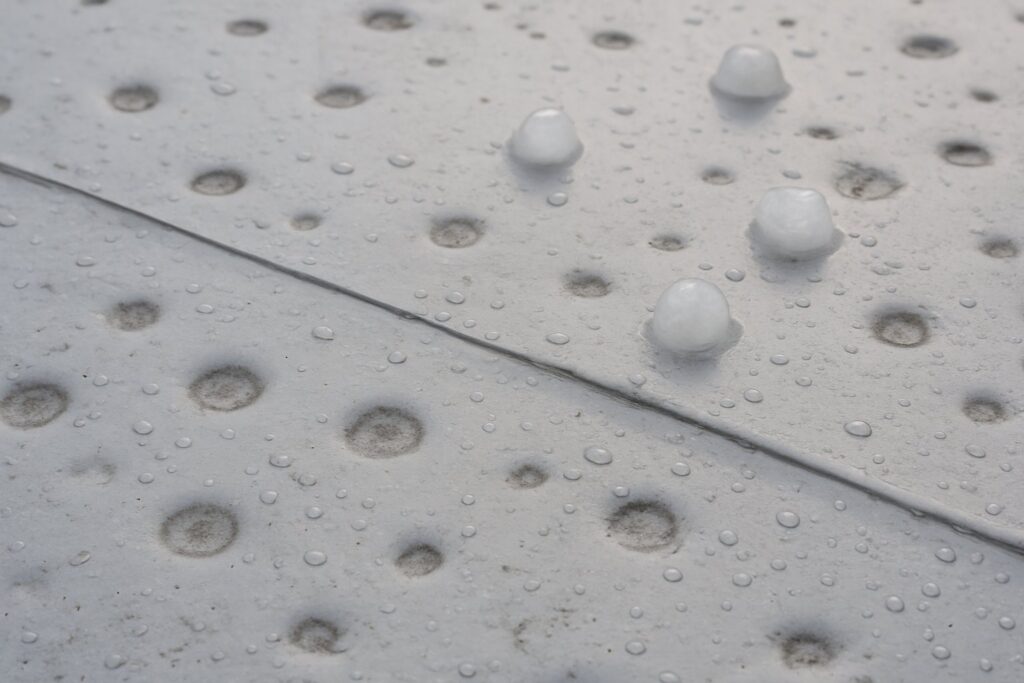
Hail damage on a TPO roof is usually invisible from the ground. Look for circular bruises or dimples in the membrane, fractures that appear only when you flex the surface by hand, spots that feel soft underfoot where the insulation is crushed, split seams near impacts, and dented vent caps and HVAC fins.
Watch the Video
How does hail damage a TPO roof?
TPO is a single-ply membrane, typically 45 to 80 mils thick, laid over insulation boards and a deck. When hail strikes it, the damage happens differently from a shingle or metal roof, and that difference is why it gets missed.
The impact compresses the membrane against the insulation underneath. That compression can fracture the membrane’s reinforcing scrim, crush the insulation board below, or both, while the top surface still looks largely intact. The result is a weakened spot rather than a hole.
What that means practically:
- Damage is frequently invisible from the ground, and often hard to see even standing on the roof unless you know what to look for.
- The roof may not leak for months. A fractured membrane still keeps water out until UV exposure and thermal cycling open the fracture properly.
- Crushed insulation matters even where the membrane held. Compressed board loses R-value and creates a depression that collects water, which then attacks the weakened area.
- Seams are especially vulnerable. An impact near a heat-welded seam can compromise the weld without visibly separating it.
This delayed-failure pattern is the central problem. Most Texas commercial policies limit how long you have to report storm damage, so a roof damaged in a spring hailstorm can begin leaking well after the claim window has closed, leaving the owner paying for a replacement that insurance would have covered.
What does TPO hail damage look like?
Trained inspectors look for a specific set of signs, and several require close examination rather than a walk-around.
- Circular bruises or dimples, often visible as slightly discolored round marks where the membrane was compressed. Chalk or a light dusting can make them show more clearly.
- Fractures in the membrane, sometimes only apparent when the surface is flexed by hand at the impact point.
- A soft or spongy feel underfoot where insulation beneath has been crushed.
- Damaged or lifted seams, particularly where an impact landed close to a weld line.
- Spatter marks, which are clean spots where hail struck accumulated dirt and oxidation. These do not damage the roof but they are strong evidence a hail event occurred and dating evidence for a claim.
- Damage to soft metal accessories, including vents, caps, gutters, and HVAC condenser fins. These dent readily and are often the clearest proof of hail size and direction.
- Collateral damage to skylights, curbs, and rooftop equipment.
That last group matters more than owners expect. Dented HVAC fins and vent caps are frequently the evidence that establishes a hail event happened, even when the membrane damage itself is subtle and contested.
Because much of this requires being on the roof and handling the membrane, a ground-level check is not a substitute. If your building took hail, get it looked at properly rather than concluding it was fine because nothing is leaking.
Does insurance cover hail damage to a TPO roof?
Generally yes for sudden hail damage, though commercial policies vary considerably more than residential ones and the details matter a great deal on a roof this expensive.
What affects the outcome:
- Reporting deadlines. Most policies limit how long after the event you may file. This is the most common reason valid claims fail, given TPO’s delayed-failure pattern.
- Cosmetic damage exclusions. Increasingly common, and they matter here because insurers may argue that a bruised but unbreached membrane is cosmetic. Documentation showing fractured scrim or crushed insulation is what counters that.
- Actual cash value versus replacement cost. ACV policies depreciate the roof by age, which on a commercial membrane can be a large reduction. Check which you hold before you need it.
- Deductible structure. Many Texas commercial policies use a percentage-of-value wind and hail deductible rather than a flat figure, which on a large building can be substantial.
- Roof age and prior condition, which insurers will examine closely.
Documentation is where these claims are won or lost. Adjusters work through many properties quickly after a regional storm, and initial estimates frequently miss crushed insulation, damaged seams, and rooftop accessory damage. Those omissions are correctable, but only if someone identifies and evidences them.
Driftwood Builders Roofing documents every affected area photographically and can share that documentation with you and your insurer. See our storm damage and insurance claim assistance page.
Can hail damaged TPO be repaired?
Often yes, and that is worth knowing because replacement on a commercial building is a major expense.
Repair is usually viable when:
- Damage is confined to a limited number of impact points
- The insulation underneath is largely intact
- Seams are sound away from the damaged areas
- The membrane still has meaningful service life
TPO repairs use heat-welded patches of matching membrane over the affected area, which is genuinely effective because the weld fuses patch to roof rather than adhering it. Where insulation has been crushed, that section is cut out and replaced before the patch goes on, since patching over compressed board leaves a depression that will pond water.
Replacement becomes the answer when:
- Impact damage is widespread across the roof area
- Insulation is crushed across large sections
- Multiple seams are compromised
- The membrane was already near the end of its life
- Water has been entering long enough to saturate insulation broadly
Saturated insulation is the factor that most often forces full replacement. Once water is inside the assembly it spreads laterally between the membrane and deck, and wet insulation neither insulates nor supports the membrane properly. Infrared scanning can map how far moisture has traveled, which is useful both for scoping the work and for supporting a claim.
The broader context on these systems is in our flat roofing guide, and our commercial roofing page covers how we handle these projects.
What should I do after a hailstorm hits my commercial roof?
Act while the damage is clearly attributable to the storm. That is the whole game with TPO, because the delay between damage and leak is what causes owners to lose otherwise valid claims.
A sensible sequence:
- Note the date of the storm and keep any local weather reporting confirming hail in your area. Dating the event matters.
- Do a ground-level check of gutters, downspouts, vents, and any visible rooftop equipment for denting.
- Check inside for new stains, damp ceiling tiles, or moisture around rooftop unit penetrations.
- Get a professional roof inspection promptly, even if nothing is leaking. This is the step most owners skip and most regret.
- Ensure every affected area is photographed, including membrane impacts, seams, insulation, and accessory damage.
- File within your policy window rather than waiting to see whether problems develop.
- Keep drains clear, since damaged areas are far more vulnerable under ponding water.
What not to do: conclude the roof is fine because it is not leaking, attempt patching with sealant or tape rather than a proper heat-welded repair, or wait for a leak before involving your insurer.
Driftwood Builders Roofing is a family-owned company headquartered in Manchaca, serving Austin and the Hill Country since 2005 with 97 years of combined construction experience across the leadership team. Our inspections and detailed estimates are free with no deposit required, and we can meet your adjuster on site to explain what we found. Call our Austin roofing company team at (512) 894-0129 or request a free estimate.
Related Videos
What Is Rolled Roofing? | Best Roofing Solution for Low-Slope Roofs
Frequently Asked Questions
How does hail damage a TPO roof?
Impact compresses the single-ply membrane against the insulation beneath it, which can fracture the membrane’s reinforcing scrim, crush the insulation board, or both, while the top surface still looks largely intact. The result is a weakened spot rather than a hole, so the roof may not leak for months even though it has been compromised.
What does hail damage look like on TPO roofing?
Circular bruises or dimples where the membrane was compressed, fractures sometimes visible only when the surface is flexed by hand, a soft or spongy feel underfoot where insulation is crushed, damaged seams near impacts, and spatter marks where hail cleaned accumulated dirt. Dented vents, caps, and HVAC condenser fins are often the clearest evidence.
Does insurance cover hail damage to a commercial TPO roof?
Generally yes for sudden hail damage, but commercial policies vary. Watch for reporting deadlines, cosmetic damage exclusions, actual cash value versus replacement cost coverage, and percentage-based wind and hail deductibles common in Texas. Documentation showing fractured scrim or crushed insulation is what counters a cosmetic-damage argument.
Can a hail damaged TPO roof be repaired?
Often yes. TPO repairs use heat-welded patches of matching membrane, which fuse to the roof rather than merely adhering. Where insulation is crushed, that section is cut out and replaced first, since patching over compressed board leaves a depression that ponds water. Replacement is needed when damage or saturated insulation is widespread.
My TPO roof took hail but is not leaking. Do I still need it inspected?
Yes, and this is the single most important point. TPO damage frequently causes no immediate leak because a fractured membrane still holds water out until UV and thermal cycling open it. Most Texas policies limit how long you have to report damage, so waiting for a leak often means the claim window has already closed.

Author: Driftwood Builders Roofing
Driftwood Builders Roofing is a family-owned residential roofing company headquartered in Manchaca, Texas, serving Austin and the surrounding Hill Country since 2005. The company has delivered 3,700 full roof replacements and 783 repairs across 3,559 different customers over 20 years in business, with 97 years of combined construction experience across the leadership team and 74 years specifically inside Driftwood Builders. The company holds the highest contractor certifications offered by the major shingle manufacturers, including GAF Master Elite Contractor (the top 3% of GAF contractors nationally), GAF Certified Green Roofer, Owens Corning certified, TAMKO Pro Certified Contractor, and a Berridge Roof Installation Seminar Certificate for standing-seam metal roofs. Driftwood is an NRCA member, holds an Angie's List Super Service Award, is BBB Accredited, and is a GuildQuality member for verified customer satisfaction data. James Hardie certification covers the siding side of the business. Services include residential roof replacement, leak and storm-damage repair, tile roof repair, metal roofing, TPO commercial roofing, roof inspections, hail and storm damage inspections with insurance claim assistance, gutter work, and James Hardie siding. The customer-protection policy is straightforward: Only Pay Upon Completion. The company serves 22 cities across the Hill Country and Greater Austin and holds a 5-star rating across Google, GuildQuality, Angi, Nextdoor, Facebook, Thumbtack, and Yelp.
