Steel Roof Panels Explained: Types, Gauges, and Coatings
Watch the Video
What types of steel roof panels are available?
Almost every residential steel roof falls into one of two families, and the difference between them affects price, lifespan, and how the roof behaves in Texas heat.
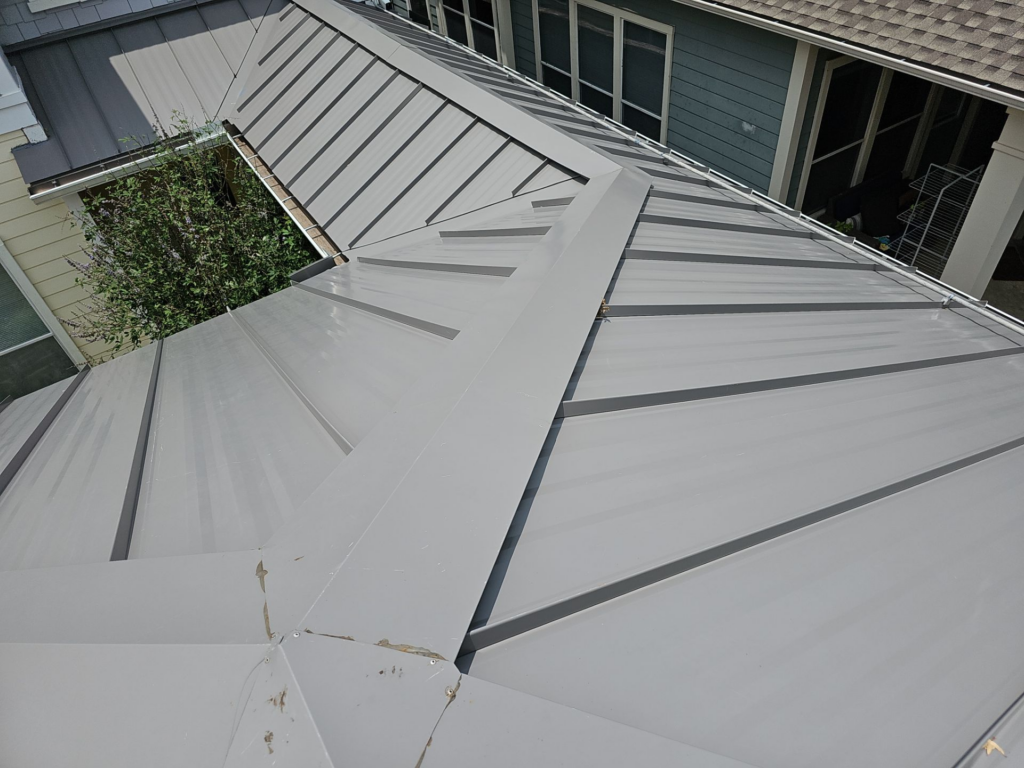
Standing seam panels run vertically from ridge to eave and lock together at raised seams, with clips hidden underneath. No fastener passes through the water-shedding surface. This is the premium residential system.
Exposed fastener panels, often called R-panel, U-panel, or corrugated depending on the profile, are screwed straight through the face of the panel. A rubber washer under each screw head does the sealing. These cost less and install faster.
The trade-off is straightforward:
- Exposed fastener panels cost less up front but carry hundreds of penetrations through the roof surface. Those rubber washers degrade under UV, and the screws typically need checking and re-tightening periodically. Because the panels are screwed down tight, thermal movement also works against the fasteners over time.
- Standing seam panels cost more but remove the penetrations from the panel field and let the metal expand and contract on concealed clips.
For homes in the Austin area we generally recommend standing seam, because our temperature swings are severe enough that thermal movement becomes a real factor. Exposed fastener panels remain a sound, sensible choice for barns, workshops, and outbuildings where the lower cost matters more than the maintenance profile. The full picture on the premium system is in our standing seam metal roofing guide.
What does gauge mean on steel roof panels?
Gauge is the thickness of the steel, and the numbering runs backwards from what most people expect. A lower gauge number means thicker metal. So 24 gauge steel is meaningfully thicker and stronger than 26 gauge, which in turn is thicker than 29.
The common residential range:
- 29 gauge. The thinnest commonly sold. Cheapest, and most prone to denting and oil canning. Typically found on budget agricultural panels.
- 26 gauge. A common residential standard. Reasonable balance of cost and durability for many homes.
- 24 gauge. The step up most often recommended for standing seam residential roofs, and noticeably more resistant to hail denting.
- 22 gauge. Heavier still, used where maximum durability is wanted.
In a hail region like Central Texas, gauge is one of the more consequential decisions you will make. A hailstone that dimples 29 gauge may leave 24 gauge visibly unmarked. Since hail dents on metal are usually cosmetic but permanent, and since insurance policies increasingly exclude cosmetic damage on metal roofs, paying for heavier gauge up front is often the cheaper path over the life of the roof.
Gauge also affects oil canning, the visible waviness that can appear in flat areas of metal panels. Thinner steel shows it more readily. That is a distinct issue worth understanding in its own right, covered in our guide to metal roof oil canning.
When comparing quotes, ask what gauge is specified. Two metal roof bids can differ substantially in price simply because one is 26 gauge and the other 24, and that will not be obvious from the totals.
Why do steel roof panels need coatings?
Bare steel rusts. Everything that determines whether a steel roof lasts decades or streaks with corrosion comes down to what is applied over the steel, which is why the coating deserves as much attention as the panel itself.
There are two layers to understand.
The metallic coating sits directly on the steel and does the corrosion protection:
- Galvalume, an aluminum and zinc alloy coating, is the common standard for roofing and offers strong corrosion resistance.
- Galvanized, a zinc coating, is the older approach and generally less durable in roofing applications than Galvalume.
The paint finish goes over that and handles color, fade resistance, and UV:
- PVDF finishes, often sold under names like Kynar, hold color and gloss well and are the premium option for a hot, high-UV climate.
- SMP finishes cost less and perform acceptably, but tend to fade and chalk sooner under sustained sun.
In Austin, UV exposure is the dominant factor. A roof that fades unevenly within several years is a real outcome with cheaper finishes, and it is not something you can fix without recoating or replacing. Ask specifically which metallic coating and which paint system a quote includes, and what the finish warranty covers, since fade and chalk warranties are usually separate from the substrate warranty.
One more practical point: lighter colors reflect more heat. In this climate that has a genuine effect on attic temperatures and cooling load, so color is not purely an aesthetic decision.
Are steel roof panels good for Austin homes?
For many homes here, yes, provided the specification is right. The three local forces that punish roofs are heat, UV, and hail, and steel handles all three differently from asphalt shingle.
Where steel performs well:
- It does not degrade the way asphalt does. There are no granules to lose and no asphalt to dry out and crack, which is the normal failure path for shingles in Texas heat.
- It sheds water and debris efficiently, which matters during our sudden heavy downpours.
- It reflects heat, particularly in lighter colors with quality finishes, reducing attic heat load.
- It stays watertight through hail that would meaningfully shorten the life of a shingle roof.
Where it is less suited:
- Complex roof geometry. Many valleys, hips, dormers, and penetrations drive metal labor costs up sharply, more so than with shingle.
- Short ownership horizons. If you are selling within a few years, you may not recover the premium.
- Cosmetic sensitivity to hail, combined with the cosmetic exclusions now common in metal roof insurance coverage.
One thing steel does not change is the need for correct attic ventilation. Trapped heat and moisture shorten the life of every roof system and can void manufacturer warranties, and it is among the most common underlying problems we find on roofs that failed early.
Whichever material you choose, the roof underneath still has to be sound. See our metal roofing page for how we approach these installations.
How do I compare steel roof panel quotes?
Metal roofing quotes are harder to compare than shingle quotes, because two bids can describe genuinely different products while looking similar on paper. Comparing the totals alone is how homeowners end up disappointed.
Ask every bidder for these specifics:
- Panel type. Standing seam or exposed fastener. This is the single largest difference and it should be stated plainly.
- Gauge. 24 or 26 changes both price and hail performance.
- Metallic coating and paint finish, plus what the finish warranty covers for fade and chalk.
- Clip and fastening system, and specifically whether it permits thermal movement.
- Flashing details at every penetration, since this is where metal roofs fail if they fail at all.
- Underlayment specified, and confirmation of a full tear-off rather than installing over the existing roof.
- Decking price per sheet, agreed in advance. We charge 50 to 100 dollars per sheet and photograph each one.
- Ventilation work included.
- Both workmanship and manufacturer warranties, in writing.
Get three quotes and compare that list rather than the bottom line. A cheaper metal roof is usually thinner steel, a lesser finish, or an exposed fastener system quoted against standing seam.
Driftwood Builders Roofing is family-owned, headquartered in Manchaca, and has served Austin and the Hill Country since 2005, with 97 years of combined construction experience across the leadership team. Our estimates are free and detailed with no deposit required. Call our Austin roofing company team at (512) 894-0129 or request a free estimate.
Related Videos
Can Solar Panels Be Installed on a Metal Roof? | Standing Seam Metal Roofing | Austin, TX
Frequently Asked Questions
What are the main types of steel roof panels?
Two families. Standing seam panels run vertically and lock at raised seams with clips hidden underneath, so no fastener penetrates the water-shedding surface. Exposed fastener panels, such as R-panel or corrugated, are screwed through the face with rubber washers sealing each screw. Standing seam costs more but removes leak points and allows thermal movement.
What gauge steel roof panel is best?
Lower gauge numbers mean thicker steel, so 24 gauge is heavier than 26, which is heavier than 29. For residential roofs in a hail region like Central Texas, 24 gauge is the step up most often recommended, since it resists hail denting and oil canning better than thinner panels. Always confirm gauge when comparing quotes.
What is Galvalume and why does it matter?
Galvalume is an aluminum and zinc alloy coating applied directly to the steel to prevent corrosion, and it is the common standard for roofing. Bare steel rusts, so the coating determines whether a panel lasts decades. Over the metallic coating sits a paint finish, where PVDF systems hold color and resist fade better than cheaper SMP finishes.
Do steel roof panels get too hot in Texas?
Steel actually reflects heat rather than absorbing it the way asphalt shingle does, particularly in lighter colors with quality reflective finishes, which reduces attic heat load. Color choice has a genuine effect on cooling in this climate. Correct attic ventilation still matters, since trapped heat shortens the life of every roof system.
Why are two metal roof quotes so different in price?
Usually because they describe different products. The common differences are standing seam versus exposed fastener, 24 versus 26 gauge, and a PVDF versus SMP paint finish. Ask each bidder to state panel type, gauge, coating and finish, clip system, flashing details, underlayment, decking price per sheet, and both warranties.

Author: Driftwood Builders Roofing
Driftwood Builders Roofing is a family-owned residential roofing company headquartered in Manchaca, Texas, serving Austin and the surrounding Hill Country since 2005. The company has delivered 3,700 full roof replacements and 783 repairs across 3,559 different customers over 20 years in business, with 97 years of combined construction experience across the leadership team and 74 years specifically inside Driftwood Builders. The company holds the highest contractor certifications offered by the major shingle manufacturers, including GAF Master Elite Contractor (the top 3% of GAF contractors nationally), GAF Certified Green Roofer, Owens Corning certified, TAMKO Pro Certified Contractor, and a Berridge Roof Installation Seminar Certificate for standing-seam metal roofs. Driftwood is an NRCA member, holds an Angie's List Super Service Award, is BBB Accredited, and is a GuildQuality member for verified customer satisfaction data. James Hardie certification covers the siding side of the business. Services include residential roof replacement, leak and storm-damage repair, tile roof repair, metal roofing, TPO commercial roofing, roof inspections, hail and storm damage inspections with insurance claim assistance, gutter work, and James Hardie siding. The customer-protection policy is straightforward: Only Pay Upon Completion. The company serves 22 cities across the Hill Country and Greater Austin and holds a 5-star rating across Google, GuildQuality, Angi, Nextdoor, Facebook, Thumbtack, and Yelp.
