Metal Roof Oil Canning: What Causes It and Can It Be Fixed?
Watch the Video
What is oil canning on a metal roof?
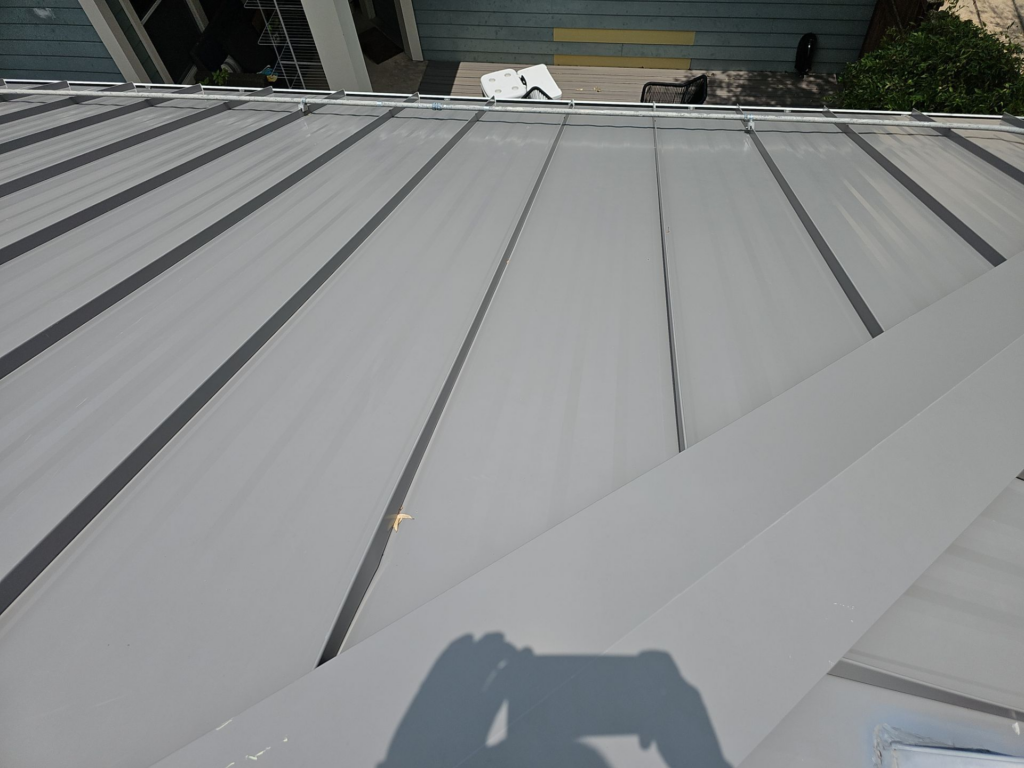
Oil canning is the term for the gentle waviness, rippling, or distortion visible in the broad flat areas of metal roof panels. It shows up as a series of soft undulations running along a panel, most noticeable when light rakes across the roof at a low angle.
The name comes from old oil cans, whose flat metal bases popped in and out when pressed. The same principle applies: a wide flat sheet of thin metal will never be perfectly rigid, and it relieves internal stress by deflecting slightly.
The most important thing to understand is what oil canning is not. It is not a structural defect. It is not a sign the roof was installed incorrectly, at least not necessarily. It does not affect the roof’s ability to shed water, and it does not shorten the roof’s life. Panels exhibiting oil canning remain fully watertight and perform exactly as intended.
It is, however, permanent and visible, which is why it causes so much frustration. Homeowners who have paid a premium for a metal roof reasonably expect flat panels, and the industry has historically been poor at setting expectations before installation.
Industry bodies generally classify oil canning as an aesthetic condition inherent to formed metal panels rather than a defect, which means most manufacturer warranties explicitly exclude it. That is a significant point to know before you buy, not after.
What causes oil canning?
Oil canning comes from stresses in the metal, and those stresses can be introduced at several stages long before the panel reaches your roof.
In the steel itself:
- Uneven internal stress from the original manufacturing, including full center or wavy edge conditions in the coil.
- Variations in thickness across the coil.
In the panel design:
- Panel width. Wider flat areas oil can more readily. A 16 inch panel will typically show less than a 20 inch panel of the same steel.
- Gauge. Thinner steel deflects more easily, so 26 gauge shows oil canning more than 24 gauge.
- Absence of stiffening. Flat panels with no striations or ribs in the pan have nothing to resist deflection.
In handling and installation:
- Rough handling during transport or forming.
- Over-tightened or misaligned fasteners, which pull the panel and induce stress.
- An uneven substrate. Decking that is not flat telegraphs directly through the panel.
- No allowance for thermal movement, which is a significant factor in Central Texas. Metal expands and contracts considerably across our temperature range, and a panel that cannot move will buckle instead.
That last cause is the one that overlaps with genuine installation quality. Oil canning by itself is not evidence of poor work, but oil canning combined with fasteners that have backed out or seams under visible strain often is. The connection between panel gauge and this issue is covered further in our guide to steel roof panels.
Can oil canning be fixed?
Honestly, no. Once a panel is oil canning, that panel will continue to oil can. There is no treatment, adjustment, or process that flattens it out.
Anyone who tells you otherwise is either misinformed or selling something. The distortion is a result of stress distribution within the steel and the geometry of the panel, and neither can be altered after forming.
What can sometimes be done:
- Correct an underlying installation problem. If the cause is over-tightened fasteners or panels pinned so they cannot move thermally, relieving that can reduce, though rarely eliminate, the effect.
- Replace individual panels. Possible, but replacement panels may oil can as well if the cause is panel width or gauge rather than a one-off handling issue. Color matching on a weathered roof is also imperfect.
- Accept it. In most cases this is the right answer, and it is worth knowing that oil canning is often far less noticeable at certain times of day and from most viewing angles.
Because warranties generally exclude it, replacement at the manufacturer’s expense is usually not available. This is precisely why the decisions made before installation matter so much more than anything available afterwards.
If your metal roof has a problem beyond appearance, that is a separate question with better answers. Most functional metal roof issues are genuinely repairable, and our guide covers when a metal roof can be repaired.
How do you minimize oil canning before installation?
This is where the real leverage is. You cannot fix oil canning afterwards, but you can substantially reduce the likelihood of it before a single panel goes up.
Specify these:
- Heavier gauge. 24 gauge rather than 26 resists deflection better and, as a bonus in Central Texas, dents less in hail.
- Narrower panels. A 16 inch panel oil cans noticeably less than a 20 inch panel in the same steel. This is one of the most effective single choices available.
- Striations or a pencil rib in the pan. Small longitudinal ridges formed into the flat area break up the surface and resist deflection. Some people prefer the look, some do not, but they work.
- Tension-leveled steel, which has had internal stresses relieved during manufacturing.
- A matte or low-gloss finish. This does not reduce oil canning at all, but it substantially reduces how visible it is, because gloss finishes reflect light in a way that emphasises every undulation.
- A flat substrate. Insist on a full tear-off and inspection of the decking, replacing anything uneven or damaged. Decking irregularities telegraph straight through.
- Correct clip systems that genuinely allow thermal movement, which matters a great deal in our climate.
Darker colors also tend to show oil canning more than lighter ones, and lighter colors reflect more heat, which is a genuine benefit in Austin summers.
Have the conversation before you sign. A contractor who raises oil canning proactively and explains these choices is telling you they have installed enough metal to know where the complaints come from.
Should oil canning stop me choosing a metal roof?
For most homeowners, no. It is worth weighing honestly rather than dismissing, but it rarely outweighs the reasons to choose metal in this climate.
In mild aesthetic conditions, a metal roof lasts roughly twice as long as an asphalt shingle, whether that is the air or the panel surface. On a metal roof in an Austin summer, the panel surface runs far hotter than the air and stays watertight through hail that would meaningfully shorten a shingle roof’s life.
Oil canning matters more if you are particularly sensitive to appearance, if the roof is highly visible from the street or from living areas, if you want large flat panels in a glossy dark color, which is the combination most likely to show it, or if you are not prepared to pay for heavier gauge and narrower panels.
It matters less on a roof that is not prominently visible, on complex roofs where panel runs are shorter, with lighter colors and matte finishes, and when the panels are striated.
The practical recommendation: specify 24 gauge, narrower panels, a matte finish, and striations if the look suits you, then accept that some degree of oil canning is normal in formed metal and is not a fault. Set that expectation with yourself before the roof goes on and it is very unlikely to trouble you afterwards.
Driftwood Builders Roofing has served Austin and the Hill Country from Manchaca since 2005. We will talk through panel width, gauge, and finish before quoting rather than after. See our standing seam metal roofing guide, call our Austin roofing company team at (512) 894-0129, or request a free estimate.
Related Videos
Metal Roof Replacement Cost vs. Shingles: Is Metal Worth the Extra Cost? | Complete Cost Comparison
Frequently Asked Questions
What is oil canning on a metal roof?
It is the visible waviness or rippling that appears in the broad flat areas of metal roof panels, most noticeable when light hits the roof at a low angle. It is an aesthetic condition inherent to formed metal panels, not a structural defect. The roof remains fully watertight and its lifespan is unaffected.
What causes oil canning?
Stresses in the steel combined with panel geometry. Contributing factors include uneven internal stress in the original coil, wider panels, thinner gauge, flat pans with no striations, rough handling, over-tightened fasteners, an uneven decking substrate, and panels installed without allowance for thermal movement, which matters a great deal in Central Texas temperature swings.
Can oil canning be fixed after installation?
No. Once a panel is oil canning it will continue to, and no treatment flattens it out. If the cause was an installation problem such as over-tightened fasteners, relieving that can reduce it. Individual panels can be replaced, though replacements may oil can too if the cause is panel width or gauge, and color matching on a weathered roof is imperfect.
Does warranty cover oil canning?
Usually not. Industry bodies generally classify oil canning as an aesthetic condition inherent to formed metal panels rather than a defect, and most manufacturer warranties explicitly exclude it. That makes it important to understand before you buy, since the decisions that reduce it are all made before installation.
How do I reduce oil canning on a new metal roof?
Specify heavier gauge such as 24 rather than 26, narrower panels, striations or a pencil rib in the pan, and tension-leveled steel. Choose a matte or low-gloss finish, which does not reduce oil canning but substantially reduces how visible it is. Insist on a full tear-off so the decking underneath is flat, since irregularities telegraph through.
Oil canning is cosmetic; denting after hail is the question that actually costs money, because it depends on whether your policy carries a cosmetic damage exclusion. See metal roofing in Converse, TX.
Author: Driftwood Builders Roofing
Driftwood Builders Roofing is a family-owned residential roofing company headquartered in Manchaca, Texas, serving Austin and the surrounding Hill Country since 2005. The company has delivered 3,700 full roof replacements and 783 repairs across 3,559 different customers over 20 years in business, with 97 years of combined construction experience across the leadership team and 74 years specifically inside Driftwood Builders. The company holds the highest contractor certifications offered by the major shingle manufacturers, including GAF Master Elite Contractor (the top 3% of GAF contractors nationally), GAF Certified Green Roofer, Owens Corning certified, TAMKO Pro Certified Contractor, and a Berridge Roof Installation Seminar Certificate for standing-seam metal roofs. Driftwood is an NRCA member, holds an Angie's List Super Service Award, is BBB Accredited, and is a GuildQuality member for verified customer satisfaction data. James Hardie certification covers the siding side of the business. Services include residential roof replacement, leak and storm-damage repair, tile roof repair, metal roofing, TPO commercial roofing, roof inspections, hail and storm damage inspections with insurance claim assistance, gutter work, and James Hardie siding. The customer-protection policy is straightforward: Only Pay Upon Completion. The company serves 22 cities across the Hill Country and Greater Austin and holds a 5-star rating across Google, GuildQuality, Angi, Nextdoor, Facebook, Thumbtack, and Yelp.
