Can a Metal Roof Be Repaired, or Does It Need Replacing?
Watch the Video
What are the most common metal roof problems?
Metal roofs rarely fail in the middle of a panel. They fail at the details, which is good news, because details are repairable.
In roughly the order we encounter them:
- Failed sealant. Sealant at seams, flashing, and penetrations has a much shorter life than the metal it protects. Under Texas UV it hardens, shrinks, and cracks. This is the single most common metal roof issue and among the easiest to fix.
- Loose or backed-out fasteners. On exposed fastener systems, thermal movement gradually works screws loose. The rubber washers also dry out and split, leaving hundreds of small openings.
- Cracked pipe boots. The rubber collars around plumbing vents degrade in sun well before the roof does, on metal and shingle alike.
- Damaged or separated flashing, particularly at chimneys, walls, and valleys where two planes meet.
- Seam separation on standing seam systems, usually where a seam was not fully engaged during installation.
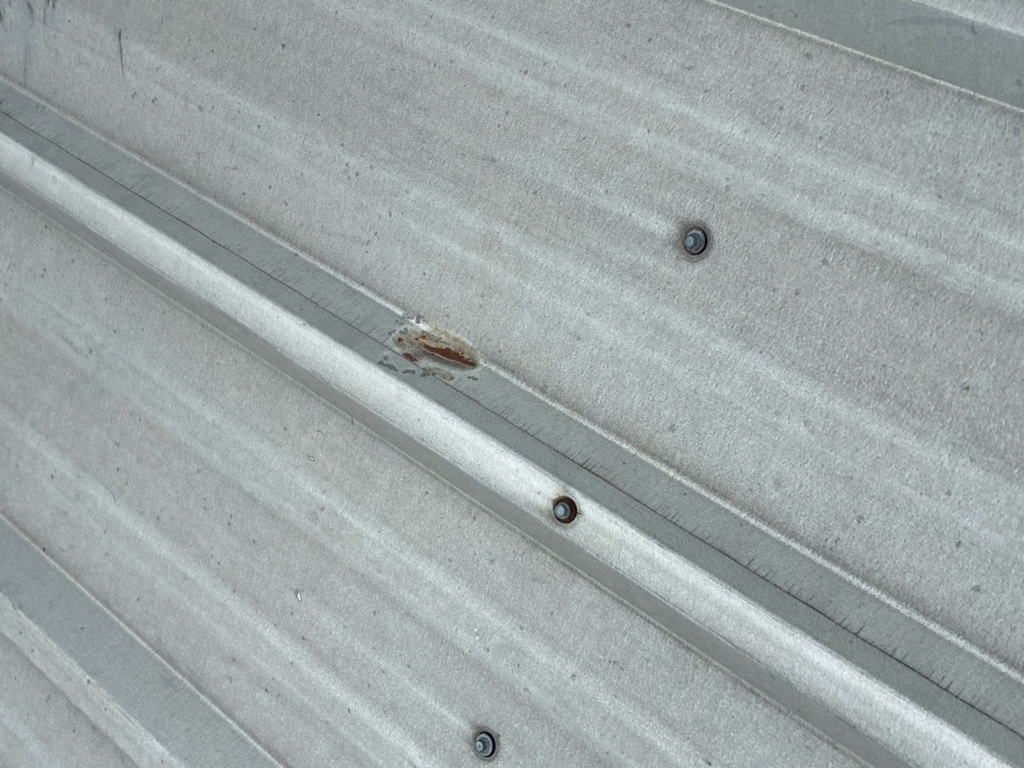
- Scratched or chipped coating, which exposes bare steel and starts localised rust.
- Hail denting, which is typically cosmetic rather than a functional failure.
Notice how many of these trace back to installation quality rather than the material. A metal roof installed without allowance for thermal movement, or with seams not properly locked, will develop problems that a correctly installed roof of the same material never will. That is why we ask about installation history before quoting a repair.
When can a metal roof be repaired?
Repair is usually the right answer, and considerably more often than with an aged asphalt roof. The reason is that metal panels themselves have a long service life, so a localised problem sits on top of a roof that still has decades left.
Repair generally makes sense when:
- The problem is at a penetration or detail rather than in the panel field. Flashing, pipe boots, and sealant are all replaceable in place.
- Fasteners are loose but the holes are still sound. Screws can be replaced, often stepping up to a slightly larger diameter to bite fresh metal.
- Damage is confined to one area or one slope, such as a limb strike or a section of separated seam.
- Coating damage is localised, where cleaning and touch-up prevents rust taking hold.
- The panels are structurally sound with no corrosion through the metal.
Individual panels can also be replaced on many systems, though this is more involved with standing seam than with exposed fastener panels, because seams interlock and neighboring panels may need releasing. Color matching is the practical limitation. A replacement panel on a roof that has weathered for fifteen years will not match exactly, so on a visible slope this becomes an aesthetic decision as much as a technical one.
If the underlying issue is a leak rather than visible damage, tracing it properly matters, because water on a metal roof can travel a long way along a seam before it drops. Our guidance on roof repair and leak repair covers how we approach that.
When does a metal roof need replacing?
Replacement becomes the honest recommendation when the problem is the panels themselves rather than what is attached to them.
Replace when:
- Corrosion has gone through the metal. Surface rust can often be treated. Rust you can push a screwdriver through cannot.
- The protective coating has failed across large areas, leaving widespread bare or chalked metal. Once the coating is gone broadly, corrosion follows everywhere at once.
- Fastener holes have enlarged to the point that screws no longer hold. On exposed fastener roofs that have been re-screwed several times, there is eventually no sound metal left to bite.
- Panels are deformed structurally rather than dented cosmetically.
- Leaks recur in different places after repairs, which usually indicates a systemic installation problem rather than isolated failures.
- The decking underneath has been compromised by long-term water intrusion, which requires removing panels regardless.
That last point catches people out. If water has been getting through for a long time, the wood beneath may need replacing even though the metal above looks serviceable. On a replacement we budget for roughly 10 percent of decking needing replacement, charged at 50 to 100 dollars per sheet with photographs of each one.
Be cautious of any contractor who inspects a metal roof and recommends full replacement without showing you photographs of corrosion through the panels or enlarged fastener holes. Metal roofs are frequently repairable, and recommending replacement is where the money is. Ask to see the evidence.
Can you put a new roof over an existing metal roof?
Sometimes it is physically possible. It is rarely a good idea, and we generally advise against it.
The arguments made for it are real enough: it costs less, it avoids disposal, and it is faster. The problems are more serious.
- Nobody inspects the decking. This is the biggest issue. Covering the old roof means the wood underneath is never examined, and if water has been getting through, the rot continues out of sight.
- Trapped moisture. Any moisture between the layers has nowhere to go, which accelerates corrosion from below.
- Added weight on a structure that was not designed for two roof systems.
- Uneven substrate. The new roof follows the contours of the old one, and any waviness or damage telegraphs through.
- Warranty problems. Many manufacturers will not honor warranties on panels installed over an existing roof.
A full tear-off costs more and takes longer, but it is the only way to see and address what is underneath. It is also the only way to correct ventilation properly, and inadequate ventilation is among the most common underlying causes we find on roofs that failed early.
There are legitimate exceptions, mostly on outbuildings where the structure is sound, the existing roof is dry, and the goal is a functional rather than long-term result. For a home you intend to keep, tear off. If the roof is going to be replaced, our standing seam metal roofing guide covers what to specify.
How much does metal roof repair cost in Austin?
There is no single figure, and anyone quoting one over the phone without seeing the roof is guessing. What the price depends on is predictable though.
The main variables:
- What actually failed. Replacing sealant or a pipe boot is a small job. Re-screwing an entire exposed fastener roof, or replacing panels on a standing seam system, is not.
- Access and pitch. Steep, tall, and complex roofs take more time and more safety equipment.
- Whether panels need replacing and whether matching material is available.
- Decking condition, which cannot be confirmed until panels come off.
- Whether it is repair or the beginning of a replacement. Repeatedly repairing a roof with systemic problems is money spent twice.
On insurance: sudden damage from hail, wind, or a falling limb is generally covered under Texas homeowners policies, while corrosion and wear are not. Worth noting specifically for metal, cosmetic damage exclusions have become more common, so hail dents may not be covered even when the storm is. Read that section of your policy. Our guide to hail damage on a metal roof goes into how those claims tend to go.
Driftwood Builders Roofing has completed 783 roof repairs and 2,776 replacements across 3,559 customers since 2005, working from Manchaca across Austin and the Hill Country. Estimates are free and detailed with no deposit required, and we photograph what we find so you can see the problem yourself. Call our Austin roofing company team at (512) 894-0129 or request a free estimate.
Related Videos
Can a Metal Roof Be Repaired or Replaced? HOA Rules Explained
Frequently Asked Questions
Can a metal roof be repaired?
Usually yes. Metal roofs rarely fail in the middle of a panel, they fail at details, and details are repairable. Failed sealant, loose or backed-out fasteners, cracked pipe boots, damaged flashing, and separated seams are all fixable in place. Because panels themselves last decades, a localised repair often sits on a roof with many years left.
When does a metal roof need to be replaced instead of repaired?
When the panels themselves are the problem. Replace when corrosion has gone through the metal, the protective coating has failed across large areas, fastener holes have enlarged so screws no longer hold, panels are structurally deformed, leaks recur in different places after repairs, or the decking underneath has been compromised by long-term water intrusion.
What is the most common problem with metal roofs?
Failed sealant. Sealant at seams, flashing, and penetrations has a far shorter life than the metal it protects, and Texas UV makes it harden, shrink, and crack. After that come loose or backed-out fasteners on exposed fastener systems, cracked rubber pipe boots, and damaged flashing at chimneys, walls, and valleys.
Can you install a new roof over an existing metal roof?
It is sometimes possible but rarely advisable. Covering the old roof means nobody inspects the decking underneath, so any rot continues out of sight. It also traps moisture, adds weight, creates an uneven substrate, and voids many manufacturer warranties. A full tear-off is the only way to see and fix what is underneath.
Does insurance cover metal roof repair?
Sudden damage from hail, wind, or a falling limb is generally covered under Texas homeowners policies, while corrosion and normal wear are not. One point specific to metal: cosmetic damage exclusions have become increasingly common, so hail dents that leave the roof watertight may not be covered even though the storm event is.
Author: Driftwood Builders Roofing
Driftwood Builders Roofing is a family-owned residential roofing company headquartered in Manchaca, Texas, serving Austin and the surrounding Hill Country since 2005. The company has delivered 3,700 full roof replacements and 783 repairs across 3,559 different customers over 20 years in business, with 97 years of combined construction experience across the leadership team and 74 years specifically inside Driftwood Builders. The company holds the highest contractor certifications offered by the major shingle manufacturers, including GAF Master Elite Contractor (the top 3% of GAF contractors nationally), GAF Certified Green Roofer, Owens Corning certified, TAMKO Pro Certified Contractor, and a Berridge Roof Installation Seminar Certificate for standing-seam metal roofs. Driftwood is an NRCA member, holds an Angie's List Super Service Award, is BBB Accredited, and is a GuildQuality member for verified customer satisfaction data. James Hardie certification covers the siding side of the business. Services include residential roof replacement, leak and storm-damage repair, tile roof repair, metal roofing, TPO commercial roofing, roof inspections, hail and storm damage inspections with insurance claim assistance, gutter work, and James Hardie siding. The customer-protection policy is straightforward: Only Pay Upon Completion. The company serves 22 cities across the Hill Country and Greater Austin and holds a 5-star rating across Google, GuildQuality, Angi, Nextdoor, Facebook, Thumbtack, and Yelp.
