GAF Master Elite Contractor | BBB A+ Rated | 4.9+ Stars Based on 500+ Customer Reviews | 3,700+ Total Projects Completed

Last Updated on: July 28, 2026

Your Smart Home Isn't a Shopping List - It's a Psychological Profile

Hero banner announcing 'The Hidden Engineering Behind Your Smart Home' with subtitle and Smarter Homes logo in the bottom-left corner of a dark page.
Picture this: you’ve just poured $3 million into your dream house. The architecture is stunning, the finishes are flawless, and you’re weeks from moving in. Then, sitting in your brand-new media room, you casually mention you want a smarter dimming experience, and suddenly you’re staring down a five-figure change order and a ceiling that has to come apart.
That scenario is exactly why serious home integrators don’t hand clients a catalog of gadgets. Instead, the best ones use something closer to a psychological intake form than a spec sheet. We recently got a look at one such internal document, a discovery guide used by high-end builders and integrators, and it reframes what a “smart home” project actually is: not a shopping trip, but an exercise in predicting how you’ll behave for the next twenty years.

"You Are Not Selling Equipment"

The guide opens with a line that sets the tone for everything that follows: the person running the discovery meeting is not there to sell equipment; they’re there to find out how the client wants to live. The instructions for conducting that meeting read almost like therapy training: ask the question, then stop talking. Let silence sit. Write down the client’s actual words, not your interpretation of them. And if a question makes someone uncomfortable, stay with it; that’s usually the question that matters most.
Why so intense? Because the answers to these questions don’t just determine which brand of speaker or light bulb gets installed. They determine the literal structural framing of the ceilings and walls, decisions that are extremely expensive or outright impossible to undo once construction is underway.

The Front Door Is a Trap Question

The guide’s opening question sounds like small talk: “Walk me through the last time you left town for a week. Who came to the house while you were gone?”

It isn’t small talk. It’s a branching decision tree for the entire access-control system.


  • “Nobody, we just lock up.” That’s a basic alarm panel, some door contacts, and a few motion sensors. Done.

  • “The dog walker comes Tuesdays, the pool guy comes Thursdays.” Now you need scheduled access codes and arrival notifications for each person.

  • “We have a nanny or house manager coming daily.” Now you’re in enterprise-grade territory: audit logs, credentialed FOB or phone-based entry, the works.

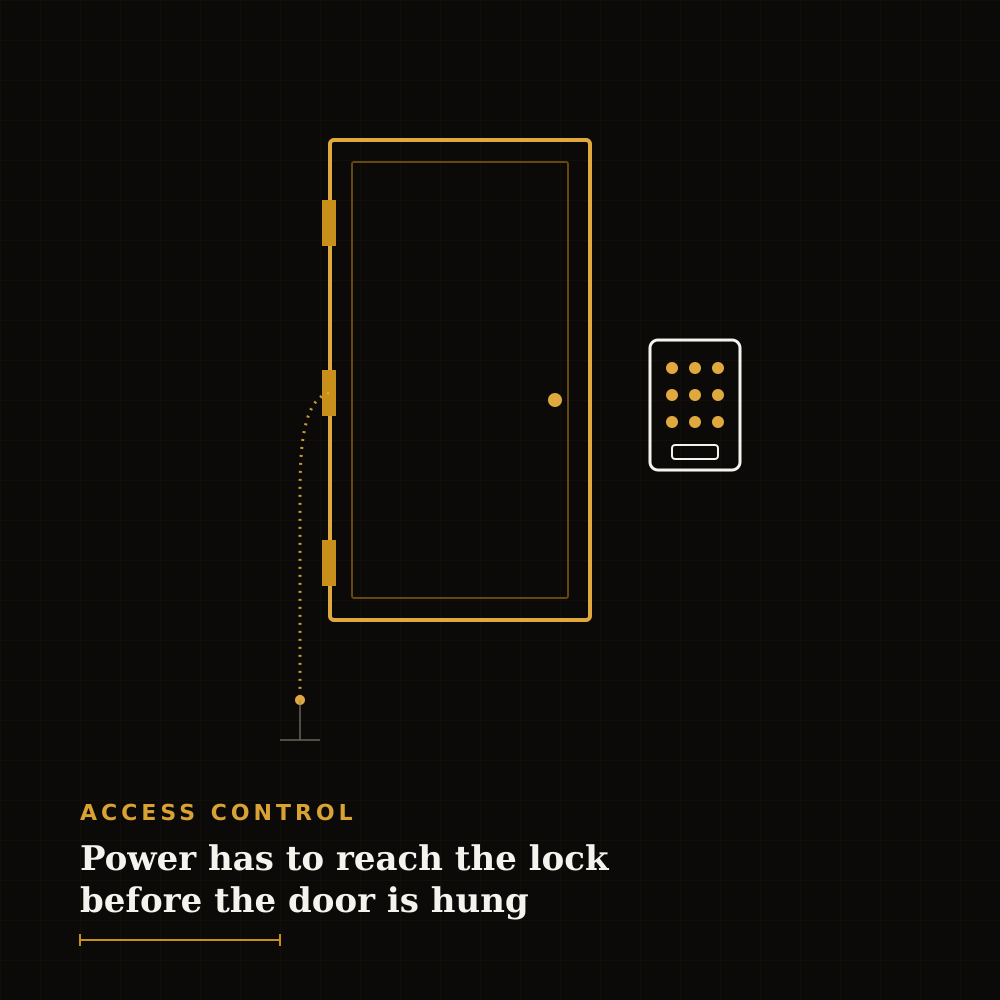
That decision has to be locked in before the door hardware is chosen, because a smart lock that never needs a battery change requires hardwired power and data. That means running a wire through the hinges of a solid custom door. Order the mahogany door first and decide on the lock later, and you’ve ruined the door.
The guide has a similar trick question for kids: “Your child forgets their key at 4 pm. What happens?” Panic and a text message mean you need remote unlock. A hidden spare key means you need remote unlock and a serious conversation about how predictable hiding spots really are.
Even the garage gets interrogated. Using it as the primary entry, the way most families actually live requires a dedicated data cable run from the garage door opener back to the server rack, not just the standard electrical outlet already up there. Skip that detail during framing, and you’re tearing open finished drywall later to fix it.
Door with electronic lock and keypad illustrating that power must reach the lock before the door is hung.

The Physics of the 2 A.M. Driveway

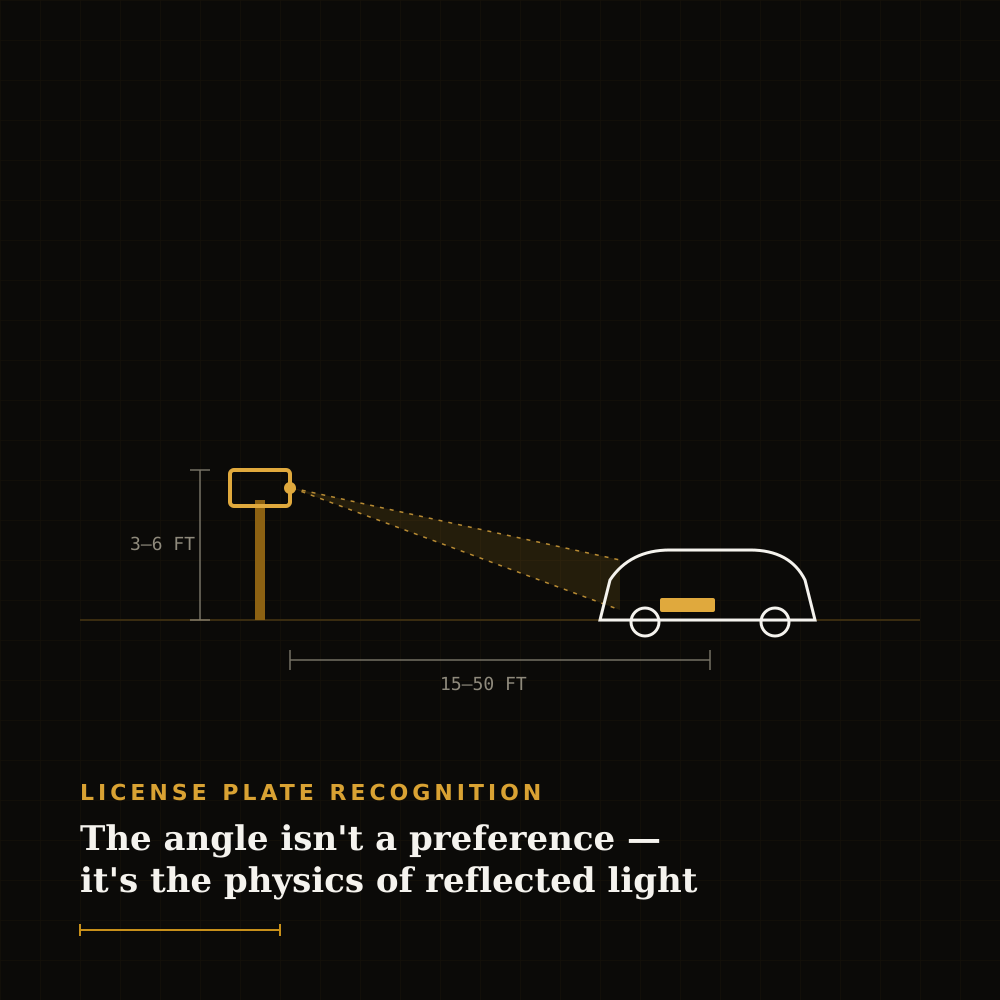
Then there’s the question about headlights sweeping across the driveway at two in the morning. A simple push notification just needs a standard security camera. But if you want the system to recognize your daughter’s car versus a stranger’s, you’re now talking about license plate recognition and the physical requirements are surprisingly rigid.
License plates are coated in retroreflective paint, designed to bounce infrared light straight back at a camera. That only works if the camera sits at a shallow, specific angle, roughly 15 to 50 feet away, mounted three to six feet off the ground. Put the camera up on the roofline for a cleaner look, and the infrared light bounces off the roofline into the street instead of back into the lens. The physics simply don’t allow for a hidden, high-mounted plate reader, which is why these cameras usually end up on a landscaping pedestal with a data cable poured directly into the driveway’s concrete.
The payoff, though, is real automation: a gate that quietly opens for the housekeeper’s car every Tuesday morning and stays shut for everyone else, full magic on the surface, buried infrastructure underneath.
Diagram showing a street camera on a post targeting a car's license plate, with dashed lines depicting reflected light and the caption 'License Plate Recognition'.

Wall Acne, Neutral Wires, and the Tyranny of the Light Switch

Once you’re inside, the guide pivots to lighting and doesn’t ask which fixtures look nice. It asks you to trace your actual physical path through the house at the end of the day and first thing in the morning, because that path determines where every keypad goes.

“But that swap requires a neutral wire at every switch location, something older or standard builds often skip because a traditional switch doesn’t need one. This is exactly the kind of detail a certified Lutron dealer flags before the drywall goes up.”
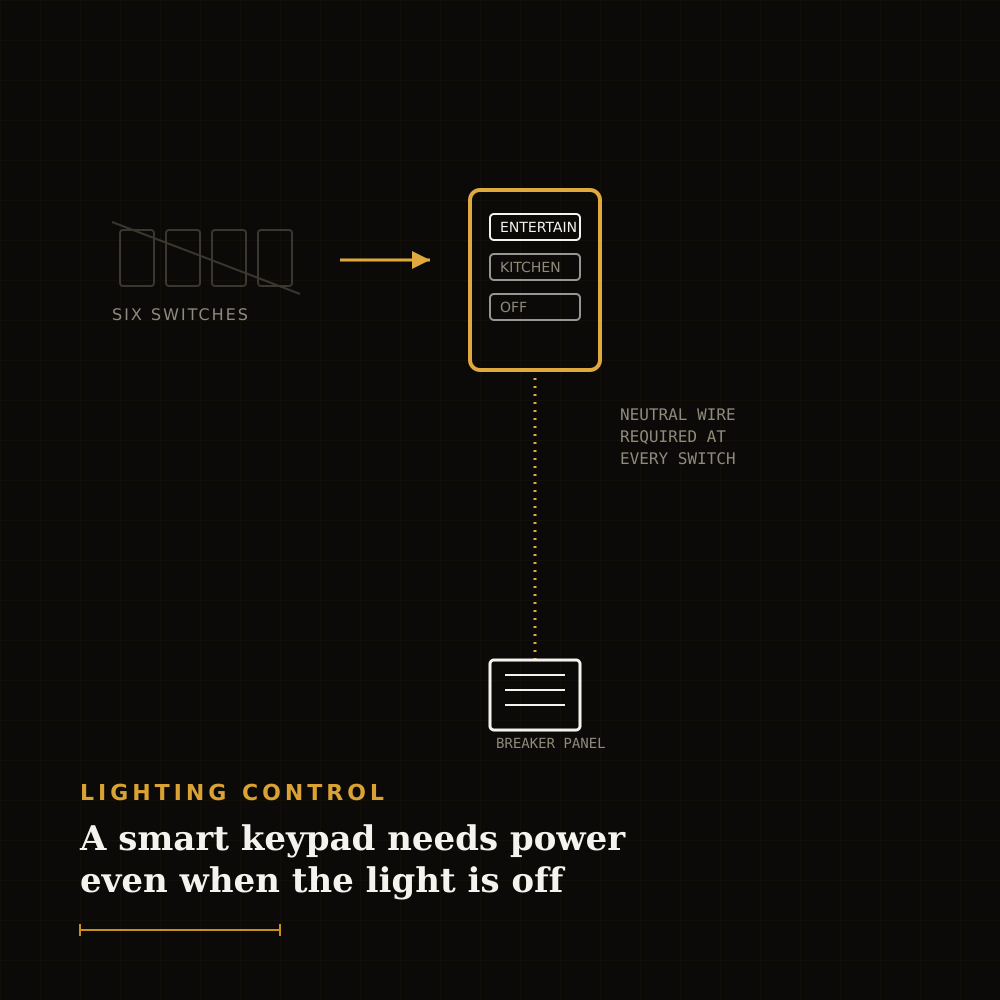
Even the label on the keypad matters. A button that says “Kitchen” just flips a light on. A button labeled “Entertain” triggers a fully programmed scene: dimmed lights, lowered shades, and music cued up. Same wall, wildly different engineering behind it.
The guide is equally specific about dimming. Wanting a warm 1% glow instead of pitch black when the lights go down for a movie isn’t a minor preference; it requires matching precise LED drivers and dimmer modules. Send a 1% signal to a cheap driver, and it either flickers like a strobe or shuts off completely.
And it issues a warning about color: if a client gets excited about full-color lighting throughout the house, that’s flagged as a red flag for buyer’s remorse. The advice is blunt: keep the novelty lighting contained to the pool or media room, not the whole house.
Schematic showing six switches feeding a boxed smart keypad with ENTERTAIN, KITCHEN, OFF buttons; a dashed line leads to a breaker panel, with a note that a neutral wire is required at every switch; caption reads 'Lighting Control: A smart keypad needs power even when the light is off'.

Shades, Speakers, and the Ceiling That Comes Down

Motorized window shades bring one of the guide’s starkest warnings. Clients almost always want the shade fabric to disappear completely into the ceiling when raised, which means the framer has to build a precisely sized pocket into the ceiling cavity, based on fabric thickness, tube size, and window width, months before the client actually picks the fabric. Fall in love with a thick blackout fabric late in the project, and it won’t fit into a pocket built for something thinner. The consequence, stated plainly in the guide: the ceiling comes down.
Audio gets the same treatment. Is music at a party background ambiance, or the main event? Background means a simple, evenly spaced ceiling speaker grid. “The point” means a true critical listening room acoustic math aimed at a specific seating position, amplifiers with serious reserve power, and a thicker speaker cable run before the drywall goes up.
Even TV habits are a diagnostic tool. Reaching for subtitles versus cranking the volume during quiet dialogue reveals whether a room should prioritize a large center-channel speaker (for dialogue clarity) or dedicated subwoofers (for impact), each of which requires different cabinetry and framing to house.
Outdoor audio gets one of the guide’s sharpest lines: burying speaker wire under a finished patio later isn’t a change order, it’s a demolition project.
Infographic of a home theater layout showing a center channel speaker and a subwoofer connected by a heavy-gauge wire, with seating placed nearby.

The Illusion of Simplicity

After all that engineering, the guide turns to something deceptively simple: how many apps does the client currently use to control their house? Usually, the answer is four to seven, and the guide instructs the designer to just let that number sit in silence.
From there, it’s a fork: some clients are fine juggling separate best-in-class apps for lighting, music, and cameras reliably, because each system runs independently. Others want one unified app for everything, which feels like magic but introduces a single point of failure. If the main controller goes offline, the whole system can go dark from a control standpoint, even if the lights and TV themselves are working fine.
The guide’s final, easily skipped questions are arguably the most important: Who fixes it when it breaks? And when the power goes out, what absolutely has to keep running?

The Real Lesson

Strip away the license plate cameras, the dimming drivers, and the acoustic wall framing, and the guide is really making one point: a smart home isn’t a technology purchase, it’s a structural commitment to a set of daily habits you’re being asked to predict in advance. Skip the discovery process, and even a flawless, multi-million-dollar build can end up as an expensive box full of gadgets that don’t quite fit the way you actually live.
Driftwood Builders Roofing
AUTHOR

Author: Driftwood Builders Roofing

Driftwood Builders Roofing is a family-owned residential roofing company headquartered in Manchaca, Texas, serving Austin and the surrounding Hill Country since 2005. The company has delivered 3,700 full roof replacements and 783 repairs across 3,559 different customers over 20 years in business, with 97 years of combined construction experience across the leadership team and 74 years specifically inside Driftwood Builders. The company holds the highest contractor certifications offered by the major shingle manufacturers, including GAF Master Elite Contractor (the top 3% of GAF contractors nationally), GAF Certified Green Roofer, Owens Corning certified, TAMKO Pro Certified Contractor, and a Berridge Roof Installation Seminar Certificate for standing-seam metal roofs. Driftwood is an NRCA member, holds an Angie's List Super Service Award, is BBB Accredited, and is a GuildQuality member for verified customer satisfaction data. James Hardie certification covers the siding side of the business. Services include residential roof replacement, leak and storm-damage repair, tile roof repair, metal roofing, TPO commercial roofing, roof inspections, hail and storm damage inspections with insurance claim assistance, gutter work, and James Hardie siding. The customer-protection policy is straightforward: Only Pay Upon Completion. The company serves 22 cities across the Hill Country and Greater Austin and holds a 5-star rating across Google, GuildQuality, Angi, Nextdoor, Facebook, Thumbtack, and Yelp.

Scroll to Top