Solar Reflective Shingles: A Texas 2 Year Review
What Solar Reflective Shingles Actually Do
Standard dark architectural shingles in Central Texas can hit surface temperatures of 150 to 170°F on a typical July afternoon. Solar reflective shingles use highly reflective granules, often coated with ceramic or specialty pigments, to bounce a larger share of incoming solar radiation back into the sky instead of conducting it into the deck below.
The relevant rating is Solar Reflectance Index (SRI), which combines reflectance and thermal emittance into one number from 0 to about 100+. A standard black architectural shingle typically scores around an SRI of 10 to 25. ENERGY STAR rated solar reflective shingles must hit an initial solar reflectance of at least 0.25 on steep slope roofs, and most premium products land between 0.28 and 0.45 SRI equivalent reflectance after weathering.
For a homeowner in Cedar Park or West Austin, that translates into measurably cooler attic spaces and lower run times on AC systems during the 100°F+ stretch from mid-June through early September.
The 2-Year Test: A Cedar Park Roof
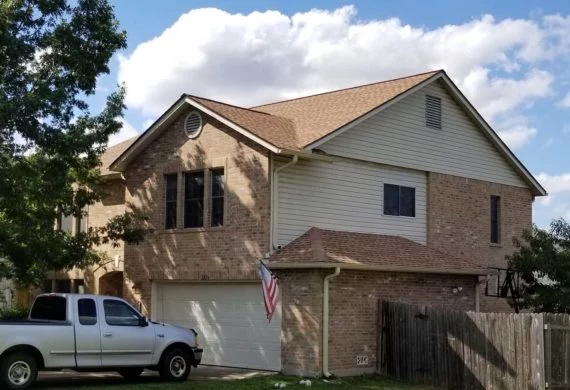
The case study behind this review: a 2,650 sq ft single story home with a 28 square asphalt roof, replaced in spring 2024 after a previous hail damaged GAF Timberline HD layer reached end of life. The replacement spec:
- GAF Timberline HDZ Reflector Series in Barkwood Reflective
- New synthetic underlayment and ice and water at all valleys and penetrations
- Ridge and soffit ventilation upgraded to match the new product’s reflective design
- R 38 blown cellulose attic insulation already in place
The house faces roughly south southwest, with no shade trees protecting the main roof plane. That is close to a worst case heat exposure scenario for Central Texas, which makes it a useful test bed.
Real Cost vs Standard Architectural Shingles
For a comparable Cedar Park reroof in 2024 to 2026, here is how solar reflective shingles compare against three common alternatives. Prices reflect a complete tear-off, new underlayment, and standard accessories on a single-story home, sourced from regional bid averages.
Roof system | Installed cost per sq ft | 25-yr lifecycle cost* | Cooling-season AC savings vs baseline |
Standard architectural asphalt (baseline) | $4.00 to $4.80 | $9,200 to $11,400 | 0% |
Solar reflective asphalt (HDZ Reflector, Landmark Solaris) | $4.50 to $6.50 | $9,800 to $12,200 | 7% to 15% |
Stone-coated steel with cool pigment | $9.50 to $13.00 | $14,800 to $18,500 | 10% to 18% |
Concrete tile with cool finish | $11.00 to $16.00 | $18,000 to $24,000 | 12% to 20% |
Lifecycle estimate includes one expected midpoint repair, gutter and flashing maintenance, and assumes the roof reaches its rated service life.
For most asphalt-roof homes, the upcharge for the reflective version runs 8% to 20%, or roughly $1,000 to $3,500 on a typical Austin-area home. The actual payback math is in the next section.
Energy Savings: What to Expect, and How to Measure It
This review does not publish metered energy data from the Cedar Park home. No monitoring equipment was installed on it and its utility bills are not something we can verify line by line, so the figures below are the published research ranges for reflective roofing rather than readings from one house.
- Cooling cost reduction of roughly 7 to 15%. That is the Cool Roof Rating Council’s estimate for a cool roof, and ENERGY STAR recognises steep slope products on the basis that they cut peak cooling demand by about 10 to 15%.
- A measurably cooler attic. Work by Oak Ridge National Laboratory, a US Department of Energy lab, puts attic temperature reductions under cool coloured shingle roofs in cooling dominated climates in the tens of degrees, with the roof surface itself running far cooler than a dark roof on a sunny day.
- A minimum reflectance to ask for. ENERGY STAR steep slope products must start at a solar reflectance of at least 0.25 and still hold at least 0.15 three years after installation. That is the number to check on the product data sheet, because a reflective granule blend that weathers badly stops earning its upcharge.
What the Cedar Park roof does demonstrate, after two full Central Texas summers on a south southwest exposure with no shade over the main plane, is durability: no premature granule loss, no hail performance problems, and no granule washout at the valleys. Set against an 8 to 20% product upcharge, savings in the range above pay the difference back over a period measured in years, not months. Payback is faster on homes with older or poorly insulated attics, west facing roof planes, or an oversized HVAC system, and slowest on well shaded north facing roofs.
If you want a figure for your own house instead of a range, compare your June to September kWh for the first summer after installation against the same four months the year before, using your utility’s usage history. That is the only measurement that reflects your attic, your insulation and your equipment.
For homeowners weighing a broader roof replacement project, the cooling benefit is real, but it should not be the only factor in product selection.
Hail and Wind Performance in Central Texas
The Austin hail belt is unforgiving. Cedar Park, Leander, and Round Rock all sit inside a corridor that sees hail 1.0″ or larger roughly every 2 to 3 years. Two-year hail and wind performance on this test roof:
- May 2024: 1.25″ hail event, mostly soft stone hail. No granule loss visible, no impact bruising on the test mat samples kept aside for inspection.
- October 2024: 70 mph straight-line wind event ahead of a frontal passage. No shingle lift or flying tabs.
- April 2025: Brief 1.5″ hail core passed roughly 1/4 mile south. Adjacent homes filed claims; this roof was not in the impact zone.
Most solar reflective asphalt lines carry a Class 3 or Class 4 impact rating when specified with the SBS-modified version. For homes in higher-exposure areas of Lakeway or the Hill Country, the Class 4 spec is worth the small additional cost because it can unlock an insurance discount.
Warranty, Insurance Discounts, and Tax Credits
Three financial factors change the payback math on a reflective roof:
- Manufacturer warranty. Major reflective products carry 30-year to lifetime limited material warranties, with a 25-year algae resistance guarantee on most lines. When installed by a certified contractor, the warranty often upgrades to a 50-year non-prorated tier on materials and an extended workmanship warranty.
- Insurance discounts. Per the Texas Department of Insurance, roofing tested for impact resistance may be eligible for a premium discount, and the amount for each class is set by each insurance company on a company-by-company basis. The credit follows the UL 2218 impact classification, where Class 4 is the highest and best credited, so a Class 4 impact-rated reflective shingle is a candidate for it. The Texas Windstorm Insurance Association does offer credits for impact-resistant roofing, subject to the UL label and TDI form PC068. When TDI first adopted these credits in 1998 (Commissioner’s Bulletin B-0024-98) the Class 4 credit ran from 4% to 35% of the basic premium depending on rating territory, and those numbers are still what most published figures trace back to, so treat any percentage you read online as illustrative and get your own carrier’s number in writing.
- Federal and utility incentives. The federal Energy Efficient Home Improvement Credit (26 U.S. Code §25C) does not apply to standard roofing as of 2026, but local utility programs occasionally offer rebates of $0.10 to $0.20 per sq ft for ENERGY STAR rated cool roofs. Utility rebates for ENERGY STAR rated cool roofs come and go, so check Austin Energy’s current rebate list rather than assuming one is available.
Stack the insurance discount, the rebate, and the energy savings, and the effective payback period in Central Texas often falls inside 4 years.
When Solar Reflective Shingles Are Not the Right Call
Reflective asphalt is not a fit for every home. Cases where standard architectural or a different system makes more sense:
- Heavily shaded north-facing roofs.Energy delta is small enough that the upcharge takes 10+ years to recover.
- HOA color restrictions.Some communities still restrict reflective products to a narrow color palette. Confirm before signing.
- Low-slope additions and porches.Reflective shingles need adequate slope; flat or near-flat sections may call for a TPO membrane or a cool-coated modified bitumen approach, which often comes up on commercial roofing projects too.
- Roofs needing structural repair.Spend the budget on deck repairs and ventilation first; the best shingle in the world cannot fix a soft deck or a starved attic.
Watch: Reflective Shingle Color in Central Texas
Best Roof Shingle Color for Austin Homes? GAF Timberline HDZ Barkwood Explained. Barkwood is the exact color on the Cedar Park case-study roof above, and it shows why cool-pigment technology means a reflective roof no longer has to be a light one.
How to Choose the Right Product for an Austin Home
Three filters to apply when shopping reflective shingles in Central Texas:
- SRI and reflectance.Ask for a product data sheet showing initial reflectance ≥ 0.28 and aged reflectance ≥ 0.20 after 3 years of weathering. Below those numbers, the cooling benefit narrows.
- Impact rating.UL 2218 Class 4 is the bar in the hail belt. Anything less leaves insurance discounts on the table.
- Installer certification.GAF Master Elite, CertainTeed SELECT ShingleMaster, or Owens Corning Platinum Preferred all carry extended workmanship warranties that only activate with certified installers. As an Austin roofing company certified by GAF since 2005, the bar for installer credentials matters more than the brand on the wrapper.
Get at least two written bids, request a specific written underlayment and ventilation scope, and confirm in writing whether ridge cap, drip edge, and starter strip are from the same reflective line.
Finding a Roofing Company That Installs Reflective Shingles in Austin
Reflective lines are ordered from the same manufacturers as standard architectural shingles, so most Austin roofing companies can get them. The difference shows up in whether the crew specs and installs the system correctly, which is what determines whether you actually see the attic temperature drop above. Four things worth confirming before you sign:
- They will name the product and put the data sheet in writing. Ask for the specific line, not just “a cool shingle.” GAF Timberline HDZ Reflector Series, CertainTeed Landmark Solaris, and the Owens Corning cool roof colors are the ones that come up most often on Central Texas bids. The bid should carry initial and aged reflectance numbers.
- They hold the manufacturer certification for that brand. GAF Master Elite, CertainTeed SELECT ShingleMaster, and Owens Corning Platinum Preferred each unlock the extended warranty tiers, and each is brand-specific. A contractor certified with one manufacturer does not automatically carry the enhanced warranty on another.
- The accessories match the reflective line. Ridge cap, starter strip, and hip and ridge should come from the same product family. Mixing a standard ridge cap onto a reflective field is common, and it undercuts both the appearance and the warranty.
- Ventilation is scoped as part of the job. A reflective roof over a starved attic gives up much of its benefit, because the heat it does absorb has nowhere to go. The written scope should say what intake and exhaust are being installed, not just the shingle.
Driftwood Builders Roofing has been a GAF certified Austin roofing contractor since 2005 and quotes reflective systems side by side against a standard architectural option, so the upcharge and the projected payback are both visible before you decide.
Watch: Why Ventilation Decides How Well a Reflective Roof Performs
How Does Roof Ventilation Work? Intake at the soffit and exhaust at the ridge are what let an attic shed the heat a reflective roof does not bounce away. This is the part of the system most often left out of a shingle bid.
FAQ: Solar Reflective Shingles in Central Texas
Do solar reflective shingles really lower energy bills in Austin?
Yes. In a Central Texas climate with long cooling seasons, most homes see a 7 to 15% reduction in cooling season electricity use. The exact savings depend on attic insulation, ventilation, HVAC age, and shading.
How long do solar reflective shingles last?
The asphalt versions carry 30-year to lifetime limited warranties and typically last 22 to 30 years in service. UV-driven granule loss is no faster than on a standard product because the reflective coatings are baked into the granules, not painted on top.
Are solar reflective shingles only available in light colors?
Not anymore. Cool pigment technology lets manufacturers offer Barkwood, Charcoal, Hickory, and similar darker tones that still reflect 0.25 to 0.30 of incoming solar radiation, far higher than the 0.05 to 0.10 of a standard dark shingle.
Will my homeowner’s insurance give me a discount?
If the product is Class 4 impact-rated, almost always. Texas insurers must offer a wind/hail premium discount; expect 10 to 28% off that portion of the policy. Always send the manufacturer’s UL 2218 certificate to your agent in writing.
Can I install solar reflective shingles over my existing roof?
Texas code generally allows one overlay, but reflective shingles perform best on a fresh deck with proper underlayment and ventilation. Most certified installers will not warrant a layover, and lifecycle cost usually favors a full tear-off.
If you are weighing a reflective roof for a Cedar Park, Round Rock, or Lakeway home, the decision should hinge on your specific roof exposure, attic condition, and insurance posture. A pre-bid inspection is worth more than a brand comparison. To talk through whether a reflective system fits your home, contact us for a written assessment and a side-by-side bid against a standard architectural option.

Author: Driftwood Builders Roofing
Driftwood Builders Roofing is a family-owned residential roofing company headquartered in Manchaca, Texas, serving Austin and the surrounding Hill Country since 2005. The company has delivered 3,700 full roof replacements and 783 repairs across 3,559 different customers over 20 years in business, with 97 years of combined construction experience across the leadership team and 74 years specifically inside Driftwood Builders. The company holds the highest contractor certifications offered by the major shingle manufacturers, including GAF Master Elite Contractor (the top 3% of GAF contractors nationally), GAF Certified Green Roofer, Owens Corning certified, TAMKO Pro Certified Contractor, and a Berridge Roof Installation Seminar Certificate for standing-seam metal roofs. Driftwood is an NRCA member, holds an Angie's List Super Service Award, is BBB Accredited, and is a GuildQuality member for verified customer satisfaction data. James Hardie certification covers the siding side of the business. Services include residential roof replacement, leak and storm-damage repair, tile roof repair, metal roofing, TPO commercial roofing, roof inspections, hail and storm damage inspections with insurance claim assistance, gutter work, and James Hardie siding. The customer-protection policy is straightforward: Only Pay Upon Completion. The company serves 22 cities across the Hill Country and Greater Austin and holds a 5-star rating across Google, GuildQuality, Angi, Nextdoor, Facebook, Thumbtack, and Yelp.
