James Hardie Siding vs. Stucco: Which Is Right for Your Austin Home?
Two Very Different Materials, Often Found on the Same Street
Stucco and James Hardie fiber cement solve the same basic problem — protecting the exterior wall — in different ways. Stucco is a cement-based plaster applied wet over a wire lath and building paper, common on Austin-area homes from several different building eras. James Hardie is a manufactured fiber-cement board, engineered and factory-produced to a consistent standard. Neither is objectively "better" in every case — the right answer depends on your home's current condition and what you're trying to solve.
Watch: Stucco Repair Process Explained
How Stucco Holds Up Over Time
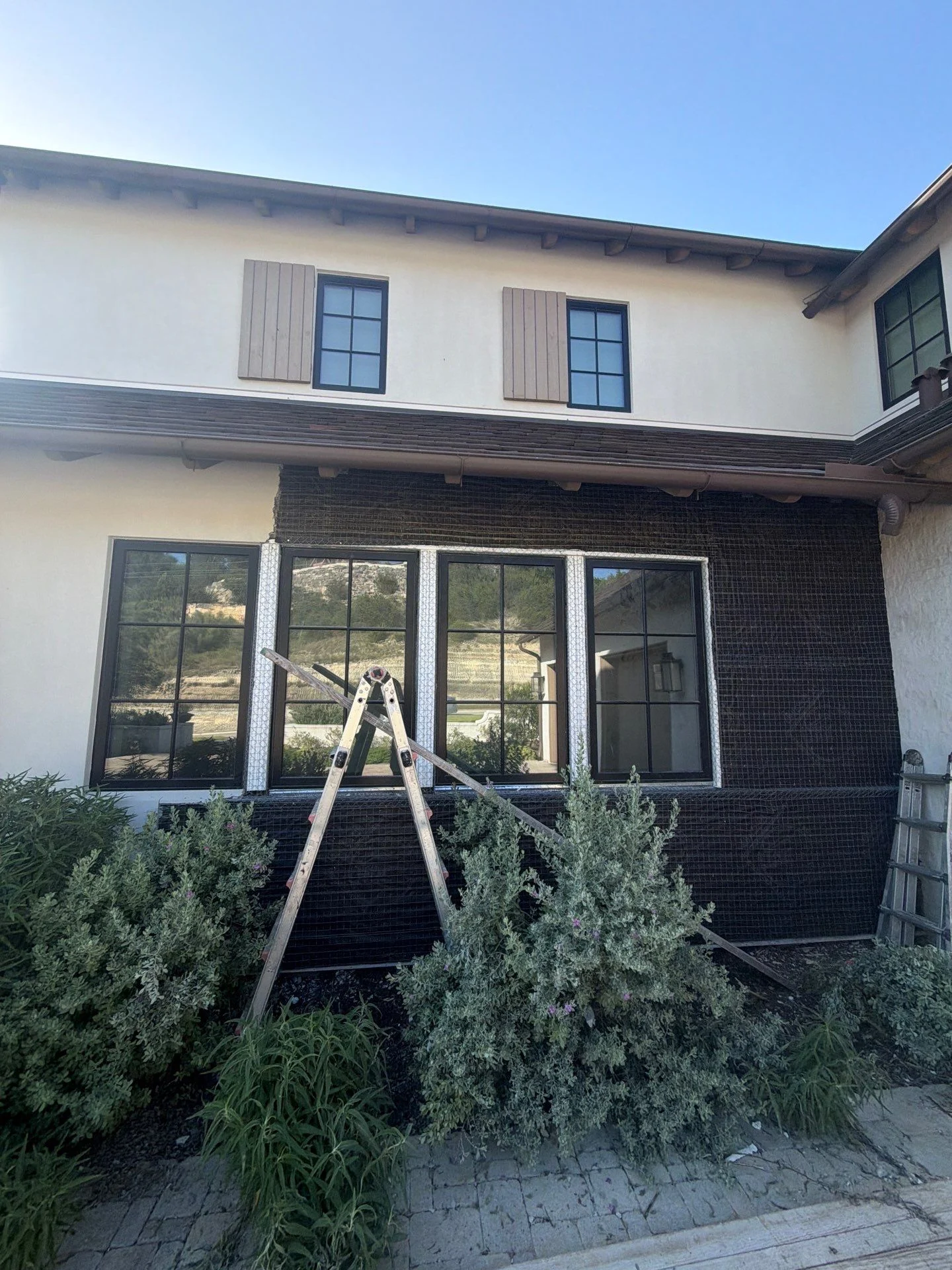
Intact, well-maintained stucco can last decades. The problems tend to show up in two ways:
- Cracking — as a home settles or with normal thermal movement, stucco can develop hairline cracks. Small, stable cracks are usually cosmetic. Cracks that are widening, or clustered in one area, can be a sign of a bigger issue underneath.
- Hidden moisture damage — this is the one that catches homeowners off guard. Stucco relies on the building paper and lath underneath staying intact. When that fails — from age, from a prior installation issue, or from water finding a way in around a window or trim detail — damage can develop behind the stucco for years without being visible from outside.
On a recent Westlake project, that's exactly what we found: window replacement work led us to discover termite damage behind the original stucco that had never shown on the surface. See the full project writeup with before/during/after photos, or our full breakdown of what we typically find behind siding and stucco for the broader pattern.
How James Hardie Fiber Cement Compares
James Hardie is manufactured to a consistent spec rather than mixed and applied on-site, which means less variability in how it performs over time. It's rated by the manufacturer for roughly 30–50 years, resists moisture differently than stucco (it doesn't rely on the same wet-application process), and — because it's engineered rather than hand-applied — repairs and partial replacements are generally more predictable than patching stucco to match an existing texture and color.
Repair the Stucco, or Convert to Hardie?
This is the real decision homeowners face, and it depends on specifics, not a general rule:
- If your stucco is in good condition with only minor, stable cracking, a repair is usually the more cost-effective choice — no reason to replace a sound exterior.
- If there's evidence of moisture damage — soft spots, staining, or cracking that's spreading — the right move is opening up the affected area to see what's actually happening underneath before deciding. Sometimes that's a stucco repair with proper moisture barrier correction; sometimes the damage is extensive enough that converting to fiber cement in that section makes more sense.
- If you're already doing major exterior work (window replacement, an addition, storm damage repair) that will disturb the stucco anyway, that's often the most cost-effective time to consider whether a full or partial conversion makes sense, since some of the labor is already happening.
We'll give you a straight answer after inspecting — not a default push toward whichever material we'd rather install.
James Hardie Siding installed on a project of ours in South Austin.
Side-by-Side: James Hardie vs. Stucco
| James Hardie Fiber Cement | Stucco | |
|---|---|---|
| Typical lifespan | Manufacturer-rated ~30–50 years | Decades, if intact and properly maintained — no fixed rating, condition-dependent |
| Consistency | Factory-manufactured to a fixed spec | Mixed and applied on-site; performance varies by installer/era |
| Moisture risk | Depends on correct clearance/installation | Hidden moisture damage behind the wall is the main risk — not visible until opened up |
| Repairability | Individual boards can usually be replaced | Patching to match existing texture/color is harder; larger repairs may require opening the wall |
| Conversion cost | Starts around $16/sq. ft. installed (see cost guide) | Not standardized by Driftwood — depends on extent/cause of damage found on-site |
Cost Comparison
Stucco repair and patching costs vary widely based on the extent of damage and matching requirements, and Driftwood doesn't currently publish standardized stucco pricing the way we do for James Hardie siding. For James Hardie conversion pricing, standard HardiePlank starts around $16/sq. ft. installed — see our full cost guide or use our siding pricing calculator for a number based on your home. For a stucco-specific estimate, the most accurate approach is a real on-site inspection, since stucco repair cost depends heavily on the extent and cause of damage found.
Frequently Asked Questions
Is James Hardie siding better than stucco?
Not universally — it depends on your home's current condition. Intact, well-maintained stucco doesn't need replacing just because fiber cement exists. Where stucco has developed real moisture or structural issues, Hardie's manufactured consistency and rated lifespan are real advantages.
Why does stucco crack?
Normal home settling and thermal movement cause most stucco cracking. Small, stable cracks are usually cosmetic; cracks that keep widening or cluster in one spot can point to a bigger issue and are worth a closer look.
Can you tell if there's damage behind stucco without removing it?
Not reliably from the outside — that's exactly what makes hidden stucco damage different from most siding problems. Soft spots when pressed and staining are signs worth investigating, but the only way to know for certain is opening up the affected area.
Should I convert my whole house from stucco to James Hardie, or just repair the stucco?
Depends on the extent of any real damage found and your goals for the home. Isolated issues are often best repaired in place; homes with widespread moisture damage, or homeowners planning a full exterior update, more often make sense as a conversion. We'll help you figure out which situation you're in.
How much does it cost to convert from stucco to James Hardie siding?
Standard HardiePlank starts around $16/sq. ft. installed — see our cost guide for the full breakdown. A conversion project may also involve additional demolition/disposal scope beyond a standard re-siding job; we'll account for that during an on-site estimate.
Author: Driftwood Builders Roofing
Driftwood Builders Roofing is a family-owned residential roofing company headquartered in Manchaca, Texas, serving Austin and the surrounding Hill Country since 2005. The company has delivered 3,700 full roof replacements and 783 repairs across 3,559 different customers over 20 years in business, with 97 years of combined construction experience across the leadership team and 74 years specifically inside Driftwood Builders. The company holds the highest contractor certifications offered by the major shingle manufacturers, including GAF Master Elite Contractor (the top 3% of GAF contractors nationally), GAF Certified Green Roofer, Owens Corning certified, TAMKO Pro Certified Contractor, and a Berridge Roof Installation Seminar Certificate for standing-seam metal roofs. Driftwood is an NRCA member, holds an Angie's List Super Service Award, is BBB Accredited, and is a GuildQuality member for verified customer satisfaction data. James Hardie certification covers the siding side of the business. Services include residential roof replacement, leak and storm-damage repair, tile roof repair, metal roofing, TPO commercial roofing, roof inspections, hail and storm damage inspections with insurance claim assistance, gutter work, and James Hardie siding. The customer-protection policy is straightforward: Only Pay Upon Completion. The company serves 22 cities across the Hill Country and Greater Austin and holds a 5-star rating across Google, GuildQuality, Angi, Nextdoor, Facebook, Thumbtack, and Yelp.