Tile Roof Underlayment Replacement: When to Lift and Relay the Tile Instead of Replacing the Roof
Why the Underlayment Is Usually What Fails
A tile roof is a water-shedding system. The tiles overlap and carry rain down to the eaves, but water can still get underneath them. The layer that stops it from reaching the deck is the underlayment.
The Tile Roofing Industry Alliance (TRI Alliance) installation manual says it directly: "Most problems with water-shedding roof installations occur from water that migrates through improper flashing of the tile, wind-driven rain or ice damming," and "Because of this possibility, the underlayment is critical to the success of the roof system."
The same manual notes that, after long exposure, some tiles "can be expected to lighten to some degree from the original color or lose some surface texture," and that this does not affect their structural integrity or water-shedding ability. In other words, a tile that looks weathered may still be doing its job. That is why a tile roof can look fine from the street while the layer underneath has failed.
Signs the Underlayment Is the Problem
Driftwood's tile roof repair page sets out the patterns its tile crew looks for:
| What you see | Most likely cause | Is the tile the problem? |
|---|---|---|
| Ceiling stain after heavy rain, tiles look fine | Failed underlayment beneath intact tile | No |
| Leak at a wall, chimney or valley | Flashing failure, or old flashing reused on a re-roof | No |
| Sagging area or soft spots | Rotted decking under the tile | No |
| Cracked or slipped individual tiles | Foot traffic, impact or fastener failure | Yes |
A stain inside does not pinpoint the failure above. On one documented Driftwood clay tile repair in Westlake (78746), staining and cracking around a recessed ceiling light showed the general area, but the cause was only found once the tiles above it were lifted: rotted decking beneath the tile system. As that project write-up notes, roof leaks can travel along decking, underlayment or framing before they appear indoors.
How a Lift-and-Relay Works
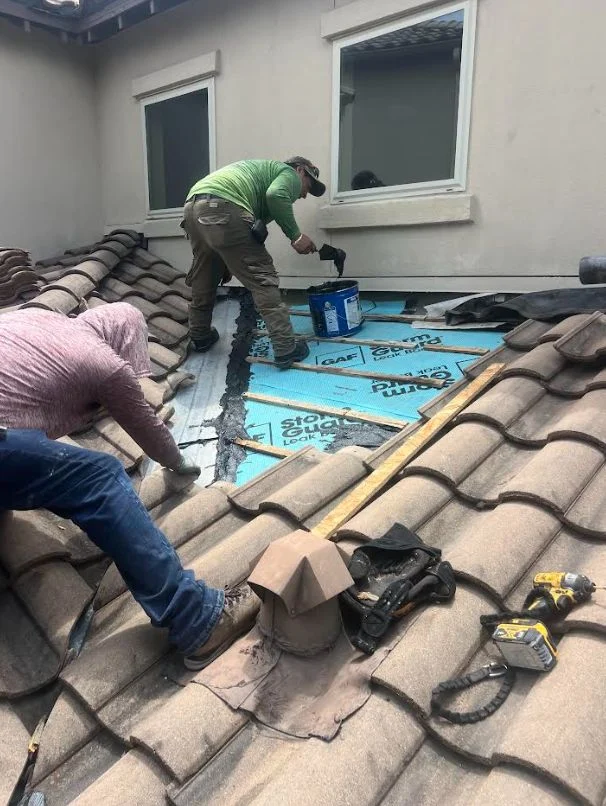
A lift-and-relay replaces what is under the tile while keeping the tile. The steps on a typical job:
- Remove and stage the tile from the affected area or the whole roof, handling it so it is not broken. The TRI Alliance manual warns that walking on tile "should be avoided and only done with extreme caution," and, where necessary, only on the lower 3 to 4 inches of each tile, near its bearing points.
- Inspect and repair the deck. The TRI Alliance manual says to verify the deck has no significant delamination or warping, check for decay or damage, and make repairs to meet local building codes.
- Replace damaged flashing. The manual's re-roof guidance says damaged, rusted or improper flashing "will be replaced when re-roofing," and the code says the same for existing flashings that are rusted, damaged or deteriorated.
- Install new underlayment to the code and the tile manufacturer's instructions (see below).
- Reinstall and fasten the tile, replacing any broken pieces with matching tile.
On the Westlake project above, Driftwood removed and staged the existing clay tiles, removed the deteriorated decking, installed replacement decking and new waterproofing, then reinstalled and secured the existing tiles and screwed down loose tiles in the repair area. That repair totaled $3,900 and took about half a working day. The price was specific to that home and scope, not a general rate.
Can Your Tile Be Reused?
Usually much of it can, but not all of it. The code is specific: under 2024 IRC Section R908.5, "Existing slate, clay or cement tile shall be permitted for reinstallation, except that damaged, cracked or broken slate or tile shall not be reinstalled." The TRI Alliance manual adds that on a re-roof, "Cracked or broken tile must be removed from the roof."
So the questions are how many tiles are damaged and whether replacements can be found:
- Breakage. Not every tile survives removal, and some are already cracked; on Driftwood's tile jobs, tile is salvaged where possible. Ask the roofer how breakage is handled and priced.
- Availability. Replacement tiles need the same profile, such as Spanish S-tile, flat concrete or barrel clay, and a color that blends. Driftwood sources matching profiles and matches as closely as possible to the existing roof, but an exact match is not always available for older or discontinued tile.
What the Code Requires Under Tile
The City of Austin enforces the 2024 International Residential Code. For clay and concrete tile, the key requirements are:
- Sheathing: tile "shall be installed over wood structural panels or solid lumber sheathing" (R905.3.1), with a limited exception for spaced sheathing.
- Slope: tile is allowed on slopes of 2 1/2:12 or steeper. From 2 1/2:12 up to 4:12, double underlayment is required (R905.3.2).
- Underlayment type: must comply with Section R905.1.1. Approved types for tile include ASTM D226 Type II felt and ASTM D1970 self-adhering polymer modified bitumen, among others listed in Table R905.1.1(1), and the underlayment must be labeled to its standard.
- Underlayment application (where wind design is not required; the table sets different options where it is): on slopes of 4:12 or more, one layer applied shingle fashion, lapped 2 inches, with 4-inch end laps offset by 6 feet; on lower slopes, two layers; or a single layer of ASTM D1970 self-adhering membrane installed to the manufacturers' instructions (Table R905.1.1(2)).
- Installation: tile must be applied according to the code and "the manufacturer's installation instructions," based on climate, roof slope, underlayment system and tile type (R905.3.8).
- Valleys: valley flashing must extend at least 11 inches from the centerline each way (R905.3.9).
- No layering: a new roof covering may not be installed over existing clay or cement tile (R908.4).
Permits: the City of Austin's permit-exempt list includes replacing a roof covering that does not adversely affect the roof structure, and replacing roof decking up to 128 square feet. Replacing more decking than that needs a permit, and in Austin's Wildland-Urban Interface area the exemption does not apply when 50% or more of the roof covering is replaced. Our guide to Austin roof permits and the wildfire code has the details. Ask your roofer which apply to your job.
Relay or Replace: How to Decide
A targeted repair fits when the problem is confined to one area: a valley, a section around a penetration, or one slope. The Westlake repair was this kind of job.
A full lift-and-relay fits when the underlayment is failing across the roof but most tiles are sound and reusable, and enough matching tile can be found to replace broken pieces.
A full replacement fits when a large share of the tile is cracked or broken, matching replacement tile cannot be found, the deck needs work across most of the roof, or you want a different roof covering.
Before deciding, get the roof inspected by someone who works on tile and will lift tiles where needed to see the underlayment and deck. Driftwood offers free inspections and estimates for tile roof repair across the Austin area, and can tell you whether a targeted repair, a relay or a replacement is the better long-term value. You can also compare underlayment types in our guide to synthetic vs felt underlayment.
Sources: 2024 International Residential Code Sections R905.1.1, Tables R905.1.1(1) and R905.1.1(2), R905.3.1, R905.3.2, R905.3.3, R905.3.8, R905.3.9, R908.4 and R908.5; Tile Roofing Industry Alliance, Concrete and Clay Roof Tile Installation Manual (2024 edition, revised May 2025); City of Austin, Work Exempt from Building Permits; Driftwood Builders Roofing tile roof repair page and Westlake (78746) clay tile repair project page.
Frequently Asked Questions
Can you replace the underlayment on a tile roof without replacing the tile?
Yes, if the tiles are in good condition. In a lift-and-relay, the tiles are removed and stacked, the underlayment and any damaged decking or flashing are replaced, and the same tiles are reinstalled. The 2024 IRC allows existing clay or cement tile to be reinstalled, but not tile that is damaged, cracked or broken.
Why is my tile roof leaking when the tiles look fine?
The tile sheds most of the water, but the underlayment below it keeps out what gets past the tile. When the underlayment fails, water can reach the deck even if every tile is intact. A roofer has to lift tiles to see it.
Will some tiles break during a relay?
Not every tile survives removal, and tiles that are already cracked must be replaced, not reinstalled. Ask how breakage is handled and whether matching replacement tile is available before work starts.
Do I need a permit to replace tile roof underlayment in Austin?
Replacing a roof covering that does not adversely affect the roof structure is on the City of Austin permit-exempt list, as is up to 128 square feet of decking. More decking, or a large replacement in the Wildland-Urban Interface area, falls outside the exemption. Ask your roofer which applies.
Can a new roof go over my old tile?
No. The 2024 IRC does not allow a new roof covering to be installed over existing clay or cement tile.

Author: Driftwood Builders Roofing
Driftwood Builders Roofing is a family-owned residential roofing company headquartered in Manchaca, Texas, serving Austin and the surrounding Hill Country since 2005. The company has delivered 3,700 full roof replacements and 783 repairs across 3,559 different customers over 20 years in business, with 97 years of combined construction experience across the leadership team and 74 years specifically inside Driftwood Builders. The company holds the highest contractor certifications offered by the major shingle manufacturers, including GAF Master Elite Contractor (the top 3% of GAF contractors nationally), GAF Certified Green Roofer, Owens Corning certified, TAMKO Pro Certified Contractor, and a Berridge Roof Installation Seminar Certificate for standing-seam metal roofs. Driftwood is an NRCA member, holds an Angie's List Super Service Award, is BBB Accredited, and is a GuildQuality member for verified customer satisfaction data. James Hardie certification covers the siding side of the business. Services include residential roof replacement, leak and storm-damage repair, tile roof repair, metal roofing, TPO commercial roofing, roof inspections, hail and storm damage inspections with insurance claim assistance, gutter work, and James Hardie siding. The customer-protection policy is straightforward: Only Pay Upon Completion. The company serves 22 cities across the Hill Country and Greater Austin and holds a 5-star rating across Google, GuildQuality, Angi, Nextdoor, Facebook, Thumbtack, and Yelp.
