Hail Damage to Siding in Converse, TX
When the National Weather Service upgraded its warning over Converse at 10:12 p.m. on September 11, 2026, it named three parts of a house: "Expect hail damage to roofs, siding, windows, and vehicles."
Siding is the surface most homeowners skip. It is also, along with window screens, one of the best pieces of evidence you have that hail actually struck your property rather than your neighbourhood, because it sits at eye level where you can photograph it without a ladder.
This page covers what hail damage looks like on each siding material, how to separate it from ordinary Texas weathering, how insurers treat it, and what siding damage implies about the roof above it.
What Hail Damage Looks Like, by Material
Different claddings fail differently, which is why generic advice is not much use.
| Material | How hail shows up | Easy to miss? |
|---|---|---|
| Vinyl | Circular or crescent cracks, clean punched holes, chipping along panel bottom edges | Cracks read as shadow lines until you get close |
| Fibre cement (James Hardie) | Chips and craters exposing grey cement under the paint, hairline cracks radiating from impacts | No, fresh chips stand out pale against paint |
| Aluminium | Dents and dimples, often in a regular pattern; paint chipping | Only visible in raking light |
| Wood and engineered wood | Splits, bruised fibres, gouges, paint loss at impacts | Often mistaken for age |
| Stucco | Chips, pockmarks, hairline cracking around impacts | Yes, blends into texture |
| Brick | Rarely damaged; check mortar and any trim, soffit and fascia instead | n/a |
Two material-specific points worth knowing. Vinyl embrittles with age and cold, so a fifteen-year-old vinyl wall can crack at hail sizes that leave new vinyl untouched. And fibre cement is hard but brittle: it resists denting well and then chips, which is why it often looks undamaged from twenty feet and clearly damaged from two.
Our broader write-ups: hail damage to siding and how James Hardie siding performs in this climate.
Hail Damage vs Old Siding: How to Tell the Difference | Not every mark on siding is hail damage. It shows how to tell genuine hail damage on siding apart from older damage and ordinary weathering.
Hail-Punctured Siding in Converse
Vinyl is the material where the difference between hail and ordinary wear is least arguable, because hail does not dent it. It goes through.
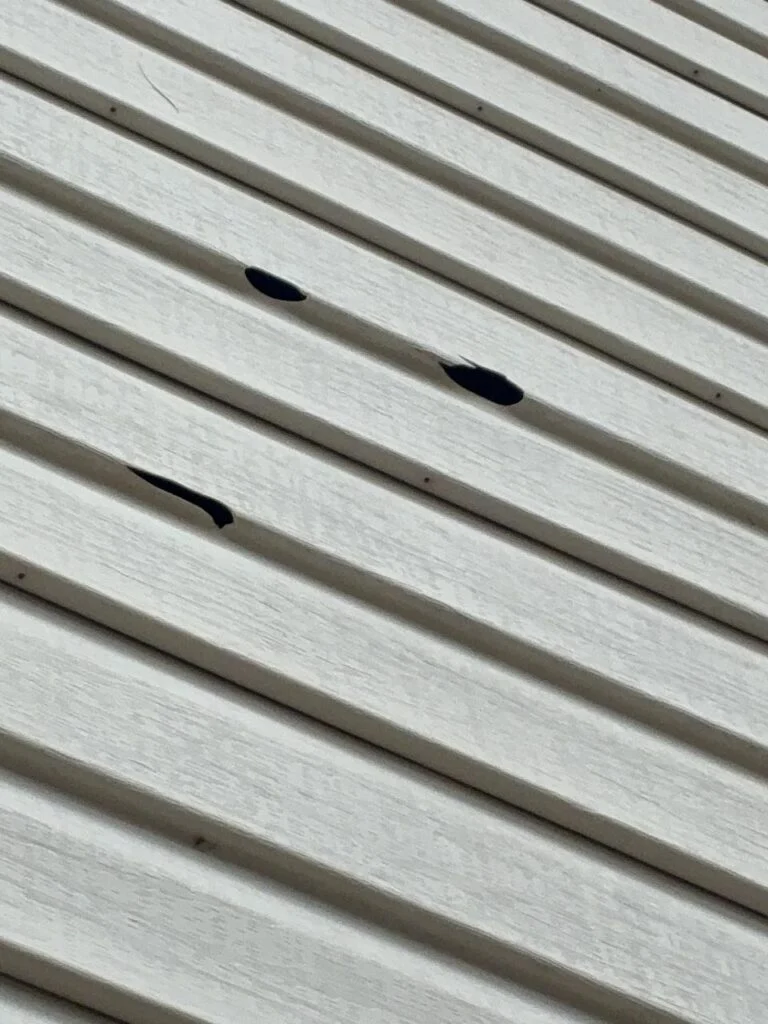
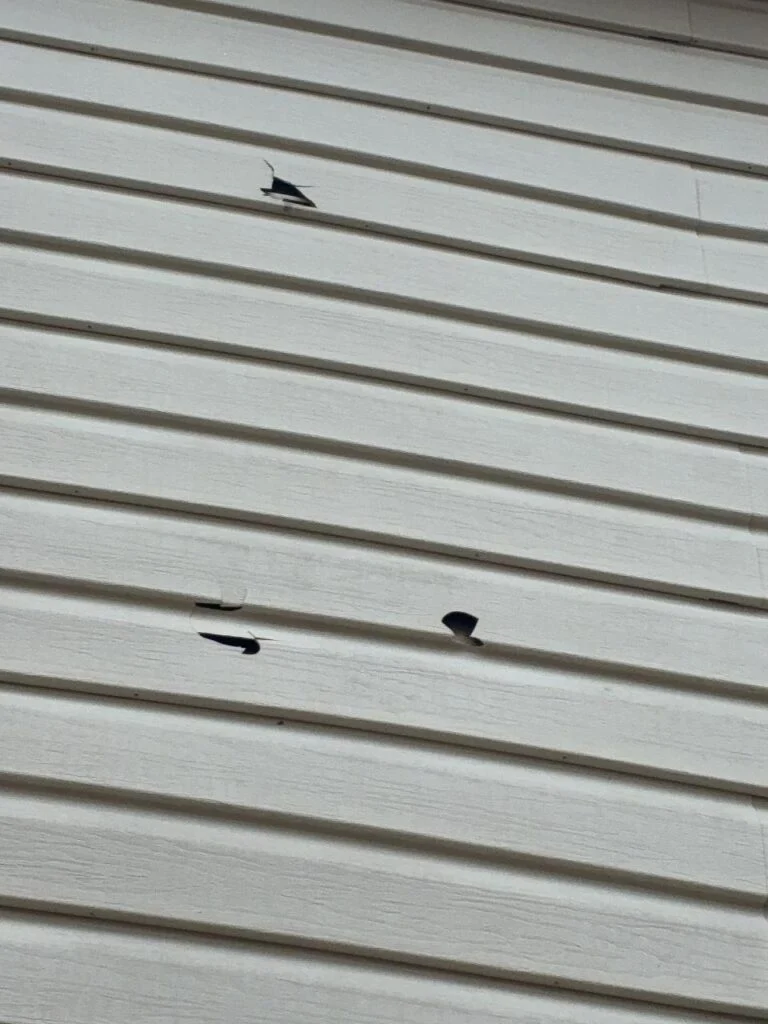
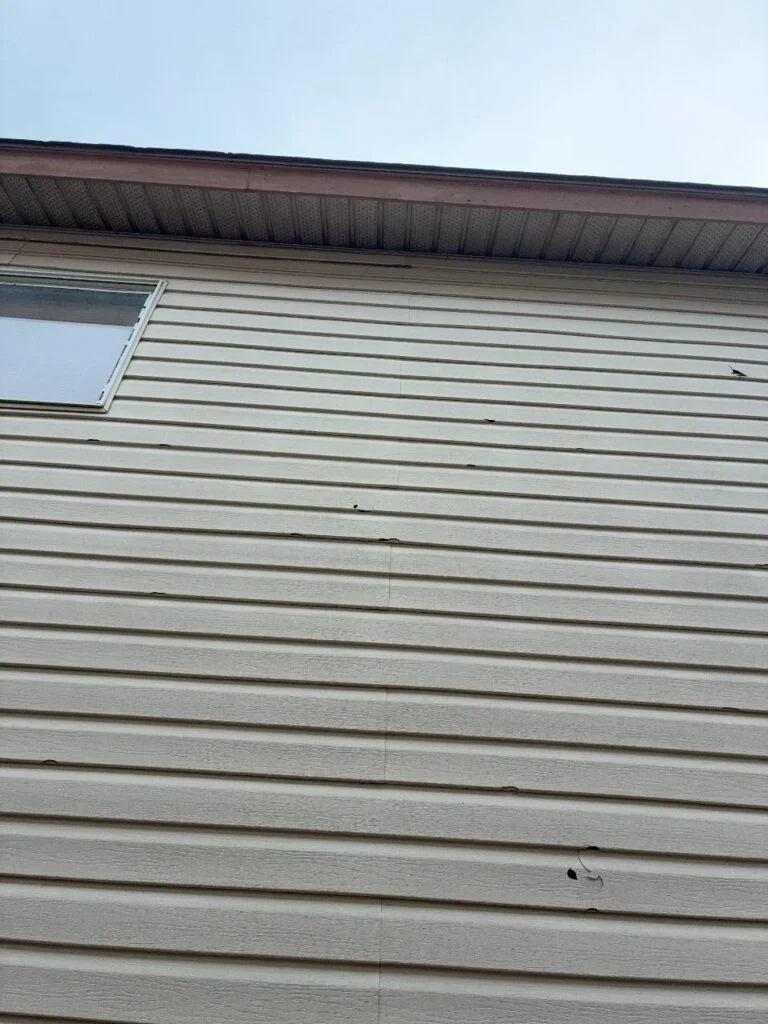
Watch: spotting siding damage from the ground
Siding is the one exterior surface a homeowner can genuinely assess without a ladder. In this clip Nick walks a Converse elevation and points out punctured boards, damage around the window beads, and a section of siding hit hard enough to come off the wall.
Hail Damage vs Ordinary Wear
This is the distinction an adjuster will draw, so draw it yourself first.
| Hail | Age, heat and installation | |
|---|---|---|
| Distribution | Clustered on storm-facing elevations | Even on all sides |
| Pattern | Random within a cluster, consistent angle | Follows seams, fasteners or sun exposure |
| Appearance | Fresh, sharp-edged, unweathered substrate | Faded, chalky, oxidised |
| Company | Gutters, screens, vents and roof damaged too | Siding alone |
| Typical defects | Cracks, punctures, chips, dents | Warping, fading, seam separation, nail pops |
Warping and buckling are almost never hail. They are usually heat expansion against siding that was nailed too tightly, which is an installation issue rather than a storm one. The same is true of most nail pops and seam gaps, covered in siding cracking and nail pops.
The strongest single test remains "what else is damaged." Hail does not selectively damage siding. If the gutter faces, downspouts, window screens, vent caps and roof on the same elevation all show fresh marks, that is a storm. If only the siding looks tired, and it looks equally tired everywhere, that is Texas sun.
Real Hail Damage vs Accidental Gutter Damage | Is This Hail Damage? Austin Roofer Explains: the same reasoning applied to soft metal, which is the most reliable hail indicator on any house.
Where to Look First
You do not need a ladder for any of this.
- Work out the storm direction. On September 11 the storm tracked southwest across eastern Bexar County with a measured 60 mph gust at Randolph AFB. Wind-driven hail hits vertical surfaces hardest on the side facing the storm, so start there.
- Stand close, then look along the wall. Face-on you see almost nothing. Sight along the wall at a shallow angle, ideally in low sun, and dents and cracks appear.
- Check the bottom edges of panels on vinyl, where chipping concentrates.
- Check around windows, where trim, wrapping and siding all meet. See hail damage to windows in Converse.
- Check soft metal on the same elevation: gutters, downspouts, vent caps, AC condenser fins. These dent before siding cracks.
- Photograph with scale and date. A coin beside an impact, and a wide shot establishing which elevation it is.
Do not seal, paint or patch anything before it is documented. A repaired impact is an impact that no longer exists in evidence.
Insurance, Deductibles and the Matching Problem
Siding damage is part of the same loss as the roof. One storm, one claim, one deductible. Document roof, siding, windows, screens and gutters together and submit them as one file.
Three things decide what you actually receive:
- Your wind and hail deductible, often a percentage of dwelling coverage in Texas. At 2 percent on a $400,000 home that is $8,000. Siding damage alone frequently sits below that, which is why the roof usually determines whether the whole claim is worth filing.
- Replacement cost versus actual cash value. Older siding depreciates like an older roof.
- Matching. The contested one. If six vinyl panels are cracked and the colour is discontinued, or the surrounding wall has faded through fifteen Texas summers, a new panel will not match. Whether the carrier pays to redo the full elevation depends on policy language and carrier practice, and it is worth asking about explicitly rather than assuming.
The full coverage picture is on does homeowners insurance cover hail damage in Converse. One limit to restate: a contractor doing the work cannot act as your public adjuster or negotiate your claim, and cannot waive your deductible, which is a crime in Texas. We inspect, document, estimate, and explain what we found to your adjuster.
Repair, Replace, or Leave It
- Leave it when the damage is purely cosmetic on a wall you do not see, the cladding is not breached, and the cost of matching exceeds the benefit. This is a legitimate answer and you should hear it when it applies.
- Spot-replace when a small number of panels are cracked or punctured, the material is still available, and colour match is acceptable. Routine on vinyl.
- Replace the elevation when damage is widespread on one wall, or when matching makes spot repair look worse than doing the wall.
- Re-side when multiple elevations are affected and the siding was near the end of its life anyway. If you reach this point, ask about impact-rated products while you are already paying for labour.
The thing not to defer: any crack or puncture that breaches the cladding. Siding is a water-management layer. Once water gets behind it, the damage moves to sheathing and framing, and that is a far more expensive repair than the siding itself. Cosmetic dimples can wait for a decision. Holes should not.
Driftwood does roofing and siding, which for a storm claim means one contractor documents the whole loss consistently. Free written estimates across Converse and northeast Bexar County: request one here, or see our siding services.
What Siding Damage Says About the Roof
The inference runs strongly in one direction and weakly in the other, and it is worth being precise about which.
Damaged siding means the roof needs inspecting. Siding is vertical, so hail strikes it at a glancing angle and loses much of its energy. Your roof is angled toward the sky and takes the same stones nearly head on. If hail cracked a fibre cement plank or punched vinyl on your wall, the shingles above absorbed considerably more.
Undamaged siding does not clear the roof. Plenty of Converse homes came through September 11 with clean walls and bruised shingle mats. Brick homes especially: brick shrugs off hail that badly damages a roof, so a brick house tells you almost nothing about its own roof.
Use siding the way an inspector does, as an accessible indicator rather than a verdict. What was actually reported near Converse that night, with times, sizes and the full warning timeline, is in our Converse hailstorm guide, and the roof-side checks are in spotting hail damage without climbing. Our Converse roofing page covers how we work locally.
Frequently Asked Questions
Can hail damage siding?
Yes. The National Weather Service warning over Converse on September 11, 2026 listed siding explicitly among expected impacts. How the damage appears depends on the material: vinyl cracks and punches, fibre cement chips and cracks, aluminium dents, and wood splits and bruises.
What does hail damage to vinyl siding look like?
Circular or crescent-shaped cracks, clean punched holes, and chipping along the bottom edge of panels. Vinyl becomes more brittle in cold and with age, so older siding cracks at hail sizes newer siding survives. Damage clusters on the elevation that faced the storm.
What does hail damage to James Hardie or fibre cement siding look like?
Chips and small craters that expose the grey cement body under the paint, and hairline cracks radiating from impact points. Fibre cement is hard but brittle. Because it is usually painted, fresh damage stands out against the finish as a lighter mark.
How do I tell hail damage from ordinary siding wear?
Direction and company. Hail is clustered on storm-facing elevations, arrives at a consistent angle, and shows up alongside damage to gutters, screens, vent caps and the roof. Wear is even across every elevation, and warping, fading and seam separation are usually age, heat or installation problems rather than storm damage.
Does homeowners insurance cover hail damage to siding?
Generally yes, as part of the same loss as the roof, under the same wind and hail deductible. It should be documented and claimed together with roof, window and gutter damage, not separately.
Will insurance replace all my siding or just the damaged panels?
That is the matching question, and it is one of the most contested parts of a siding claim. If the damaged panel is discontinued or the colour has faded so a new panel will not match, whether the carrier pays to replace the full elevation varies by policy language and by carrier.
Can damaged siding panels be replaced individually?
Physically yes, and on vinyl it is routine. The practical issue is matching: colours fade with UV exposure and product lines are discontinued, so a replacement panel frequently looks different even when it is the same nominal colour.
Does hail-damaged siding need to be replaced immediately?
Cracks and punctures let water behind the cladding, and the damage that follows is to the sheathing and framing rather than the siding. It does not need replacing the same week, but it should not be left through a wet season.
Is siding damage a sign my roof is damaged too?
Strongly. Siding is vertical and is struck at a glancing angle, while the roof is angled toward the sky and takes the same hail nearly head on. If hail had the energy to crack siding, the roof almost certainly needs inspecting.
What siding holds up best to hail?
Fibre cement and steel generally outperform vinyl, and thicker vinyl outperforms thin. No residential cladding is hail-proof at the sizes this area can produce. Impact-rated products exist and are worth asking about when re-siding anyway.
Should I use the same contractor for roof and siding?
It helps for a storm claim, because one contractor can document the whole loss as one event with one consistent set of photographs and one scope. That is what an adjuster needs to see.
How much does hail-damaged siding repair cost?
It depends heavily on material, how many elevations are affected, and whether matching forces a full-elevation replacement rather than spot repairs. Spot replacement of a few vinyl panels is modest; a full-elevation fibre cement replacement is a significant project. We quote from a measured scope after inspection rather than by phone.
Sources
Warning language and storm reports: National Weather Service Austin/San Antonio, Severe Thunderstorm Warning 0170 and accompanying Severe Weather Statements, and Local Storm Reports, September 11 to 12, 2026 (products WUUS54, WWUS54 and NWUS54 KEWX). The quoted impact statement is from the 10:12 p.m. CDT update. The 60 mph gust at Randolph AFB is a measured AWOS observation.
Deductible and claim-handling law: Texas Insurance Code Chapter 707; Texas Insurance Code §4102.163; Texas Department of Insurance, Roofing and insurance: Know the law.
This page is general information for Texas homeowners. It is not legal advice, insurance advice or a coverage opinion. Repair cost comparisons here are relative rather than quoted prices; every project is priced from a measured scope after inspection.

Author: Driftwood Builders Roofing
Driftwood Builders Roofing is a family-owned residential roofing company headquartered in Manchaca, Texas, serving Austin and the surrounding Hill Country since 2005. The company has delivered 3,700 full roof replacements and 783 repairs across 3,559 different customers over 20 years in business, with 97 years of combined construction experience across the leadership team and 74 years specifically inside Driftwood Builders. The company holds the highest contractor certifications offered by the major shingle manufacturers, including GAF Master Elite Contractor (the top 3% of GAF contractors nationally), GAF Certified Green Roofer, Owens Corning certified, TAMKO Pro Certified Contractor, and a Berridge Roof Installation Seminar Certificate for standing-seam metal roofs. Driftwood is an NRCA member, holds an Angie's List Super Service Award, is BBB Accredited, and is a GuildQuality member for verified customer satisfaction data. James Hardie certification covers the siding side of the business. Services include residential roof replacement, leak and storm-damage repair, tile roof repair, metal roofing, TPO commercial roofing, roof inspections, hail and storm damage inspections with insurance claim assistance, gutter work, and James Hardie siding. The customer-protection policy is straightforward: Only Pay Upon Completion. The company serves 22 cities across the Hill Country and Greater Austin and holds a 5-star rating across Google, GuildQuality, Angi, Nextdoor, Facebook, Thumbtack, and Yelp.
