GAF Master Elite Contractor | BBB A+ Rated | 5.0 Stars Based on 500+ Customer Reviews | 3,700+ Total Projects Completed

Converse, TX Hail & Insurance Claim Guide: What Homeowners Need to Know After the September 11, 2026 Storm

Last Updated on: September 15, 2026

Converse, TX Hail & Insurance Claim Guide: What Homeowners Need to Know After the September 11, 2026 Storm

Short answer: Yes. The National Weather Service logged hail reports in and around Converse late on Friday, September 11, 2026, ranging from about 1 inch to roughly 2.5 inches. The largest report came from about three miles southeast of Converse at 9:59 p.m., and golf-ball-sized hail was reported in the Paloma subdivision at 10:10 p.m. Being inside a hail swath is not the same as having a damaged roof. Hail size, hail density, wind and roof condition all varied over short distances, so the useful next step is usually a professional roof inspection — not an automatic insurance claim.

Did Converse, Texas Get Hail on September 11, 2026?

Yes. The National Weather Service office in Austin/San Antonio issued a series of preliminary Local Storm Reports for eastern Bexar County that night. Six reports were logged between 9:59 p.m. and 10:20 p.m. CDT on September 11 — five of them hail, one a measured wind gust — covering Converse, the Paloma area, Kirby, China Grove and Saint Hedwig.

That 21-minute window matters. One fast-moving storm core tracked across the area, which is why one neighborhood can have shredded window screens while the next one over came through with nothing but a loud night.

Radar-estimated hail is not the same as a confirmed report

Two very different kinds of "hail data" get quoted after a storm, and they are not interchangeable. Radar-estimated hail infers a likely maximum size across a grid of the sky — useful for seeing where a hail core tracked, but a modeled estimate over an area, never a measurement at your address. Most commercial hail maps are built from it. Local Storm Reports are ground observations relayed to the Weather Service by trained spotters, the public, broadcast media or automated stations, and each is tagged measured or estimated.

Both show up in the record for this storm. The 1.75-inch Paloma report is tagged measured. The larger 2.5-inch report is tagged estimated, and the NWS remark says so: the size came from social-media photographs of hail in Converse, and the location and timing were "estimated based on strongest hail indications within Converse on archived radar imagery."

Neither tells you what happened on your roof. They tell you the storm was capable of damage in your area — a reason to look, not proof of a loss.

Wind was in the mix too

At 10:04 p.m. the automated station at Randolph Air Force Base measured a 60 mph thunderstorm wind gust. Wind matters twice over: it drives hail in at an angle, changing which slopes take the worst of it, and it causes its own shingle damage that looks nothing like hail. The two often arrive together and are assessed differently — see our guide to telling hail damage from wind damage.

How Big Was the Hail in Converse?

Reported hail ranged from about 1 inch to roughly 2.5 inches, depending on where you were standing. Every report below comes from the National Weather Service Austin/San Antonio preliminary Local Storm Reports for the night of September 11, 2026. Times are CDT.

LocationApprox. timeReported hail sizeSource & NWS notes
3 miles SE of Converse9:59 p.m.2.00–2.50 in.Public. Size estimated. NWS remark: numerous social-media pictures of hail in the 2 to 2.5 inch range in Converse, including broken windshields and car windows; location and timing estimated from archived radar imagery.
4 miles SSE of Converse — Paloma subdivision10:10 p.m.1.75 in. (golf ball)Public. Size measured. NWS remark: dime to golf-ball sized hail reported via social media between 10:05 and 10:15 in the Paloma subdivision.
2 miles NE of Saint Hedwig10:17 p.m.1.00 in.Trained spotter. Size estimated.
3 miles ENE of Kirby10:18 p.m.1.00–1.50 in.Trained spotter report relayed to NWS. Size estimated.
1 mile WSW of China Grove10:20 p.m.1.00 in.Broadcast media relay, near Highway 87 and Foster Road. Size estimated.
2 miles S of Schertz (Randolph AFB)10:04 p.m.60 mph wind gust — not hailAutomated AWOS station KRND. Measured.

Two things are worth drawing out of that table.

Size varied enormously over a few miles. A 2.5-inch stone carries far more impact energy than a 1-inch stone. The two Converse-area reports were logged about two miles and eleven minutes apart and still differed by three quarters of an inch; the 2.5-inch report and the 1-inch report near Saint Hedwig were seven miles and eighteen minutes apart. Those describe genuinely different events for a roof — not one uniform "Converse hailstorm."

No report does not mean no hail. Local Storm Reports only exist where a person reported something. Parts of the area had hail nobody called in, and some places inside the mapped swath got very little. This is exactly why the map below is a starting point rather than evidence.

Converse Hail Storm Map — September 11, 2026

Map showing the approximate September 11, 2026 hail swath near Converse, Texas and Randolph Air Force Base
Approximate hail swath from the September 11, 2026 Converse-area storm. Hail size varied significantly over short distances. Map is for general educational purposes and should not be used to determine whether a specific property sustained damage. Zones are drawn from National Weather Service Austin/San Antonio local storm reports and verified storm data; graphic produced by Driftwood Builders Roofing.

The shaded bands show roughly where different hail sizes were reported, along a corridor running from the Kirby side of eastern Bexar County, across Converse and the I-10 East corridor, toward St. Hedwig. The pins mark the actual reports in the table above.

What the map is: a fair picture of where the storm's hail core tracked, and a reasonable way to decide whether looking at your roof is worth an hour of your time.

What the map is not: parcel-level evidence. It cannot tell you that your roof was hit, and it cannot tell you that it was not. Hail swaths have soft, uneven edges, and within a single shaded band the amount of hail that actually fell can differ street to street. Nobody — roofer, adjuster or meteorologist — can read damage to your house off a map.

Which Areas Around Converse Were Affected?

Based on the reports the National Weather Service actually received, the affected corridor ran roughly west-southwest to east-northeast across eastern Bexar County, south of Randolph Air Force Base:

  • Converse and the area immediately southeast of it. The largest reported hail, at 9:59 p.m.
  • The Paloma area. The only subdivision the Weather Service named, with golf-ball-sized hail at 10:10 p.m.
  • The I-10 East corridor. The storm crossed I-10 between Converse and the Saint Hedwig side as it moved east.
  • Kirby, west-southwest of Converse, with 1 to 1.5-inch hail at 10:18 p.m.
  • China Grove, to the south near Highway 87 and Foster Road, with 1-inch hail at 10:20 p.m.
  • Saint Hedwig, to the east, with 1-inch hail at 10:17 p.m.
  • Unincorporated eastern Bexar County between and around those points.

Every hail report that night was in Bexar County. No hail Local Storm Reports were issued for Schertz, Cibolo, Universal City or Live Oak, and the only report from the Schertz area was the measured wind gust at Randolph. That absence is not proof nothing fell in those cities — only that nothing was reported to the Weather Service. If you are just north or east of the shaded band and you heard hail on the windows, your roof deserves the same look as one in the middle of the swath.

We work across this side of the metro; our Converse roofing page covers services and local specifics for 78109 homeowners.

What Time Did the Hail Hit Converse? The Warning Timeline

The National Weather Service issued Severe Thunderstorm Warning number 0170 for central Bexar County at 10:10 p.m. CDT on Friday, September 11, and set it to run until 11:15 p.m. The warning was updated four times before being cancelled early. The full sequence, taken from the warning products themselves, looks like this:

Timeline of National Weather Service Severe Thunderstorm Warning 0170 over Converse, Texas on September 11, 2026, from the 10:10 PM issue to the 10:45 PM cancellation
How National Weather Service Severe Thunderstorm Warning 0170 changed over Converse on the night of September 11, 2026. Source: NWS Austin/San Antonio, products WUUS54 and WWUS54 KEWX.
Time (CDT)ProductStorm locationStated hail hazardSource
10:10 p.m.Warning issuedNear Kirby, near Converse, moving southwest at 15 mphHalf dollar, 1.25 in.Radar indicated
10:12 p.m.UpdateOver Kirby, near ConverseGolf ballPublic
10:25 p.m.UpdateNear China GroveQuarter, 1.00 in.Radar indicated
10:34 p.m.UpdateNear China GroveNickel, 0.88 in.Radar indicated
10:45 p.m.Cancelled

Two details in that sequence matter to a homeowner deciding whether to have a roof looked at.

The warning was upgraded two minutes after it was issued, and it was upgraded because of people on the ground. The 10:10 p.m. warning was radar-indicated and called for half-dollar hail. The 10:12 p.m. update changed the source to “Public” and the hazard to golf ball, and it added a sentence the first warning did not carry: “People and animals outdoors will be injured. Expect hail damage to roofs, siding, windows, and vehicles.” The Weather Service only escalates that language when reports are coming in.

The worst of it was brief, and it was early. Every hail report that night falls between 9:59 and 10:20 p.m. — a window of about twenty minutes. By 10:25 p.m. the storm had moved southwest toward China Grove and was weakening, and the warning was cancelled at 10:45 p.m., half an hour before it was due to expire. Note that the largest report, the 2 to 2.5 inch hail southeast of Converse, carries a 9:59 p.m. timestamp that precedes the warning. That is not a contradiction: the Weather Service assigned that time and location after the fact, from archived radar imagery, which is why that particular report is flagged as estimated rather than measured.

The warning text named these communities as being in the storm’s path: San Antonio, Schertz, Cibolo, Converse, Universal City, Live Oak, Randolph AFB, Kirby, Alamo Heights, Windcrest, Terrell Hills, Olmos Park, Saint Hedwig, Elmendorf, China Grove, Calaveras Lake, Zuehl and Sandy Oaks. Being named in a warning polygon means the storm was forecast to pass nearby. It is not a statement that hail fell on a given street, and it is not a substitute for looking at your own roof.

Did Converse lose power that night?

Yes. KENS 5 reported that CPS Energy had more than 8,000 customers without power on Friday night, and that most of those outages were on the east side around Kirby and Converse, where CPS reported roughly 4,600 outages. By 11 p.m. the count had fallen to fewer than 2,000. Restoration was fast, which is consistent with wind and debris on distribution lines rather than widespread structural damage — but the same 60 mph gusts that brought those lines down were driving the hail sideways into elevations and windows, which is why the collateral checks further down this page matter as much as the roof slope itself.

Can 1.75- to 2.5-Inch Hail Damage a Roof?

Hail that size is certainly capable of causing functional roof damage. Golf-ball-sized hail and larger routinely fractures asphalt shingle mats, dents soft metals and cracks tile. What it does not do is guarantee that any particular roof was damaged.

The gap between "capable of damage" and "damaged your roof" is filled by variables that change block to block, and sometimes slope to slope on the same house:

  • Hail size and density. A brief burst of 1.75-inch stones and a sustained ten-minute barrage of them are very different loads on a roof.
  • Wind speed and direction. Wind-driven hail comes in at an angle, concentrating impacts on the slopes facing the storm and largely sparing the others. A 60 mph gust was measured nearby that night.
  • Roofing material and its age. A ten-year-old architectural shingle absorbs impact differently than a twenty-five-year-old three-tab that has already lost much of its granule surface and flexibility.
  • Roof slope and orientation. A steep slope facing away from the storm may show almost nothing while the opposite elevation is covered in impact marks.
  • Tree cover. Overhanging canopy can shield part of a roof — and can also drop limbs and debris that leave marks a homeowner mistakes for hail.
  • Prior condition. Existing granule loss, blistering, thermal cracking, earlier repairs and manufacturing defects all affect both how the roof responds and how an adjuster reads it.
  • Hailstone shape and hardness. Same nominal diameter, very different behavior between a soft, layered stone and a dense, jagged one.

If you want a general sense of what a given hail size typically does to a given roofing material, our hail size and roof damage risk tool lays it out. Use it to calibrate expectations, not to diagnose your roof.

What Does Hail Damage Actually Look Like?

It looks different on every roofing material, and the version that matters most — a fractured shingle mat — is often the version you cannot see from the ground at all.

Asphalt shingles

The dominant roof type across Converse, and fairly consistent in how it shows hail:

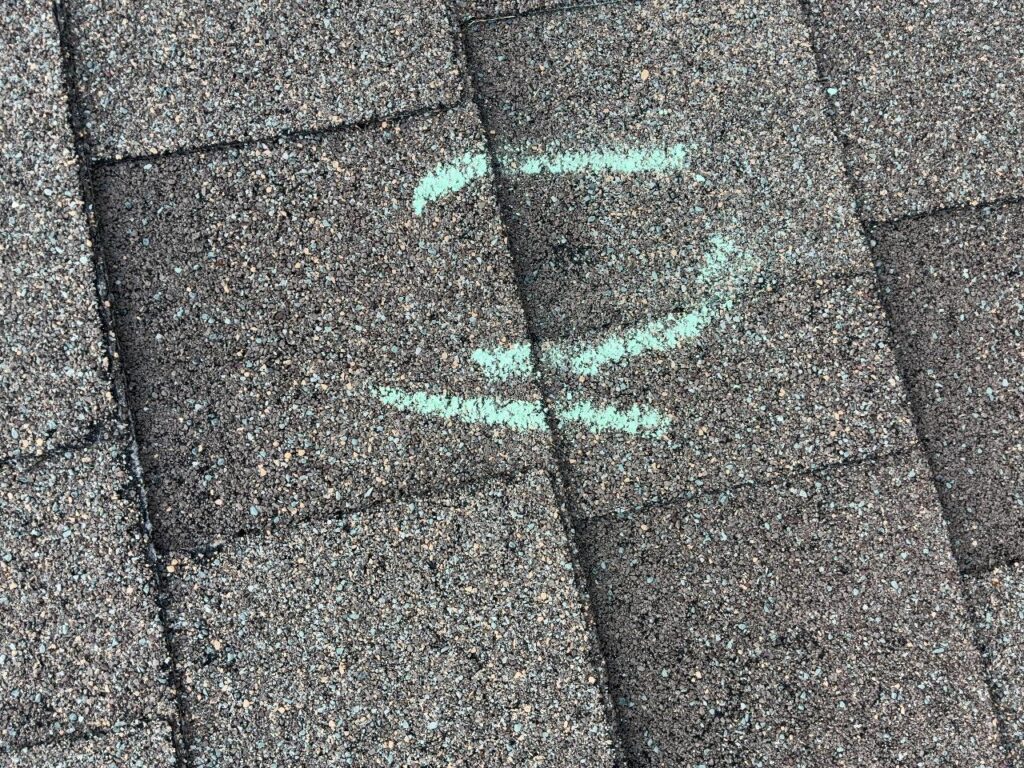
  • Granule displacement and loss. Protective ceramic granules knocked off at the point of impact, exposing darker asphalt. Fresh impacts look like small, dark, roughly circular spots scattered with no pattern.
  • Bruising. A soft spot that gives slightly under pressure, like a bruise on fruit. The surface can look nearly normal while the mat underneath is crushed.
  • A fractured reinforcement mat. In harder impacts the fiberglass mat inside the shingle cracks. This is the failure that shortens the shingle's life, and it is frequently invisible from a distance.
  • Exposed asphalt. Where granules are gone, UV reaches the asphalt directly and that spot ages faster from then on.
  • Creased or torn shingles usually point to wind rather than hail. Both can be present after a storm like this one.

Some granule loss is ordinary aging rather than storm damage — our guide on roof granule loss covers the difference.

Metal roofing

  • Dents and dimpling across panels, most visible in raking light early or late in the day.
  • Cosmetic versus functional damage is the central question here. A dent that does not breach the coating or compromise water-shedding may be treated as cosmetic, and many policies handle cosmetic metal damage differently through an exclusion or endorsement. Your policy language controls that, not the roofer.
  • Seams, fasteners and clips. Impacts near a seam or exposed fastener can loosen the assembly or distort the panel where it matters.
  • Flashing and trim. Ridge caps, valleys, headwall and sidewall flashing and pipe collars are thinner and take impact first.
  • Coating damage. A fractured or chipped factory finish gives corrosion a place to start on a steel substrate.

Our walkthrough of hail damage on a metal roof goes deeper on that cosmetic-versus-functional line.

Tile roofing

  • Cracked or broken tiles, most often field tiles that take a direct hit, plus ridge and hip pieces.
  • Hidden hairline fractures that do not show until the tile is lifted or water finds them.
  • Underlayment damage beneath the tile, which is the actual waterproofing layer on most tile systems.
  • Damage caused by the inspection itself. Tile is walked in specific places, in specific ways. An untrained person on a tile roof will reliably break more tiles than the hail did.

If you have tile, see our tile roof repair guide before anyone sets foot up there.

TPO and other flat / low-slope roofs

  • Punctures through the membrane, sometimes very small and very hard to find.
  • Membrane bruising and scuffing, where impact damages the membrane or crushes the insulation board beneath without leaving a visible hole.
  • Seam and flashing damage at parapets, curbs, drains and penetrations — where most low-slope roofs fail first anyway.
  • Rooftop accessory impacts: HVAC units and fins, condenser coils, vents, skylights, pipe boots and drain covers.

More detail in our guide to hail damage on TPO roofing.

Collateral damage you can check from the ground

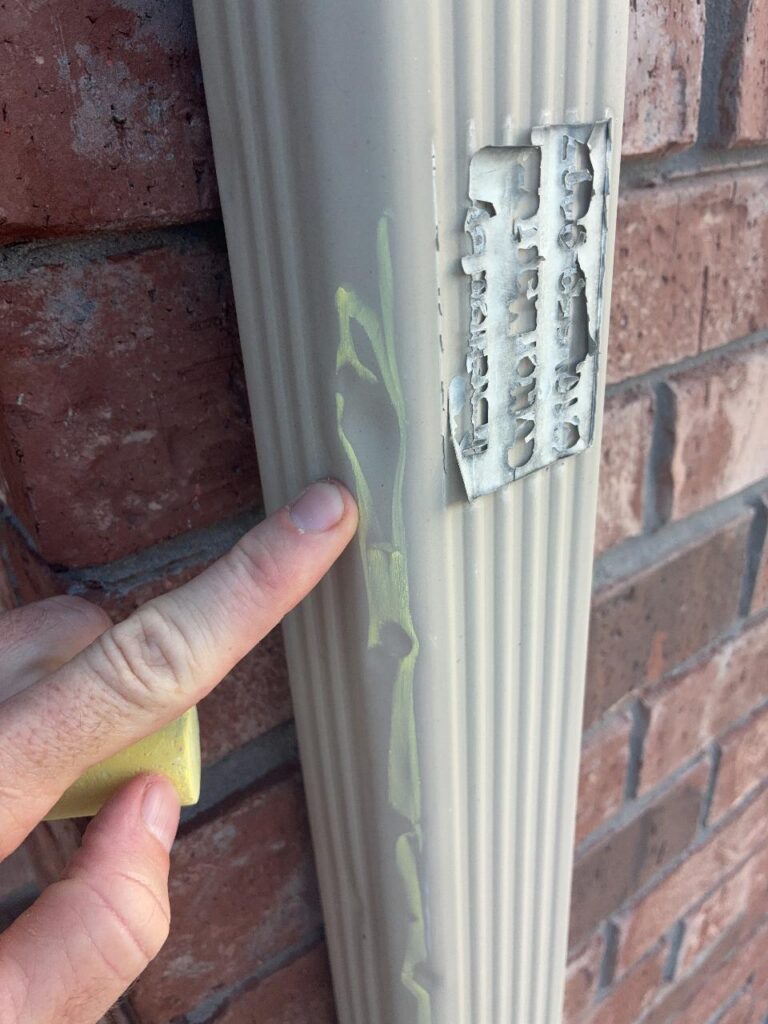
Soft metal and thin plastic dent before shingles fail, which makes them a useful early read on whether damaging hail actually fell at your address: gutters and downspouts, gutter aprons and drip edge, metal roof vents, turbines and pipe collars, window screens, air-conditioner condenser fins, fence caps, mailboxes, grills and light fixtures — and any vehicle parked outside. The same storm that dents a hood is capable of bruising a shingle.
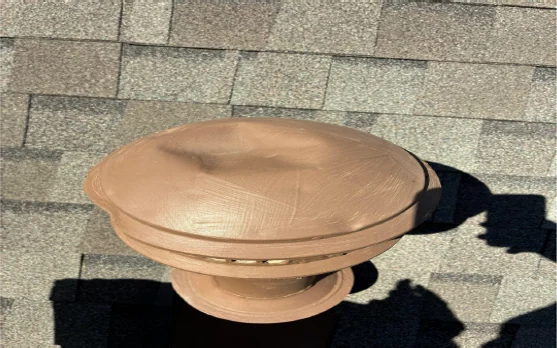
Dented metal roof exhaust vent cap from a hail impact
A direct hail strike on a roof exhaust vent cap. Soft metal like this deforms before a shingle fails, which is why vents, gutters and screens are the first things worth looking at. Photographed during a Driftwood Builders Roofing inspection in Central Texas in May 2026 — an illustrative example, not a photograph of September 11, 2026 Converse storm damage.
Please do not climb on your roof to look for hail damage. Falls from roofs are the most serious injury risk in this entire process, storm debris and granule loss make a roof unusually slick, and walking an impacted roof can cause damage that was not there before — particularly on tile, aging shingles and low-slope membranes. Everything a homeowner usefully needs to see can be seen from the ground or from inside the attic. Our guide on spotting hail damage without climbing shows how.

Nick Riley walks a real hail-damaged Austin roof in the video above and points out the three signs that come up most often on an inspection — granule loss and bruising on the shingles themselves, and dents on the soft metals like vents, flashing, gutters and downspouts. If you are trying to make sense of what you are seeing from your driveway in Converse this week, it is a useful four minutes: the same damage patterns apply regardless of which side of San Antonio you live on.

What Should I Do After the Converse Hailstorm?

A practical order of operations. Steps 1 through 5 cost you nothing and commit you to nothing.

  1. Photograph obvious exterior damage, safely, from the ground. Wide shots of each elevation plus close-ups of anything dented or torn. Include something for scale where you can.
  2. Check ceilings, upstairs rooms and the attic for leaks or staining. A flashlight in the attic looking for daylight, damp decking or wet insulation tells you more than anything you could see from outside.
  3. Photograph collateral damage. Gutters, downspouts, screens, vents, AC fins, fencing and any vehicles that were parked outside. Date-stamped phone photos are fine.
  4. Do not climb onto the roof. See the warning above. This is the step people skip and regret.
  5. Schedule a professional roof inspection. Someone should get on the roof who knows how to walk it safely and what a hail impact actually looks like on your specific material.
  6. Read your policy — specifically the declarations page. Find your wind/hail deductible, whether your roof is covered on a replacement-cost or actual-cash-value basis, and whether any roof-surface or cosmetic-damage endorsement applies. Your agent can walk you through it.
  7. Decide whether what was documented looks significant enough to warrant contacting your insurer. This is the decision point, and it belongs to you — informed by what the inspection actually found and what your policy actually says.
  8. If you file, document everything. Keep your photos, the inspection report, the date and time of every call, and the name of everyone you speak with. The Texas Department of Insurance recommends exactly this.
  9. Be available for the adjuster's inspection. TDI advises homeowners to be present so nothing gets missed. Your roofing contractor can be there too, to point out the physical conditions they documented.
  10. Compare the insurer's scope with the contractor's construction scope. They are two different documents written for two different purposes. More on that below.
  11. Complete the repair or replacement if the inspection and your coverage support it — and keep the paperwork, including proof that you paid your deductible.
An inspection does not obligate you to file a claim. It is a fact-finding step. Plenty of roofs inside a hail swath come through with cosmetic marks and years of service life left, and plenty of homeowners look at a small documented loss against a large deductible and reasonably decide not to file. Knowing which situation you are in is the entire point.
Schedule a Converse hail-damage roof inspection. We will get on the roof, document what is actually there with photographs, and tell you plainly what we see: whether there is observable storm damage, roughly how severe it looks, and whether repair or replacement is the sensible conversation. You will have enough information to decide for yourself whether contacting your insurer makes sense. Request an inspection — and no, scheduling one does not mean you have to file a claim.

Should I File an Insurance Claim for Hail Damage?

Not automatically, and not because a map put your street inside a colored band.

The Texas Department of Insurance advises homeowners to file a claim as soon as they can if hail or strong winds damaged the home. That conditional is the whole point, and an inspection is how you find out whether it is met. Filing first and finding out afterward puts a claim on your record before you know whether there is anything to claim.

Once you know what the roof actually looks like, the things that reasonably bear on the decision are:

  • Your deductible against the likely scope. A percentage wind/hail deductible is often larger than homeowners expect. If documented damage is limited and the deductible is high, the arithmetic may answer the question on its own.
  • Functional or cosmetic. A fractured shingle mat and a scuffed metal panel are different problems with different coverage implications.
  • Whether it is repairable. Damage on one slope is a different conversation than impacts across every elevation.
  • Roof age and existing condition. Age alone does not disqualify a claim, but it affects depreciation and can affect how the loss is settled.
  • Your policy's terms. Replacement cost versus actual cash value, roof-surface endorsements, cosmetic-damage exclusions and matching provisions all live in your policy, not in general advice.
  • Your claim history — a conversation for your agent, not a contractor.

We are not going to tell you to file, and not going to tell you not to. Coverage decisions are made by your insurer under your policy. Your agent, and where appropriate a licensed public insurance adjuster or an attorney, are the people qualified to advise you on coverage.

What a roofing contractor can and cannot do in Texas. Driftwood Builders Roofing is a roofing contractor, not a public insurance adjuster. Under Texas law a contractor who is doing the work cannot also act as your public adjuster on the claim, and cannot advertise that it will handle your insurance claim (Texas Insurance Code §4102.163).

What we can do: inspect the roofing system, photograph and document the physical conditions we observe, prepare a roofing estimate and a construction scope of work, meet your adjuster at the property, point out the observable physical conditions we documented, explain the scope we propose and why, and perform the approved roofing work.

What we cannot do: interpret your policy, determine what is covered, represent you in your claim, or negotiate your claim or its value with your insurer. Those belong to you, your insurer, your agent, and if you choose, a licensed public adjuster or attorney.

How Does a Roof Hail Insurance Claim Work in Texas?

The mechanics are fairly consistent from carrier to carrier, even though the outcomes are not.

Step 1 — Report the loss

You contact your insurer or agent and report a hail loss, with the date of the storm — September 11, 2026 for this event. Have your documentation and your inspection findings ready. You will be given a claim number and assigned an adjuster.

Step 2 — The adjuster's inspection

The insurance company's adjuster comes to the property and inspects the roof and exterior. TDI advises homeowners to be present so nothing gets overlooked. Your roofing contractor can also be present to point out the physical conditions they documented and to explain the construction scope they have proposed. That is a factual exchange about the building, not a negotiation about coverage.

Step 3 — Coverage decision and the insurer's estimate

The carrier decides whether the loss is covered and, if so, produces its own estimate of the work. That estimate is written on the insurer's terms, with its own pricing database, line items and depreciation. Read it carefully. If you disagree with the decision, TDI publishes guidance on your options.

Step 4 — The contractor's construction scope

Separately, your roofing contractor produces a construction scope: what actually has to be built, in what sequence, to leave you with a correct roofing system that meets current code and the manufacturer's installation requirements. This is a building document, not a coverage opinion.

Step 5 — Repair or replacement

Work proceeds once you have made your decisions and signed a contract. You pay your deductible — always, in Texas, and you should keep proof that you did. Your insurer may ask for it.

Step 6 — Recoverable depreciation, if your policy provides it

On a replacement-cost policy, the portion withheld as depreciation is typically released after the work is completed and documented, subject to your policy's terms and its deadlines. See the RCV and ACV section below.

If you have received a letter from your carrier telling you the roof needs to be replaced, our guide on what to do after an insurance roof replacement letter in Texas covers that specific situation. For the general process, see how the roof insurance claim process works.

This longer video is the one to watch if you are weighing whether to file at all. It walks through what Texas homeowners commonly get wrong about roof coverage: what carriers actually evaluate, why approval is never automatic, and how roof age, policy terms and the cause of damage all feed into the outcome. For a Converse homeowner sitting on a pile of storm photos and an unread declarations page, it is a good primer before you pick up the phone.

How Does My Wind/Hail Deductible Work?

Most Texas homeowners policies carry a separate wind and hail deductible, and it is usually expressed as a percentage rather than a flat dollar amount. That percentage is typically applied to the applicable policy limit — most often Coverage A, the dwelling limit — not to the cost of your roof.

A simple example:

Coverage A (dwelling limit)$400,000
Wind/hail deductible2%
Your deductible on this claim$8,000

The mistake worth avoiding: assuming the 2% applies to the roof price. If a contractor quotes $18,000 for the replacement, the deductible in this example is still $8,000 — 2% of the dwelling limit — not 2% of $18,000.

Your declarations page is where the real numbers are. Percentages commonly run from 1% to 5%, some policies carry a flat wind/hail deductible instead, and some have separate deductibles for different perils. Your policy terms control. If the declarations page is not clear to you, your agent can confirm which limit the percentage applies to.

Can a Texas Roofer Waive My Deductible?

No. It is illegal in Texas, for the roofer and potentially for the homeowner who goes along with it.

Texas law prohibits a contractor from offering to waive, rebate, absorb or otherwise cover any part of an insured's deductible. The Texas Department of Insurance states it plainly: "It's also illegal in Texas for a contractor to offer to waive, rebate, or absorb a property policyholder's deductible." The prohibition sits in Texas Business and Commerce Code §27.02 and Texas Insurance Code Chapter 707.

Chapter 707 also requires the policyholder to pay the deductible and allows the insurer to ask for proof that it was paid — a receipt or a canceled check. Contracts of $1,000 or more that involve an insurance settlement must carry a notice saying the policyholder has to pay the deductible. Under the 2019 law (House Bill 2102), violations can carry a fine of up to $2,000 and up to six months in jail.

Red flag: a roofer who offers to "eat," waive, rebate, discount or otherwise cover your insurance deductible is offering to break the law — and is telling you something about how they will treat every other commitment in your contract. The same goes for inflating an estimate to bury the deductible inside it. The Texas Attorney General's consumer protection hotline is 800-621-0508.

There is a second rule worth knowing while you are here. Under Texas Insurance Code §4102.163, a roofer who is doing the work cannot act as your public insurance adjuster on the claim, and per TDI, "contractors can't advertise that they'll handle your insurance claim." Any roofing company that tells you it will negotiate your claim, get your roof approved or fight your insurance company for you is describing something Texas does not permit it to do.

What Does RCV vs. ACV Mean?

Two terms that decide how much money actually reaches you, and in how many pieces.

  • Replacement Cost Value (RCV) — what it costs today to replace the damaged property with new material of like kind and quality.
  • Actual Cash Value (ACV) — replacement cost minus depreciation for the age, wear and remaining life of what was damaged.
  • Depreciation — the value subtracted for that age and wear.
  • Recoverable depreciation — on a replacement-cost policy, the withheld depreciation that can be released to you after the work is completed and documented, within your policy's deadlines.

A hypothetical, using the $8,000 deductible from the section above:

Replacement cost of the roof scope (RCV)$18,000
Depreciation withheld− $5,000
Actual cash value (ACV)$13,000
Less your deductible− $8,000
First payment to you$5,000
Recoverable depreciation released after completion$5,000
Total paid by the insurer$10,000
Your out-of-pocket$8,000 — your deductible

On an actual cash value policy, that withheld $5,000 is not recoverable. The insurer's payment stops at $5,000 and the remaining $13,000 is yours to fund. This is the single biggest reason to read your declarations page before a storm rather than after one.

These figures are illustrative. Real numbers depend on your policy, the scope of the loss, the age and material of your roof, and the carrier's own estimating practices. Your policy terms control, and your insurer and agent are the ones who can tell you how yours will be settled.

How Long Should a Texas Hail Claim Take?

Texas sets statutory deadlines for insurers, and the Texas Department of Insurance publishes them for consumers:

  • 15 business days to acknowledge that it has received your claim.
  • 15 business days after receiving everything it needs from you to decide whether it will pay.
  • That decision deadline can be extended by 45 days if the company tells you why it needs more time.

Read those as the framework, not as a promise about your claim. Circumstances vary, additional extensions can apply after a widespread weather catastrophe, and the clock on the decision deadline depends on when the insurer has received everything it asked for — which is one practical reason to send requested documentation promptly and keep a record of when you sent it.

Your own policy may also impose requirements on you, including how quickly you must report a loss and cooperate with the investigation. Those are in the policy, and they matter. If you believe your insurer is missing its deadlines, TDI's help line is 800-252-3439.

Does Hail Damage Mean I Need a Full Roof Replacement?

No. Plenty of hail-damaged roofs are repaired, and plenty of roofs inside a hail swath need nothing at all.

What actually drives the answer:

  • How much of the roof is affected, and how many slopes. Impacts confined to one elevation are a very different job than impacts on all four.
  • Roof age and remaining service life. Repairing a roof with two years left is usually money spent twice.
  • Whether the damage is functional. Cosmetic marks on a sound shingle are not the same as a fractured mat.
  • Shingle brittleness. Older asphalt shingles crack when lifted. On a brittle roof, a repair can create more damage around the repair area than it fixes.
  • Whether the material can still be matched. Discontinued lines, changed color formulations and weathered existing shingles all make a seamless repair harder. Matching is also a policy question on the coverage side — check your policy.
  • Previous repairs and existing deterioration. A roof already patched in several places is a poor candidate for another patch.
  • Decking condition. If the substrate under the damaged area is deteriorated, the scope grows regardless of the hail.
  • The economics of repeating the repair. Three repairs over four years usually costs more than one replacement, and leaves you with an old roof either way.
  • The roofing material itself. Tile and metal are often more repairable in isolated areas than an aging asphalt field.

Our full comparison is here: roof repair vs. replacement — which saves you more. If you are replacing anyway, this is also the moment to ask about Class 4 impact-resistant shingles, which perform differently in hail and may qualify for a premium discount with some carriers.

This is the longest video in our library on the repair-versus-replacement decision, and it is the closest thing to sitting through the conversation we have with homeowners on the roof. It covers how age changes the math, when damage genuinely can be repaired, and the signs that point toward replacement. Worth watching before you decide what to ask a contractor for.

What if the Insurance Estimate and the Contractor's Estimate Differ?

They frequently do, and it usually is not because someone is wrong. They are two documents answering two different questions.

The insurer's estimate answers: what does the carrier consider covered, at its pricing, for the damage its adjuster identified. The contractor's construction scope answers: what has to be built to leave you with a correct, code-compliant roofing system.

Common reasons a construction scope contains things an insurance estimate does not:

  • Different quantities. Measurements, waste factors, slope and complexity are calculated differently.
  • Code-required work. Current building code may require components the old roof did not have — ice and water barrier in certain locations, drip edge, specific fastening patterns.
  • Flashing details. Step, counter, headwall, sidewall, valley and chimney flashing that has to be replaced rather than reused.
  • Ventilation components. Intake and exhaust that have to be replaced or corrected as part of a compliant system.
  • Decking. Deteriorated sheathing found at tear-off, which by definition nobody could see during the inspection.
  • Accessories. Pipe boots, vents, ridge caps, starter and other components that are not reusable.
  • Manufacturer requirements. Installation specifications that must be met for the warranty to be valid.

What we do about it is narrow and specific: we document the physical conditions we observed, we write out the construction scope we propose, and we explain what each line is for and why we believe the building requires it. That is a conversation about the roof.

What we do not do is negotiate your claim, argue coverage, or represent you to your insurer. Coverage decisions remain the insurer's, under your policy. If you want someone to advocate for you on coverage, that is a licensed public insurance adjuster or an attorney — and by Texas law it cannot be the contractor doing the work. If you disagree with your carrier's decision, TDI publishes guidance on the options available to you, including appraisal, complaint and mediation routes depending on your policy.

Be Careful With Storm Chasers After the Converse Hailstorm

Large hail events draw out-of-area crews. Some are perfectly legitimate. Some are not, and the storm-chasing pattern is recognizable enough to be worth a few minutes of your attention before you sign anything.

Things worth slowing down for:

  • High-pressure door knocking, particularly a demand for a signature during the first conversation.
  • Any offer to waive, absorb or rebate your deductible. Illegal in Texas. This one is disqualifying on its own.
  • "Free roof" promises and guarantees that insurance will approve a full replacement. No contractor can guarantee a coverage decision, because no contractor makes it.
  • Claiming they will handle, file or negotiate your claim. Texas does not allow the contractor doing the work to act as your public adjuster, and TDI says contractors cannot advertise that they will handle your claim.
  • Vague contracts — blank spaces, no scope of work, no materials specified, no price, or a document that is actually an assignment of your claim rights.
  • No verifiable local history. A local address, a real office, permits pulled in this jurisdiction, a track record you can check.
  • No references and no recent local projects they can point you to.
  • No workmanship warranty, or a warranty from an entity that will not exist next hail season.
  • Large upfront payments. TDI advises not paying in full up front and not making the final payment until the work is done.
  • Pretending to be an adjuster, or implying they work with or for your insurance company.

None of this means an out-of-town company is automatically bad or a local one automatically good. It means the checks are the same checks you would run before any five-figure decision: read the contract, verify the company, get more than one bid, and never sign a document with blank spaces in it. Our longer write-up on storm chaser red flags goes through the pattern in detail.

Frequently Asked Questions

Did Converse, TX get hail on September 11, 2026?

Yes. The National Weather Service Austin/San Antonio office logged five hail reports and one measured wind gust in eastern Bexar County between 9:59 p.m. and 10:20 p.m. CDT that night, covering Converse, the Paloma area, Kirby, China Grove and Saint Hedwig.

How large was the hail in Converse?

Reported sizes ranged from about 1 inch to roughly 2.5 inches. The largest report, about three miles southeast of Converse at 9:59 p.m., described hail in the 2 to 2.5 inch range based on social-media photographs. The Weather Service listed that size as estimated.

Where did the largest hail fall?

About three miles southeast of Converse, at 9:59 p.m. The Weather Service noted that the location and timing were estimated from archived radar showing the strongest hail signatures within Converse, so it marks a general area rather than a precise point.

Was Paloma hit by hail?

The Weather Service received a report of dime to golf-ball sized hail in the Paloma subdivision between roughly 10:05 and 10:15 p.m., logged at 1.75 inches and tagged as measured. Paloma is the only subdivision NWS named for this storm. That does not mean every home in Paloma was damaged.

Can golf-ball-sized hail damage a roof?

It can. Hail around 1.75 inches is capable of fracturing asphalt shingle mats, denting soft metals and cracking tile. Whether it did depends on hail density, wind direction, your roofing material and its age, slope orientation, tree cover and the roof’s prior condition.

Can 2-inch or 2.5-inch hail damage shingles?

Hail that size is well above the threshold where functional shingle damage becomes likely, and large enough to break automobile glass, which was reported in Converse. It is still not automatic: roofs on the same street can differ depending on which slopes faced the storm and how worn the shingles already were.

How can I tell if my roof has hail damage?

From the ground, look for dents in gutters, downspouts, metal vents, window screens and air-conditioner fins, and dark spots on shingles where granules were knocked off. Inside, check the attic and upstairs ceilings for damp decking, daylight or staining. A definitive answer needs someone on the roof who knows what hail bruising looks like on your material.

Can hail damage be invisible from the ground?

Yes, and it is the most common misunderstanding after a storm. Bruising — a crushed shingle mat under a surface that still looks normal — and hairline fractures in tile are often undetectable from the driveway. A roof can look fine from the street and still have a shortened service life.

Should I climb on my roof after a hailstorm?

No. Falls are the most serious risk in this process, loose granules make a storm-hit roof unusually slick, and walking an impacted roof can create damage that was not there before, especially on tile, aging shingles and low-slope membranes. Everything a homeowner needs to see can be seen from the ground or the attic.

Should I call a roofer before filing an insurance claim?

Having a professional inspection first is usually the more informed order. It tells you whether there is documented damage, how severe it looks, and whether repair or replacement is the realistic conversation — all things you would otherwise be guessing at when you call your insurer.

Should I automatically file an insurance claim after hail?

No. The Texas Department of Insurance advises filing promptly if hail damaged your home, and an inspection is how you find out whether it did. If documented damage is limited and your wind/hail deductible is large, the arithmetic may answer the question. The decision is yours, ideally made with your agent.

How much is my hail deductible?

Check your declarations page. Texas wind/hail deductibles are usually a percentage, commonly 1% to 5%, applied to the applicable policy limit — most often Coverage A. On a $400,000 Coverage A limit, a 2% deductible is $8,000. It is not a percentage of what the roof costs. Your policy terms control.

Can a roofer pay my deductible in Texas?

No. It is illegal for a contractor to offer to waive, rebate or absorb a policyholder’s deductible, under Texas Business and Commerce Code §27.02 and Texas Insurance Code Chapter 707. Violations can carry a fine of up to $2,000 and up to six months in jail. A roofer who offers this is a major red flag.

What does ACV mean?

Actual Cash Value — replacement cost minus depreciation for age, wear and remaining useful life. On an ACV policy that depreciation is not recoverable, so the homeowner funds the gap between the payment and the actual cost of the work.

What does RCV mean?

Replacement Cost Value — what it costs today to replace the damaged property with new material of like kind and quality, before depreciation is subtracted.

What is recoverable depreciation?

On a replacement-cost policy, the insurer typically pays actual cash value first and withholds the depreciation. Once the work is completed and documented, that withheld amount can be released, subject to the policy’s terms and deadlines. On an actual cash value policy there is normally nothing to recover.

Does hail damage automatically mean roof replacement?

No. Many hail-damaged roofs are repaired, and many roofs inside a hail swath need nothing. It turns on how many slopes are affected, roof age and remaining life, whether the damage is functional or cosmetic, shingle brittleness, whether the material can be matched, and the condition of the decking.

Can hail damage a metal roof?

Yes. Hail can dent panels, fracture the factory coating, distort panels near seams and fasteners, and damage flashing and trim. The key question is usually whether the damage is cosmetic or functional, and many policies treat cosmetic metal damage differently through an exclusion or endorsement. Your policy language decides that.

Can hail crack a tile roof?

Yes — field, ridge and hip tiles can crack or shatter, and hairline fractures may only show up later. The bigger risk on tile is often the inspection itself: walking a tile roof incorrectly breaks more tiles than the hail did, which is why it should only be walked by someone trained on it.

Can hail damage a TPO roof?

Yes. Hail can puncture the membrane, bruise it or crush the insulation board beneath without leaving an obvious hole, and damage seams and flashings at parapets, curbs, drains and penetrations. Rooftop equipment, vents and skylights are often hit first.

Should my roofer attend the insurance adjuster inspection?

It is generally useful. A contractor can be present to point out the physical conditions they documented and explain the construction scope they proposed — a factual conversation about the building. In Texas, a contractor doing the work cannot act as your public adjuster or negotiate the claim for you.

What if the insurance estimate is different from the contractor’s estimate?

Common, and usually two documents answering different questions. A construction scope may include code-required components, flashing details, ventilation, decking found at tear-off and manufacturer installation requirements an insurance estimate did not list. A contractor can document and explain its own scope. Coverage decisions remain with the insurer.

How quickly should I have my roof inspected after hail?

Reasonably soon. Waiting makes it harder to tie damage to a specific storm date, undocumented damage can let water in during the next rain, and most policies require prompt reporting of a loss. There is no need to decide anything on the spot, but there is a reason not to leave it for months.

Does an older roof affect an insurance claim?

It can. Age does not automatically disqualify a claim, but it affects depreciation, and some policies settle older roofs on an actual cash value basis or apply a roof-surface endorsement. Existing wear also makes it harder to separate storm damage from ordinary deterioration. Your policy language holds the answer.

How do I avoid hail-storm roofing scams?

Refuse any offer to waive or absorb your deductible — that is illegal in Texas. Do not sign at the door, never sign a contract with blank spaces, get more than one bid, verify the company has a real local presence and history, confirm the workmanship warranty, and do not pay in full up front.

Was there a severe thunderstorm warning for Converse on September 11, 2026?

Yes. The National Weather Service Austin/San Antonio office issued Severe Thunderstorm Warning number 0170 for central Bexar County at 10:10 p.m. CDT, valid until 11:15 p.m. It was upgraded at 10:12 p.m. from radar-indicated half-dollar hail to golf ball hail based on public reports, and it was cancelled early, at 10:45 p.m. Converse, Kirby, Schertz, Cibolo, Universal City, Live Oak, Randolph AFB, Saint Hedwig and China Grove were all named in the warning text.

How long did the hail last in Converse?

The reported hail falls in a window of about twenty minutes. Every Local Storm Report from that night is timestamped between 9:59 p.m. and 10:20 p.m. CDT. By 10:25 p.m. the storm had tracked southwest toward China Grove with the stated hazard down to quarter-size hail, and the warning was cancelled at 10:45 p.m. A short hail event can still cause a full roof replacement; duration is not a good proxy for damage.

Did Converse lose power during the September 11 hailstorm?

Yes. KENS 5 reported that CPS Energy had more than 8,000 customers without power that Friday night, with about 4,600 of those on the east side around Kirby and Converse. Outages were down to fewer than 2,000 by 11 p.m. Quick restoration points to wind and debris on power lines rather than widespread structural damage, so it says nothing either way about whether an individual roof was damaged.

About Driftwood Builders Roofing

Driftwood Builders Roofing is a Central Texas roofing company with roughly two decades of history and thousands of completed projects across the region. We are a GAF Master Elite contractor, a certification held by a small percentage of roofing contractors nationally.

We do roof repairs and full roof replacements in asphalt shingle, standing seam metal, tile and flat/TPO systems, along with storm-damage inspections. On the Converse and eastern Bexar County side of the metro, most of what we see is builder-grade asphalt shingle on homes built in the 1990s and 2000s — roofs now well into the second half of their service life, where hail exposure and existing wear interact in ways that are worth having a professional look at rather than guessing about.

What we are not is an insurance adjuster. We inspect roofs, document conditions, write construction scopes and build roofing systems. Coverage is between you and your carrier.

Get a Converse hail-damage roof inspection. If your home is in or near the September 11 hail swath — Converse, Paloma, the I-10 East corridor, Kirby, China Grove, St. Hedwig or anywhere in eastern Bexar County — we will document what is actually on your roof and give you a straight read on whether it is repair, replacement or nothing at all. That gives you what you need to decide, with your agent, whether a claim makes sense.

Schedule an inspection  ·  Roofing services in Converse, TX

Scheduling an inspection does not obligate you to file an insurance claim, and it does not obligate you to hire us.

More Converse Roofing Guides

This page covers the storm itself. These cover the decisions that follow it, written for Converse specifically rather than adapted from generic advice.

Sources

Storm data: National Weather Service Austin/San Antonio, preliminary Local Storm Reports issued September 11–12, 2026 (product NWUS54 KEWX). Reports and remarks quoted above are from those products. NWS Austin/San Antonio.

Insurance law and consumer guidance: Texas Department of Insurance — Roofing and insurance: Know the law; Hail damage to your home or car? What to do next; Insurance companies must meet deadlines to respond to Texas claims; Public adjusters: What to know before you hire one; New state law cracks down on roof scams.

Statutes: Texas Insurance Code Chapter 707 (payment of insurance deductible); Texas Business and Commerce Code §27.02; Texas Insurance Code §4102.163.

Warning timeline: National Weather Service Austin/San Antonio, Severe Thunderstorm Warning 0170 and the accompanying Severe Weather Statements, issued September 11–12, 2026 (products WUUS54 KEWX and WWUS54 KEWX). Times, hazard wording and named locations quoted above are taken from those products.

Power outage figures: Marcus Risen, “Power outages in San Antonio area amid Friday night storms,” KENS 5, September 11, 2026, reporting CPS Energy figures.

This article is general information for Central Texas homeowners. It is not legal advice, insurance advice, or a coverage opinion. Your policy terms control what is and is not covered.

Driftwood Builders Roofing
AUTHOR

Author: Driftwood Builders Roofing

Driftwood Builders Roofing is a family-owned residential roofing company headquartered in Manchaca, Texas, serving Austin and the surrounding Hill Country since 2005. The company has delivered 3,700 full roof replacements and 783 repairs across 3,559 different customers over 20 years in business, with 97 years of combined construction experience across the leadership team and 74 years specifically inside Driftwood Builders. The company holds the highest contractor certifications offered by the major shingle manufacturers, including GAF Master Elite Contractor (the top 3% of GAF contractors nationally), GAF Certified Green Roofer, Owens Corning certified, TAMKO Pro Certified Contractor, and a Berridge Roof Installation Seminar Certificate for standing-seam metal roofs. Driftwood is an NRCA member, holds an Angie's List Super Service Award, is BBB Accredited, and is a GuildQuality member for verified customer satisfaction data. James Hardie certification covers the siding side of the business. Services include residential roof replacement, leak and storm-damage repair, tile roof repair, metal roofing, TPO commercial roofing, roof inspections, hail and storm damage inspections with insurance claim assistance, gutter work, and James Hardie siding. The customer-protection policy is straightforward: Only Pay Upon Completion. The company serves 22 cities across the Hill Country and Greater Austin and holds a 5-star rating across Google, GuildQuality, Angi, Nextdoor, Facebook, Thumbtack, and Yelp.

author avatar
Nicholas Riley

Leave a Comment

Your email address will not be published. Required fields are marked *

Scroll to Top