Replacing a Few Hardie Boards: How to Match Profile, Texture and Color
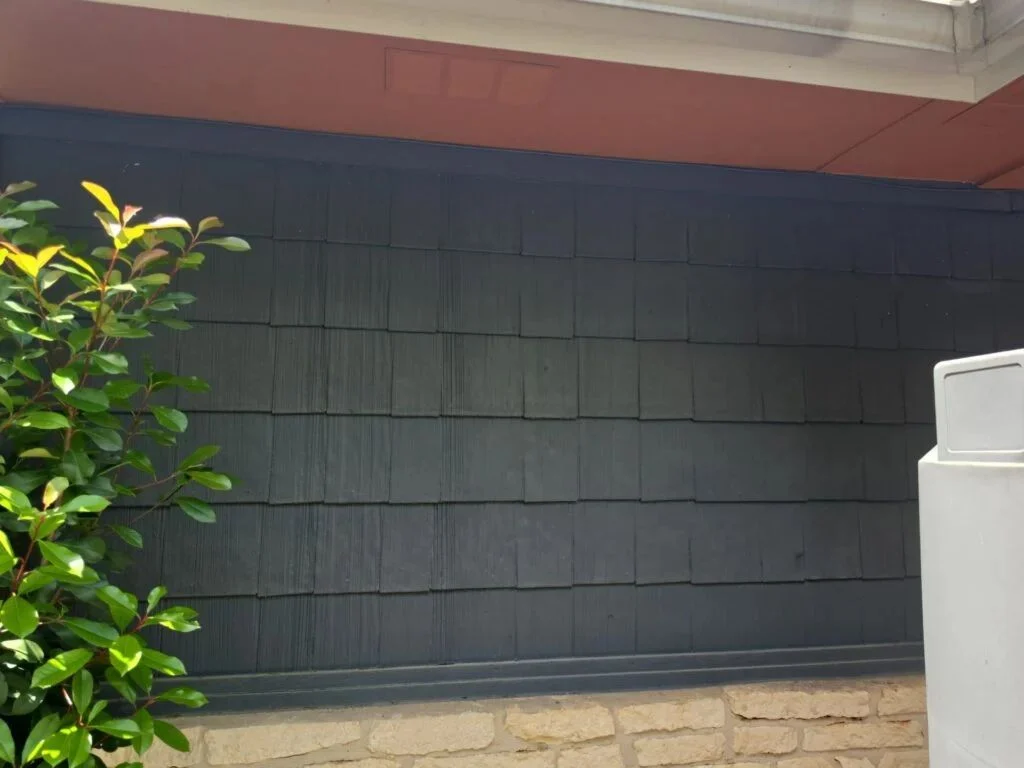
Step 1: Identify the Texture and Exposure
Before anyone orders boards, the existing siding has to be identified. Start by confirming it is James Hardie at all. Not every fiber cement or composite house is, and the original builder's paperwork or a past contractor's invoice can save guesswork.
Texture. James Hardie's HardiePlank installation instructions list these lap siding textures: Select Cedarmill, Smooth, Beaded Cedarmill, Beaded Smooth, Custom Colonial Smooth and Custom Colonial Roughsawn. The Cedarmill textures have a wood-grain look; the Smooth ones do not. A close-up photo in low-angle light shows the grain clearly.
Width and exposure. Lap boards overlap, so the part you see (the exposure) is narrower than the board. Hardie's instructions call for a minimum overlap of 1 1/4 inches, and their coverage chart pairs each board width with its exposure. Measure from the bottom edge of one course to the bottom edge of the next, then compare:
| Board width | Exposure |
|---|---|
| 5 1/4 in. | 4 in. |
| 6 1/4 in. | 5 in. |
| 7 1/4 in. | 6 in. |
| 8 1/4 in. | 7 in. |
| 9 1/4 in. | 8 in. |
| 12 in. | 10 3/4 in. |
The chart also lists 7 1/2, 8 and 9 1/2 inch widths. If your measurement does not land on a size in the chart, measure several courses and go by what is actually on the wall. The replacement boards have to be set to the same line as the existing ones.
Step 2: Primed and Painted, or ColorPlus?
James Hardie siding is either primed and painted on site, or factory-finished with ColorPlus Technology. The two are repaired differently, so this is the next thing to pin down. Records from the original install are the most reliable way to tell. If you have none, ask the contractor to check it during the inspection.
ColorPlus. Hardie's instructions say "James Hardie touch-up kits are required to touch-up ColorPlus products," that touch-up "should be used sparingly," and that if large areas need it, the area should be replaced with new ColorPlus siding. Hardie also says it does not warrant third-party touch-up paints on ColorPlus, and problems from them are not covered under the ColorPlus Limited Finish Warranty. It does not recommend caulking ColorPlus joints "as the Caulking and ColorPlus will weather differently." Hardie's FAQ notes that products and colors vary by region, so confirm the color is still offered where you live before planning a ColorPlus-only repair.
Primed and field-painted. New primed boards get painted to match the wall. Hardie says factory-primed products "must be painted within 180 days of installation," recommends 100% acrylic topcoats, and says not to use stain or oil or alkyd paint.
If a ColorPlus wall has already been repainted at some point, treat it like a field-painted wall. For repainting ColorPlus, Hardie says repriming "is normally not necessary." Our guide to painting James Hardie siding covers ColorPlus and field paint in more depth.
Step 3: Matching Paint on a Field-Painted Wall
Having the original color name or formula is a good start, but it is not the whole answer. Paint that has been on a sunny wall for years will not look the same as a fresh coat of the same color. A few practical ways to handle it:
- Match to the wall, not the label. A paint store can match a color from a sample. Ask the contractor to take it from an area near the repair, not from a protected spot under an eave.
- Test before committing. Paint a replacement board or a small area and look at it in daylight from where people actually see the wall.
- Paint to a natural break. If a new board still stands out, painting the whole wall section between two corners or trim boards hides the edge where old paint meets new.
- Watch the caulk lines. Hardie's instructions note that "field painting over caulking may produce a sheen difference" compared with painted primed siding, so a joint packed with caulk can catch the light differently.
When the Profile or Color Is Not Available
Older houses sometimes have a width, texture or ColorPlus color that is no longer stocked locally. When that happens, the choices are:
- Use a matching board from somewhere less visible. Sometimes a board from a hidden area, such as behind a fence or a shed, can be moved to the visible spot and the hidden spot filled with the closest current product. Whether this works depends on how the boards come off.
- Re-side a whole wall or elevation in a current product so the change lands at an outside corner, where a different texture or color reads as a deliberate break rather than a patch.
- Re-side the house, if other walls have problems too.
Our siding replacement cost guide explains when partial replacement pays off against full replacement, including when the existing product and color can still be matched.
A Few Boards, a Wall, or an Elevation?
| What you find | Usually the better-looking fix |
|---|---|
| Texture and width available, wall is field-painted | Replace the boards, then paint to match or to a natural break |
| ColorPlus, color still offered, small damage | Replace boards with the same ColorPlus color; Hardie touch-up for nicks |
| ColorPlus color no longer offered | Repaint the wall, or re-side the elevation |
| Texture or width no longer available | Re-side the wall or elevation to a corner |
| Damage on several walls, or water damage behind the boards | Look at the repair-or-replace question first |
The last row is a different question from matching. If boards are cracked, soft or loose in several places, see our guide to common siding problems and what is repairable and our article on siding cracking and nail pops before deciding how many boards to replace.
In the City of Austin, siding work up to 128 square feet is on the permit-exempt list. A larger repair or a whole-elevation re-side can go past that, so ask whether a permit is needed and who pulls it.
What a Careful Board Replacement Involves
A good match is wasted if the new boards are not installed to the same standard as the rest of the wall. Things to expect from the contractor:
- Careful removal. Hardie's preferred method is blind nailing, near the top of each board where the next course covers the nails. Getting a damaged board out means working under the course above without cracking it. Hardie's instructions refer installers to its Technical Bulletin 17 for a fastening exemption "when doing a repair."
- A look behind the board. Hardie requires a water-resistive barrier "appropriately installed with penetration and junction flashing." If the house wrap is torn or the sheathing is wet once the board is off, that needs attention before new siding covers it.
- Joints and cut edges done right. Hardie recommends joint flashing at butt joints and says to "caulk, paint or prime all field cut edges."
- Matching the course lines, so the new board's bottom edge and exposure line up exactly with the boards on either side.
Driftwood is a James Hardie Siding Contractor. We can identify what is on your wall, tell you honestly whether a few boards will blend in or whether a wall-level repair will look better, and quote it either way. Inspections and estimates are free. Start with our siding installation and repair page, or see our James Hardie siding cost guide if a larger section is likely.
Sources: James Hardie HardiePlank Lap Siding installation instructions (HZ10, effective December 2019), including the coverage chart and ColorPlus touch-up section; James Hardie, Frequently Asked Questions (jameshardie.com); City of Austin, Work Exempt from Building Permits; Driftwood Builders Roofing, Siding Replacement Cost in Austin.
Frequently Asked Questions
Can you replace just a few Hardie boards?
Yes, individual boards can be replaced without redoing the wall, as long as the boards around them and the barrier behind them are sound. The harder part is making the new boards match in texture, width and finish.
Why do my new siding boards not match?
The usual reasons are a different texture, a different board width or exposure, a different finish (ColorPlus versus field paint), or fresh paint next to paint that has weathered for years. Each one has a different fix, from repainting to a natural break to re-siding the elevation.
How do I find out what Hardie siding I have?
Check the original builder or contractor paperwork first. Otherwise, identify the texture from a close-up photo and measure the exposure from the bottom of one course to the bottom of the next, then compare it with the widths in James Hardie's coverage chart.
Can I touch up ColorPlus with regular paint?
James Hardie says its touch-up kits are required for ColorPlus, and it does not warrant third-party touch-up paints. Problems caused by them are not covered under the ColorPlus Limited Finish Warranty.
Do I need a permit to replace a few siding boards in Austin?
Siding work up to 128 square feet is on the City of Austin's permit-exempt list. Larger jobs fall outside it, so ask your contractor whether your project needs one.

Author: Driftwood Builders Roofing
Driftwood Builders Roofing is a family-owned residential roofing company headquartered in Manchaca, Texas, serving Austin and the surrounding Hill Country since 2005. The company has delivered 3,700 full roof replacements and 783 repairs across 3,559 different customers over 20 years in business, with 97 years of combined construction experience across the leadership team and 74 years specifically inside Driftwood Builders. The company holds the highest contractor certifications offered by the major shingle manufacturers, including GAF Master Elite Contractor (the top 3% of GAF contractors nationally), GAF Certified Green Roofer, Owens Corning certified, TAMKO Pro Certified Contractor, and a Berridge Roof Installation Seminar Certificate for standing-seam metal roofs. Driftwood is an NRCA member, holds an Angie's List Super Service Award, is BBB Accredited, and is a GuildQuality member for verified customer satisfaction data. James Hardie certification covers the siding side of the business. Services include residential roof replacement, leak and storm-damage repair, tile roof repair, metal roofing, TPO commercial roofing, roof inspections, hail and storm damage inspections with insurance claim assistance, gutter work, and James Hardie siding. The customer-protection policy is straightforward: Only Pay Upon Completion. The company serves 22 cities across the Hill Country and Greater Austin and holds a 5-star rating across Google, GuildQuality, Angi, Nextdoor, Facebook, Thumbtack, and Yelp.
