Rotting Wood or Cedar Siding: How to Tell How Bad It Is, and When to Re-Side
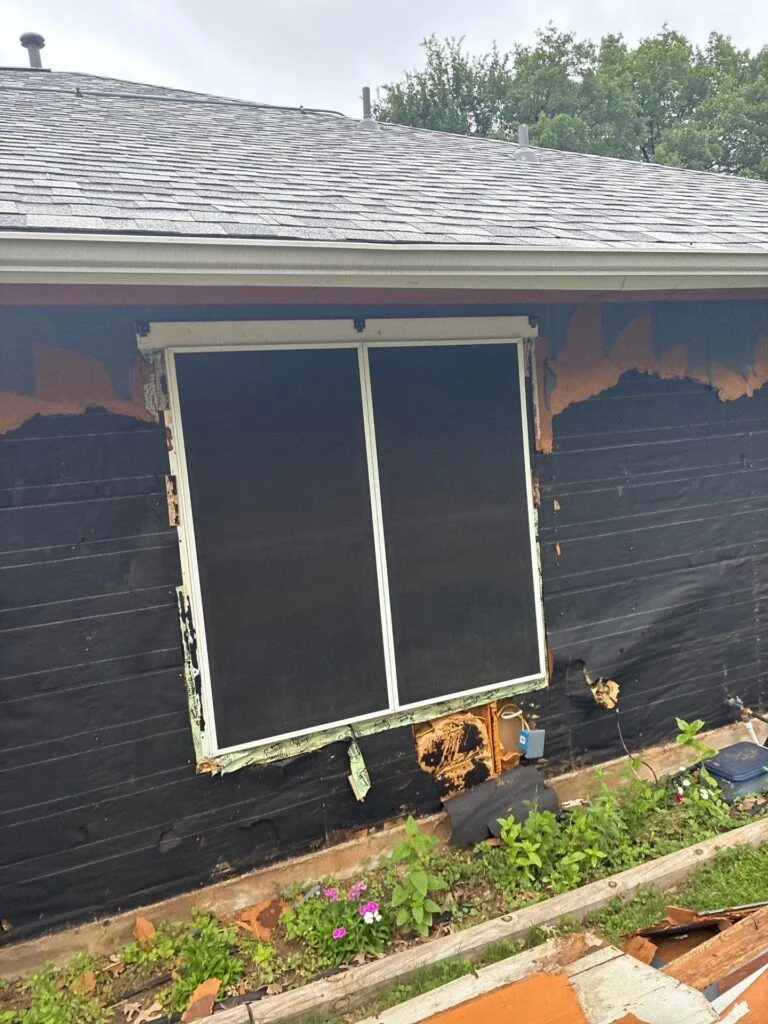
Why Wood Siding Rots
Rot is wood decay caused by fungi, and those fungi need water. The U.S. Forest Products Laboratory's Wood Handbook states that serious decay "occurs only when the moisture content of the wood is above the fiber saturation point," which it puts at an average of 30%. Humid air alone does not get wood that wet. It takes rain, condensation or contact with wet ground. The same handbook says fully air-dried wood usually sits at or below 20% moisture content, and that "wood will not decay if it is kept air dry, and decay already present from prior infection will not progress."
That is the most useful fact for a homeowner: rot is a symptom. Somewhere, water is reaching the wood and not drying out. Replace a rotted board without fixing that, and the new board sits in the same conditions. The Wood Handbook says the same about repairs: "every effort should be made to correct the moisture condition that led to the damage."
It also warns that wood with visible decay should be assumed to have lost much of its strength, so a slightly soft board can be worse than it looks.
Where Rot Starts on a House
Rot on siding rarely starts in the middle of a dry wall. It shows up where water collects, splashes or gets behind the boards. The Wood Handbook says the design and maintenance of walls and roofs are critical "particularly at roof edges and points where roofs interface with walls." On a typical house, check these spots first:
- Bottom courses near soil, mulch or a deck. Splash-back and wet ground keep the lowest boards damp. The Wood Handbook recommends 6 inches of clearance between soil and siding. Our guide to siding clearance requirements covers the gaps at grade, roofs and decks.
- Where a lower roof meets a wall. Water running off the end of a roof-to-wall joint can be sent behind the siding if there is no kickout flashing. See kickout flashing and siding rot.
- Under window and door corners. Window openings are breaks in the wall's water barrier. Rot that spreads down from a window corner often traces back to the flashing. See window and door trim rot.
- Butt joints, cut ends and the bottom edges of boards, where paint wears first and water can soak into end grain.
How to Check Your Siding
You can learn a lot from the ground without removing anything.
- Press test. Press firmly with your thumb along the bottom courses and around windows. Sound wood feels hard. Soft or spongy wood is a sign of decay. The Wood Handbook describes wood attacked by white-rot fungi as often feeling "spongy."
- Probe test. Gently push a screwdriver or awl into suspect spots. If it sinks in easily or the wood breaks up in small cubes or crumbles, that is advanced decay. The handbook notes that brown-rotted wood can "crack across the grain forming cube-like structures" and be crushed into powder.
- Look at the paint pattern. Peeling concentrated at seams, bottom edges and window corners points to moisture.
- Look inside. Stains or soft drywall below a window, or a musty smell in one room, can mean water is getting past the siding.
Surface rot vs deep rot
Not all soft wood is the same. The Wood Handbook describes a shallow kind of decay that mainly affects the outer surface, where the wood "may be firm immediately beneath the zone of decay." Heavily weathered, fissured wood often falls in this group. If your probe stops at a firm layer just below the surface, the damage may be shallow. If it goes through the board, or the board flexes when pressed, the rot is deep. Deep rot also raises the question of what is behind the board, because water that rots siding from the back has usually been sitting on the sheathing too. See what we find behind siding for examples.
When Rot Points to a Water-Management Problem
A single rotted board at a splash zone is usually a local issue. A pattern is different. Treat rot as a sign that the wall's water management has failed when you see:
- Rot in the same place on several walls, such as under every window, which points to how the openings were flashed.
- Rot that returns after a previous repair.
- Rot running down the wall below a roof-to-wall joint.
- Bottom courses that sit tight to soil, paving or a deck with no gap.
- Soft sheathing or wet house wrap found when a board is removed.
The building code addresses these points. The 2024 International Residential Code, which the City of Austin enforces, requires flashing at wall and roof intersections (R903.2.1) and at exterior window and door openings, and says "overlapped flashing shall be applied in shingle fashion" (R703.4), so each upper layer laps over the one below it. When siding rots because those details are missing, replacing boards alone will not fix it. The flashing, clearances and trim need correcting at the same time.
Repair the Boards or Re-Side?
There is no single answer, and repair is often the right one. These are the conditions that usually decide it:
| Condition | Points toward repairing boards | Points toward re-siding |
|---|---|---|
| Extent | A few boards in one area | Rot on several walls or elevations |
| Depth | Surface softness, firm wood beneath | Probe goes through; sheathing is soft |
| History | First repair in that spot | Same areas repaired before and failing again |
| Water source | Clear, fixable cause (a gutter, a sprinkler, soil against the wall) | Missing flashing or clearances across the house |
| Rest of the siding | Sound, holding paint | Weathered, split or due for a full repaint anyway |
Repairing wood siding in kind, with matching wood boards, primer and paint, is work a wood-siding specialist or carpenter does. Driftwood does not install or repair natural wood or cedar siding, so if the wood is mostly sound and you want to keep it, that is the right kind of contractor to call.
Re-siding makes more sense when problems are spread out or keep coming back, and it is the point where the water-resistive barrier, flashing and clearances can be redone as one system, rather than patched one board at a time.
In the City of Austin, the permit-exempt list covers siding work up to 128 square feet. A larger job falls outside that exemption, so ask your contractor whether a permit is needed and who will pull it.
Re-Siding With James Hardie Fiber Cement
Driftwood is a James Hardie Siding Contractor, and when rot has turned a repair into a re-side, fiber cement is what we install. James Hardie's HardiePlank installation instructions make the water-management details part of the job:
- "A water-resistive barrier is required in accordance with local building code requirements," and it "must be appropriately installed with penetration and junction flashing."
- "All clearance details in figs. 3-14 must be followed." In the December 2019 edition those include 6 inches between ground and siding, at least 1 inch above roofing, decks and paved surfaces, at least 1/4 inch above horizontal Z-flashing with the gap left uncaulked, and kickout flashing at roof-to-wall eaves.
- Field-cut edges must be caulked, painted or primed, and factory-primed boards "must be painted within 180 days of installation."
Those are the same weak points where wood siding rots, which is why a re-side is a chance to fix the cause and not just the cladding. If rotted sheathing turns up once the old siding comes off, it has to be dealt with before new siding goes on. Hardie's instructions say to correct irregularities in framing and sheathing first. A good quote explains how found damage is handled and gets your approval before extra work. Our siding replacement cost guide lists what a complete quote should include.
Cost. On that guide, natural wood (cedar, etc.) is listed at "$6 to $16/sq. ft. (general Austin-market range)," and fiber cement / James Hardie at "$16 to $25/sq. ft. (Driftwood's real, current installed pricing)." The wood figure is a general market range for installation, not a price for repair. Our James Hardie siding cost guide breaks the Hardie price down by product.
If you are not sure whether you are looking at a few bad boards or a wall that needs re-siding, we can take a look. Driftwood offers free inspections and estimates, and we will tell you plainly whether your situation calls for a wood repair specialist or a fiber cement re-side. Start with our siding installation and repair page or call (512) 894-0129.
Sources: USDA Forest Products Laboratory, Wood Handbook: Wood as an Engineering Material, FPL-GTR-282 (2021), Chapter 14, Biodeterioration of Wood; James Hardie HardiePlank Lap Siding installation instructions (HZ10, effective December 2019); 2024 International Residential Code sections R703.4 and R903.2.1; City of Austin, Work Exempt from Building Permits; Texas Department of Insurance, What your home policy won't cover; Driftwood Builders Roofing, Siding Replacement Cost in Austin.
Frequently Asked Questions
Can I just caulk and paint over rotted wood siding?
Caulk and paint can seal a sound board, but they do not stop decay that is already in the wood or fix the water getting to it. The Wood Handbook says decay will not progress if wood is kept dry, so the first step is finding and stopping the water. Soft or crumbling wood should be cut out and replaced, not painted over.
How do I know if rot has gone past the siding?
You often cannot tell from outside. Signs that it may have include a probe going straight through the board, boards that flex when pressed, and stains or soft drywall inside below the same spot. The only sure check is removing a board and looking at the sheathing and house wrap behind it.
Is rot near the ground always a clearance problem?
Not always, but it is the first thing to check. Soil, mulch, paving or a deck built tight to the siding keeps the bottom boards wet. The Wood Handbook recommends 6 inches between soil and siding, and James Hardie requires 6 inches between ground and siding for its lap siding.
Does homeowners insurance cover siding rot?
Insurance questions depend on your policy, and we cannot tell you what yours covers. The Texas Department of Insurance notes that most homeowners policies exclude wear and tear and deterioration. For a specific question, read your policy or contact your agent or TDI at 800-252-3439.
Does Driftwood repair wood or cedar siding?
No. Driftwood installs James Hardie fiber cement siding. For keeping and repairing existing wood or cedar boards, a wood-siding specialist is the right call. When rot is widespread and you are considering re-siding, we can inspect and quote James Hardie.

Author: Driftwood Builders Roofing
Driftwood Builders Roofing is a family-owned residential roofing company headquartered in Manchaca, Texas, serving Austin and the surrounding Hill Country since 2005. The company has delivered 3,700 full roof replacements and 783 repairs across 3,559 different customers over 20 years in business, with 97 years of combined construction experience across the leadership team and 74 years specifically inside Driftwood Builders. The company holds the highest contractor certifications offered by the major shingle manufacturers, including GAF Master Elite Contractor (the top 3% of GAF contractors nationally), GAF Certified Green Roofer, Owens Corning certified, TAMKO Pro Certified Contractor, and a Berridge Roof Installation Seminar Certificate for standing-seam metal roofs. Driftwood is an NRCA member, holds an Angie's List Super Service Award, is BBB Accredited, and is a GuildQuality member for verified customer satisfaction data. James Hardie certification covers the siding side of the business. Services include residential roof replacement, leak and storm-damage repair, tile roof repair, metal roofing, TPO commercial roofing, roof inspections, hail and storm damage inspections with insurance claim assistance, gutter work, and James Hardie siding. The customer-protection policy is straightforward: Only Pay Upon Completion. The company serves 22 cities across the Hill Country and Greater Austin and holds a 5-star rating across Google, GuildQuality, Angi, Nextdoor, Facebook, Thumbtack, and Yelp.
