New Roof Construction vs Roof Replacement
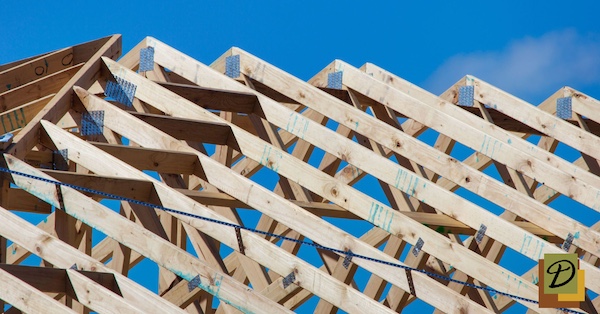
What is the difference between new roof construction and roof replacement?
The core difference in new roof construction vs roof replacement is the starting point. New construction builds the entire roofing system from the framing up on a bare structure, while replacement reuses the existing structure and swaps out the worn materials on top of it. Although the finished result looks similar from the curb, the planning, timeline, and cost behind each path are quite different.
New construction roofing is more extensive because you are starting from the beginning. The full roof line and roofing structure must be designed before any materials go on, which gives homeowners freedom to choose pitch, layout, materials, and ventilation from scratch. A roof replacement instead follows the home’s current structure, so most of the design is already set.
Both paths require professional installation to keep manufacturer and workmanship warranties valid.Driftwood Builders Roofing has served Austin and Central Texas since 2005 and is a GAF Master Elite certified contractor.
What Does "New Roof Construction" Mean?
New roof construction is the installation of a roofing system on a structure that has never been roofed before. In practice that covers three situations:
- A newly built home. The roof goes on once the framing and sheathing are complete, before the interior is finished.
- An addition. A new room, garage, porch, or second story extends the roof line onto framing that did not exist before.
- A new detached structure. A separate garage, workshop, barn, or accessory dwelling unit built from the ground up.
In each case the crew starts with bare framing. There is nothing to tear off, no old fasteners to pull, no existing decking to evaluate, and no previous flashing to work around. Every component, from the sheathing and underlayment through the flashing, ventilation, and the roof covering itself, is specified and installed new.
A roof replacement starts from the opposite position. The structure already carries a roof, and the job begins by removing it. What is underneath is not fully known until the tear-off is finished, which is why replacement scopes are written with contingencies that new construction does not need.
One point that trips homeowners up: putting a new roof on an existing house is not new roof construction, even though every material on the roof is new. The distinction is about the structure underneath, not the age of the materials on top.
New Roof Construction vs. Roof Replacement: Side-by-Side Comparison
Both projects finish in the same place, a complete roof, but almost everything about how they get there differs. This is the short version:
| Factor | New Roof Construction | Roof Replacement |
|---|---|---|
| Existing roof present? | No. The structure has never been roofed. | Yes. A roof is already in place and comes off first. |
| Tear-off required? | None. Work begins on bare framing. | Yes. Old covering, underlayment, and fasteners are removed and hauled away. |
| Decking condition | New sheathing installed to current code across the whole roof. | Unknown until tear-off. Sound decking is reused, damaged sections are replaced. |
| Flashing | All new, detailed into walls, chimneys, and valleys as the structure goes up. | Usually replaced, but has to fit siding, masonry, and penetrations that are already built. |
| Primary use case | New homes, additions, and new detached structures. | Aging, worn, or storm-damaged roofs on existing homes. |
| Complexity | Sequenced around framing, inspections, and other trades on an active build site. | Concentrated. Most residential replacements are finished in days rather than weeks. |
| Insurance involvement | Rare. Normally paid from the build budget or construction loan. | Common when hail or wind damage is the trigger. |
| Typical project context | Part of a larger build, coordinated with a builder or general contractor. | A standalone project the homeowner contracts directly. |

Roofing System vs. Standard Roof Replacement
A related question comes up constantly on estimates, and it is not the same distinction as the one above. A roofing system means every layer is replaced and specified to work together: decking repairs, underlayment, drip edge, starter strip, field shingles, hip and ridge cap, all flashing, and matched intake and exhaust ventilation, usually from a single manufacturer. That completeness is what qualifies a roof for a manufacturer’s enhanced warranty rather than a materials-only warranty.
A standard roof replacement can mean considerably less: new shingles and underlayment over reused flashing, reused vents, and the existing drip edge. Both bids may say “full roof replacement” on the cover page. When you compare quotes, the useful question is not the headline price, it is which of those components are listed as new and which are being reused.
How is a new construction roof installed from scratch?
On a newly built home, the roof goes on after the roof framing is complete. The crew works in layers to keep the structure sealed and weather ready:
- Framing: the trusses and roof line are set, establishing the pitch and overall shape.
- Sheathing and decking: wood panels are installed across the frame to form a solid base.
- Underlayment: a protective layer prevents moisture from developing inside the home.
- Shingles and finishes: your chosen shingles, flashing, and ventilation are added last.
This sequence is more time consuming, but it is vital for a solid and stylish roofing system on a newly constructed home. It also lets you build in the right ventilation and material choices for the intense Central Texas summer heat from day one.
What does a roof replacement involve on an existing home?
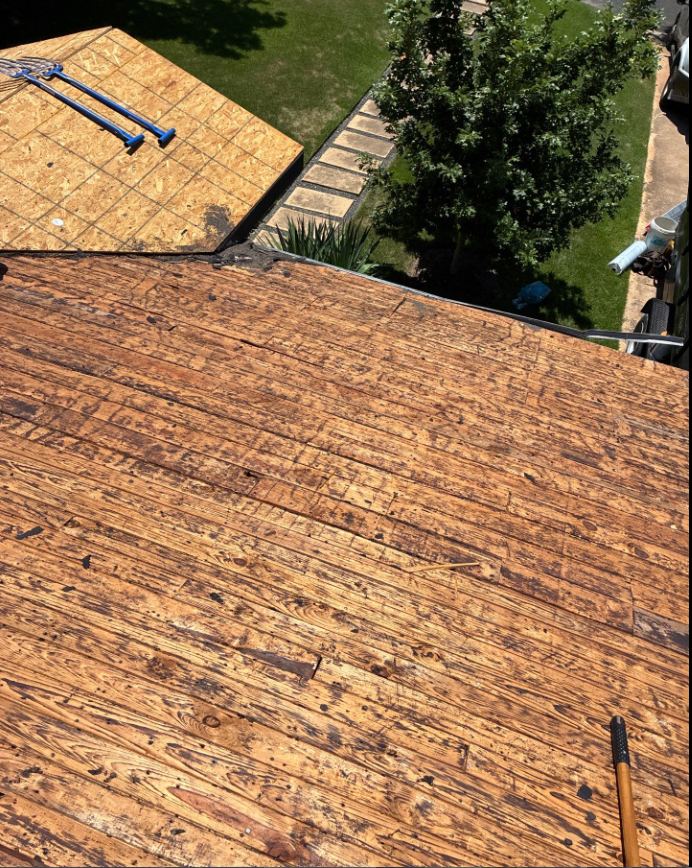
A roof replacement is usually installed on the current roofing structure, framing, and wood decking. The crew tears off the old roof, including the old felt, into a large dumpster, reuses the sound existing parts, and installs new shingles, venting, felt, and flashing onto the existing structure. Because it follows the home’s current roof line, it is typically a faster installation that costs less in the end.
One important step is inspecting the decking once the old materials are removed. A replacement can reveal hidden damage from past leaks, spring hail, or straight-line winds. If a serious issue is found, sections of decking can be replaced or repaired before the new roof goes on, which protects the long-term performance of the system. Scheduling a roof inspection ahead of time helps you anticipate that scope.

New roof construction vs roof replacement: how do timing and cost compare?
The biggest practical differences between the two are timing, planning, and cost. New construction requires the full design and build sequence, while a replacement reuses much of what is already in place. The table below summarizes how they stack up.
| Factor | New Roof Construction | Roof Replacement |
|---|---|---|
| Starting point | Bare framed structure | Existing roof structure |
| Design freedom | Full control over pitch, layout, materials, ventilation | Follows the home’s current roof line |
| Typical timeline | Longer, built in stages from framing up | Faster, often completed in days |
| Relative cost | Higher due to full build scope | Generally lower, reuses existing parts |
| Hidden surprises | Few, everything is new | Possible decking damage revealed at tear-off |
For most Austin homeowners, a roof replacement is the relevant choice, since new construction roofing applies when a home is being built. Driftwood Builders Roofing provides free estimates and does not ask for a deposit, so you can compare scope and cost with no pressure.
New Roof Construction vs. Roof Replacement Cost
There is no single price for either project, and any number quoted without a look at the roof is a guess. Both are priced from the same set of drivers, which is why two homes on the same street can come back with very different figures:
- Roof size. Priced in squares, where one square is 100 square feet of roof surface, not floor area. A complex roof line carries far more surface than its footprint suggests.
- Pitch. Steeper roofs slow production and require fall protection and staging, which adds labor hours per square.
- Material. The single biggest lever. Three-tab, architectural, designer, and metal sit at very different price points, and the choice also affects lifespan and wind rating. Our comparison of dimensional vs. three-tab shingles walks through that trade-off.
- Tear-off. A replacement-only cost. Removing and disposing of the old roof takes labor, dumpster capacity, and landfill fees. A second existing layer roughly doubles that portion of the job.
- Decking. New construction sheathes the whole roof as a known line item. On a replacement it is the one variable nobody can price in advance, because damaged boards are not visible until the old roof is off. A reputable estimate states a per-sheet rate up front rather than leaving it open.
- Flashing. Chimneys, walls, skylights, valleys, and pipe penetrations each add detail work. Retrofitting flashing into finished masonry or siding takes longer than building it in while a house goes up.
- Ventilation. Bringing intake and exhaust into balance may mean adding soffit vents or converting to ridge venting, which is scoped work rather than an accessory.
- Access. Steep driveways, narrow lots, heavy tree cover, low-clearance gates, and anywhere a dump trailer cannot sit close to the house all add handling time.
- Complexity. Hips, valleys, dormers, multiple slope changes, and low-slope sections needing a different membrane all raise the cost per square above a simple gable.
For real Central Texas figures on the replacement side, including what moves a local quote up or down, see our guide to roof replacement cost in Austin. New construction roofing is normally priced inside the overall build rather than as a standalone contract, so it is quoted through the builder or general contractor.
Do I Need New Roof Construction or a Roof Replacement?
For most homeowners this resolves in one question: does the structure already have a roof? The rest follows from there.
- Building a new home, an addition, or a new detached structure? That is new roof construction. It is scheduled as part of the build, after framing and sheathing.
- Existing home with a roof that is old, worn out, or storm damaged across multiple slopes? That is a roof replacement. If you are unsure whether yours has reached that point, the warning signs a roof needs replacing are a practical checklist.
- Damage confined to a small, defined area? A repair or a partial replacement may be the right call instead of a full one. Whether that works depends on the age of the roof and whether the existing shingles can still be matched, which we cover in can you repair just a section of a roof.
- Decking or framing found to be structurally damaged? Rot from a long-running leak, impact damage, or a failed structural member means reconstruction has to happen before any new roof goes on. That is added scope inside a replacement, not new construction, and it is the most common reason a replacement estimate changes once the tear-off starts.
- Hail or wind was the trigger? The claim often decides the scope before the roof does. Whether homeowners insurance covers a roof replacement in Texas depends on your policy and on the damage documented at inspection.
Which option is right for your Austin home?
The right choice in new roof construction vs roof replacement usually depends on the situation rather than preference. If you are building a new home in Cedar Park, Round Rock, Leander, Georgetown, or anywhere across Central Texas, new construction roofing is part of the build. If you own an existing home with an aging or storm-damaged roof, replacement is the path that restores protection efficiently.
Either way, the Central Texas climate should guide your material and ventilation decisions. Summer heat, spring hail, and straight-line winds all put real stress on a roof, and local building codes set minimum standards your installer must meet. If storm damage is involved, Driftwood Builders Roofing documents it and can meet your adjuster on site to explain what we found.
Not sure which option fits your home? Request a free estimate and our team will walk you through the right approach for your property.
Frequently Asked Questions
Is a roof replacement faster than new roof construction?
Yes. A roof replacement reuses the existing structure, framing, and decking, so it usually takes considerably less time than new construction. New roof construction is built in stages from the framing up, which extends the timeline.
Does a new construction roof cost more than a replacement?
Generally, yes. New construction roofing involves building the entire system from scratch, while a replacement reuses existing parts and only swaps the worn materials. Replacement typically costs less in the end for that reason.
Can a roof replacement uncover hidden damage?
Yes. Once the old shingles and felt are torn off, the crew inspects the wood decking. A replacement may reveal hidden damage from past leaks or storms, and any compromised sections can be repaired or replaced before the new roof goes on.
Do both options require professional installation for warranty coverage?
Yes. Both new construction and replacement roofs require professional installation to keep manufacturer and workmanship warranties valid. Driftwood Builders Roofing is GAF Master Elite certified, which supports strong warranty options on both.
Does Driftwood Builders Roofing handle both new construction and replacement in Austin?
Yes. Driftwood Builders Roofing handles new roof construction and roof replacement for residential and commercial properties across Austin and Central Texas, including Cedar Park, Round Rock, Leander, Lakeway, Georgetown, Pflugerville, Buda, and Kyle. Estimates are free with no deposit required.
What is considered new roof construction?
New roof construction is the installation of a roofing system on a structure that has never had one: a newly built home, an addition, or a new detached structure such as a garage, workshop, or accessory dwelling unit. Work starts on bare framing, so there is no tear-off, no disposal of old material, and no existing decking to evaluate.
What is the difference between a new roof and a roof replacement?
The phrase “new roof” gets used loosely for both. In roofing terms, new roof construction means the first roof on a new structure, while a roof replacement means removing an existing roof and installing a new one on a structure that already had one. Both leave you with a brand new roof. Only one of them starts from bare framing.
Is replacing a roof considered new construction?
No. A roof replacement is treated as work on an existing structure, not new construction, even though every material installed is new. That distinction matters for permitting and for how an insurance claim is handled, so it is worth confirming the specifics with your city and your carrier.
Is new roof construction cheaper than roof replacement?
Not usually, though the comparison is rarely like-for-like. New construction includes sheathing the entire roof, all new flashing, and a full ventilation design, and it is sequenced around other trades. A replacement reuses the existing structure and roof geometry, but it carries costs new construction does not: tear-off, disposal, and any decking found damaged once the old roof is off. Scope sets the price far more than the category does.
Can you replace only part of an existing roof?
Sometimes. A partial replacement can work when the damage is confined to one slope or section, the roof still has meaningful service life left, and the existing shingles can be matched closely enough in age and color to blend. It is a poor choice when the roof is near the end of its life, when the wear is spread across multiple slopes, or when an insurance claim already covers the full roof.
Get a Free Written Roof Estimate

Author: Driftwood Builders Roofing
Driftwood Builders Roofing is a family-owned residential roofing company headquartered in Manchaca, Texas, serving Austin and the surrounding Hill Country since 2005. The company has delivered 3,700 full roof replacements and 783 repairs across 3,559 different customers over 20 years in business, with 97 years of combined construction experience across the leadership team and 74 years specifically inside Driftwood Builders. The company holds the highest contractor certifications offered by the major shingle manufacturers, including GAF Master Elite Contractor (the top 3% of GAF contractors nationally), GAF Certified Green Roofer, Owens Corning certified, TAMKO Pro Certified Contractor, and a Berridge Roof Installation Seminar Certificate for standing-seam metal roofs. Driftwood is an NRCA member, holds an Angie's List Super Service Award, is BBB Accredited, and is a GuildQuality member for verified customer satisfaction data. James Hardie certification covers the siding side of the business. Services include residential roof replacement, leak and storm-damage repair, tile roof repair, metal roofing, TPO commercial roofing, roof inspections, hail and storm damage inspections with insurance claim assistance, gutter work, and James Hardie siding. The customer-protection policy is straightforward: Only Pay Upon Completion. The company serves 22 cities across the Hill Country and Greater Austin and holds a 5-star rating across Google, GuildQuality, Angi, Nextdoor, Facebook, Thumbtack, and Yelp.
