
GAF Master Elite® Contractor | BBB A+ Rated | 500+ Customer Reviews Across Multiple Platforms | 3,700+ Projects Completed | Open 24/7

Roof Repair in Schertz, TX

Short answer. Driftwood Builders Roofing repairs roofs across Schertz, Texas: leaks, failed valleys, flashing, pipe boots, eaves, and storm and wind damage. The inspection is free, you get a photo report you keep, and we tell you plainly whether a repair is enough or whether the roof is past repairing.

Roofs rarely fail in the middle of an open slope. They fail where water concentrates, or where two materials meet: in valleys, around anything that goes through the roof, along walls and at the eaves. Most of the repair work we do in Schertz is at those details, and the example below is a good illustration of why.

We are a GAF Master Elite contractor and have worked on Central and South Texas roofs for more than twenty years. For everything else we do in the city, see our roofing company in Schertz page.

A Recent Schertz Roof Repair, From First Look to Water Test

These are our own photographs, taken on a Schertz home in August and September 2026. They are not stock images. We have cropped out anything that would identify the house.

What we found

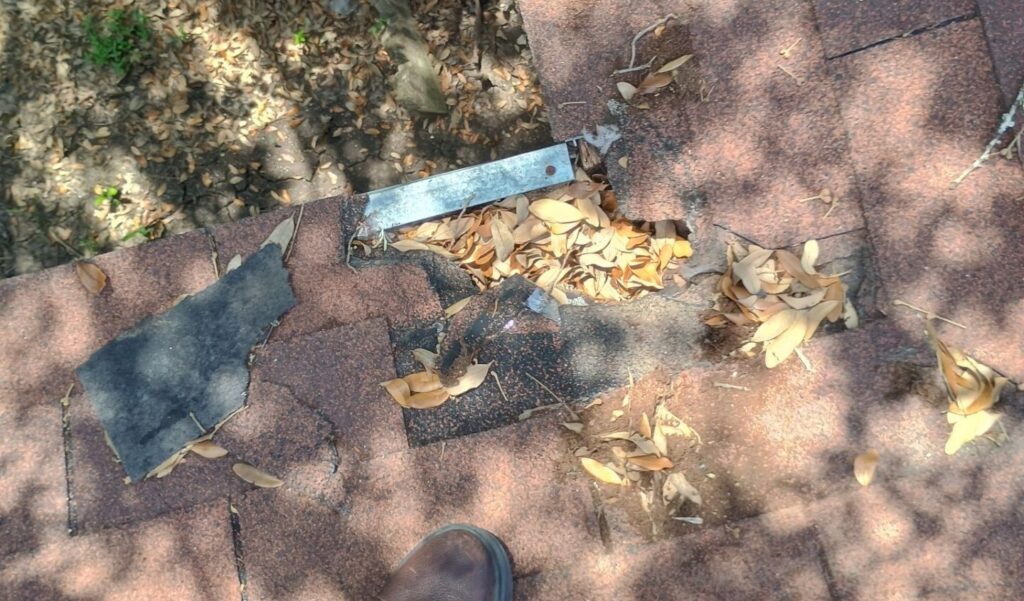
The leak was at the bottom of a roof valley, where the roof over the front entry meets the main roof. A valley collects the water from two slopes and carries all of it to one point at the eave. On this house it also collected leaves from the large oaks overhead. Packed debris holds water against the shingles instead of letting it run off, and over time the shingles at the bottom of the valley had torn away and the roof had opened up to the deck beneath.
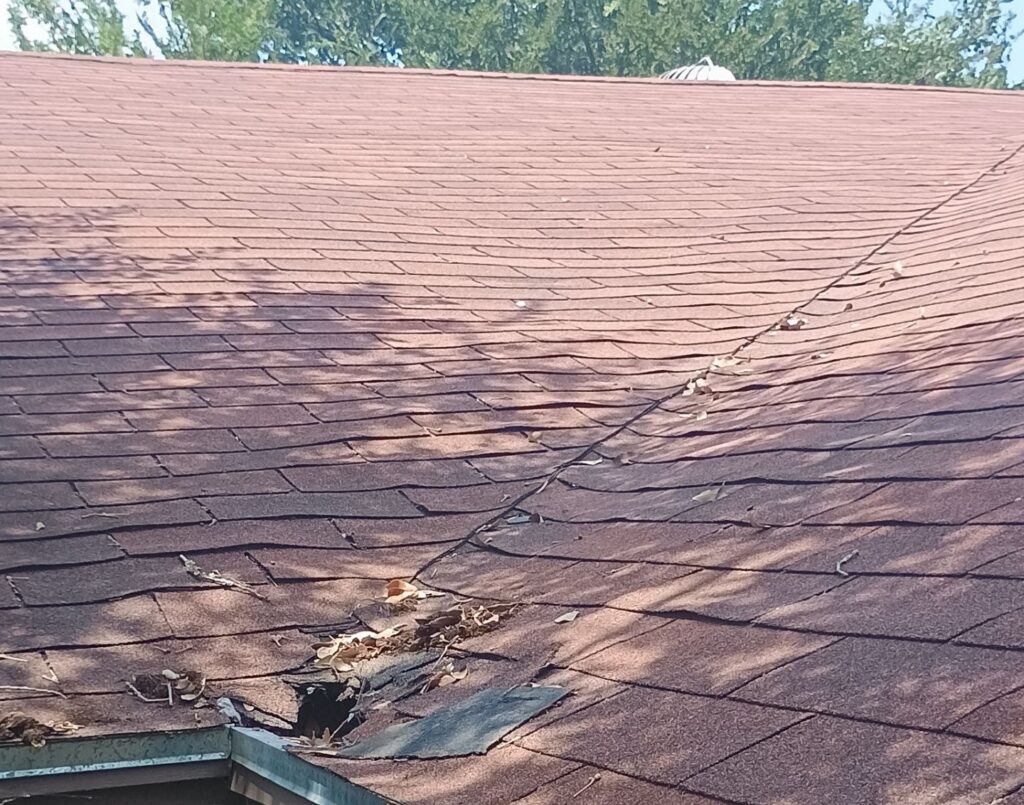
Asphalt shingle roof valley ending at the eave, with torn shingles, packed leaf debris and a hole through to the roof deck at the bottom of the valley
Before: the valley where the entry roof meets the main roof. The torn shingles and the opening sit right at the bottom, where the water from both slopes ends up.
Close-up of torn asphalt shingles and an exposed metal edge at the bottom of a roof valley, with oak leaves packed into the opening
Close-up of the same spot. Oak leaves are packed into the opening, the shingles around it have torn, and a piece of the metal edge is exposed. Water had a direct route into the roof deck here.

What the repair involved

A patch on top of this would not have lasted. The crew opened the roof around the valley back to the rafters and removed the decking under the failed section, then installed new decking, laid new underlayment along the valley and reshingled it, tying the new shingles into the existing roof on both slopes.
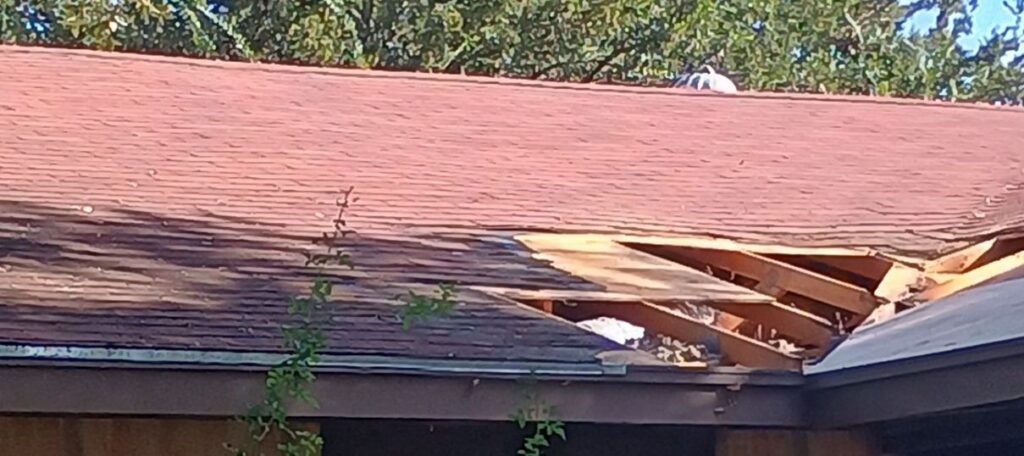
Roof section opened down to the rafters where the valley meets the eave, with the old decking removed during the repair
During the repair: the roof opened at the valley, with the old decking removed down to the rafters. This is the part of a leak repair that a homeowner never sees, and the part that decides whether the repair lasts.
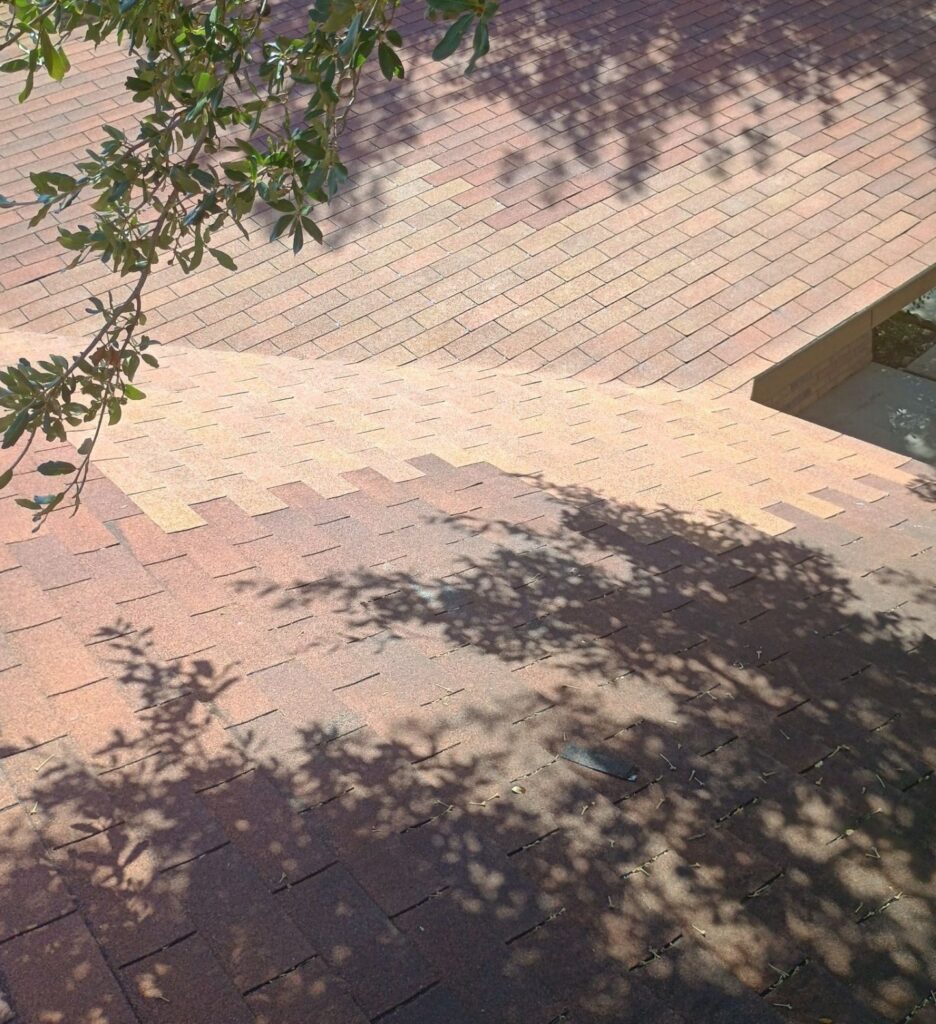
Finished roof valley repair, with the new shingles visibly lighter than the weathered shingles around them
After: the finished valley. The new shingles are brighter than the weathered shingles around them. That is normal for a repair and it narrows as the new shingles weather, but it is worth knowing before you agree to one.

How we checked it

About two weeks after the repair, we went back and water-tested it: a hose laid in the valley above the repaired section, run long enough to put a real volume of water through the area that had been leaking.
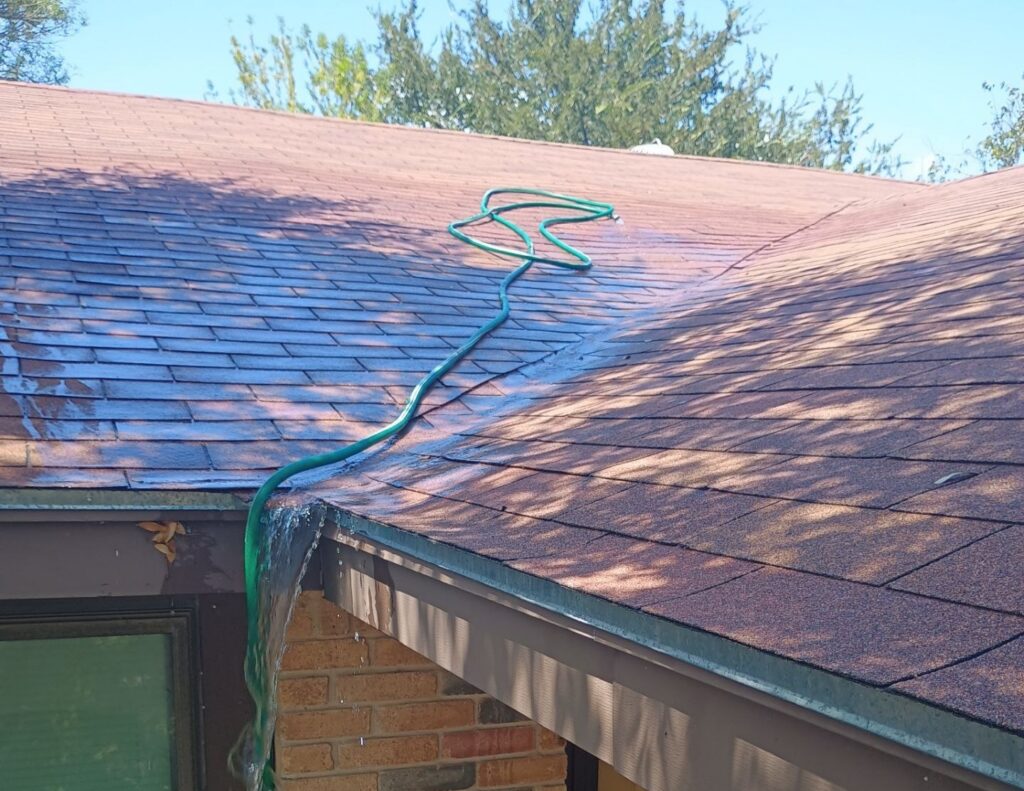
Garden hose running water down a repaired roof valley, with the water sheeting off the eave above the front entry
The water test. Water from the hose runs the full length of the repaired valley and sheets off the eave above the entry, which is exactly where it should go.

These photographs record one repair on one Schertz home. The damage was not hail: the work was finished several weeks before the September 2026 storm. We include it because it shows the most common kind of leak we fix, and what a repair done properly actually involves.

Common Roof Repair Problems on Schertz Homes

A lot of Schertz roofs are reaching the age where details start to fail. Census figures put the median Schertz home at a 2001 build year, and about 44 percent of the city’s roughly 16,200 homes were built between 1990 and 2009. Many of those are still on their first or second roof. Source: US Census Bureau, American Community Survey five-year estimates, 2023.

  • Valleys. Two slopes drain into one line, and debris collects there. A valley that holds leaves holds water, and the bottom of the valley at the eave is where it gives out first, as in the example above.
  • Pipe boots and roof vents. The rubber collar around a plumbing vent dries and cracks in the Texas sun long before the shingles around it are worn out. It is one of the cheapest repairs we do and one of the most common leak sources.
  • Flashing. Where a roof meets a wall, a chimney or a second-storey section, the metal flashing and its sealant are doing the waterproofing, not the shingles. Lifted or failed flashing often leaks well away from where the stain shows up inside.
  • Eaves, drip edge and fascia. Water that gets behind the drip edge or sits in a blocked gutter rots the edge of the decking and the fascia board. It often shows as soft decking at the eave or staining on the soffit.
  • Wind damage. Shingles that have lifted, creased or lost their seal in a wind event let water under the course above. A creased shingle can look fine from the ground.
  • Hail. Hail impacts can break the shingle surface and damage vents and soft metal. For how a hail inspection works, see our Schertz hail damage roof inspection page, and for what was actually recorded locally, the September 2026 Schertz hail storm page.

Leaks, Eaves and Flashing: How We Trace a Leak

The stain on your ceiling is rarely directly under the hole in the roof. Water gets in at one point, runs along the underside of the decking or down a rafter, and drips where gravity finally lets it go. So the first job is to find the entry point, not to patch the spot above the stain.

  1. Start inside where we can. The stain, and the attic above it if it is accessible, tells us roughly where to look.
  2. Work uphill on the roof. We check every detail above that area: valleys, penetrations, flashing, and anything that interrupts the flow of water.
  3. Photograph what we find. You see the cause, not just our word for it, and the photographs are yours to keep.
  4. Repair the cause, then the damage. If water has been getting in for a while, the decking under the entry point may need replacing too, as it did on the valley above.
  5. Test it. A leak repair is not finished until water has been run over it.

Repair or Replace? How We Decide on a Schertz Roof

Most of the time, a leak is a repair. We recommend replacement only when the evidence points that way, and we will show you that evidence.

  • Isolated or widespread. One failed valley, one cracked pipe boot or one area of wind damage is a repair. Damage spread across most slopes is a different conversation.
  • The age and condition of the rest of the roof. An asphalt roof in this climate typically gives fifteen to twenty years. If the shingles everywhere are losing granules, brittle or curling, a repair can still stop today’s leak, but you should know the next one is coming.
  • What is under the shingles. If decking is soft in several places rather than one, that changes the answer.
  • Storm damage. If the damage is from hail or wind and it is widespread, it may be an insurance question. That decision is your insurer’s, made against your policy. Under Texas law a contractor doing the work cannot act as your public adjuster, so what we do is document the roof accurately and give you the evidence.

What a Schertz Roof Repair Visit Includes

  • A free inspection, with the cause of the problem photographed.
  • A straight answer on repair versus replacement.
  • A written scope and price before any work starts.
  • A City of Schertz permit pulled in our name where the work requires one.
  • A water test on leak repairs, so you are not left waiting for the next storm to find out.
Free Schertz roof inspection. If your roof is leaking or you have spotted damage, we will find the cause, photograph it and tell you honestly what it needs. Request an inspection or call (512) 894-0129. For the full range of work we do locally, see our Schertz roofing contractor page.

Frequently Asked Questions

How much does a roof repair cost in Schertz?

It depends almost entirely on what has to be opened up. A sealed pipe boot and a valley rebuilt down to new decking are both "roof repairs", and they are not close in price. We do not publish a Schertz price range, because any number we printed would be wrong for most roofs. You get a written price after a free inspection, with photographs of what the price is for.

Can you fix a roof leak without replacing the whole roof?

Usually, yes. Most leaks start at one detail: a valley, a flashing, a pipe boot, an eave. If the rest of the roof is sound, repairing that detail properly is the right answer. Replacement only makes sense when the damage is spread across the roof or the roof is at the end of its life, and we will say which one you have.

Will the repair shingles match my roof?

Not exactly, at least at first. New shingles start brighter than shingles that have spent years in the Texas sun, even when the colour name is the same. You can see that difference in the finished repair photograph on this page. The gap narrows as the new shingles weather. If a close match matters to you, tell us before the work starts so we can source the nearest product and talk through where the repair will be visible.

How do I know the repair actually stopped the leak?

Because we test it. After a leak repair we run water over the repaired area with a hose and check for any sign of it getting through, as shown in the last photograph on this page. A repair that has not been tested is an educated guess, and in a dry Texas spell you might not find out for weeks.

Is my roof leak hail damage?

Not necessarily. The Schertz repair on this page was a failed valley packed with leaf debris, and it was finished weeks before the September 2026 storm. Hail can certainly cause leaks, but so can age, debris, flashing and pipe boots. A proper inspection tells you which, and that matters, because only storm damage is an insurance question.

How quickly can you get out to a leaking roof in Schertz?

Most Schertz inspections are scheduled within a few business days. If water is coming in, say so when you call and it is treated as urgent, because water moving through a roof does more damage the longer it runs.

Do I need a permit for a roof repair in Schertz?

The City of Schertz issues its own building permits. Requirements for a full re-roof and for a small repair are not the same, so we check what the specific job needs. If the work requires a City of Schertz permit, we pull it in our own company name.

Scroll to Top