Hail Damage Roof Inspection in Schertz, TX
A hail inspection is easy to do badly. Someone walks a roof for four minutes, draws some circles, photographs the circles and hands you an estimate. The circles look convincing. They are not evidence.
This page shows what the work looks like when it is done properly, using photographs from an actual Schertz roof rather than descriptions or stock imagery.
Start From the Ground - What You Can Check Yourself
Before anyone gets on a ladder, there is a useful check you can run in ten minutes without leaving the lawn. Hail that is large enough to matter to a roof almost always leaves a record on softer surfaces at eye level.
- Gutters and downspouts. Aluminium dents where shingle merely bruises. Look along the length of a downspout in low, raking light.
- Window screens and frames. Screens tear or dimple, and the horizontal sill tracks catch the worst of it.
- Vent and flashing metal visible from the yard. Any soft metal you can see.
- Granules at the base of downspouts. Some shedding is normal on an ageing roof. A sudden heap of it after a storm is not.
- Everything that is not the house. Air-conditioner fins, garden furniture, post caps, mailboxes, vehicles. These are often the clearest evidence on a property.
What the Chalk Is Actually For
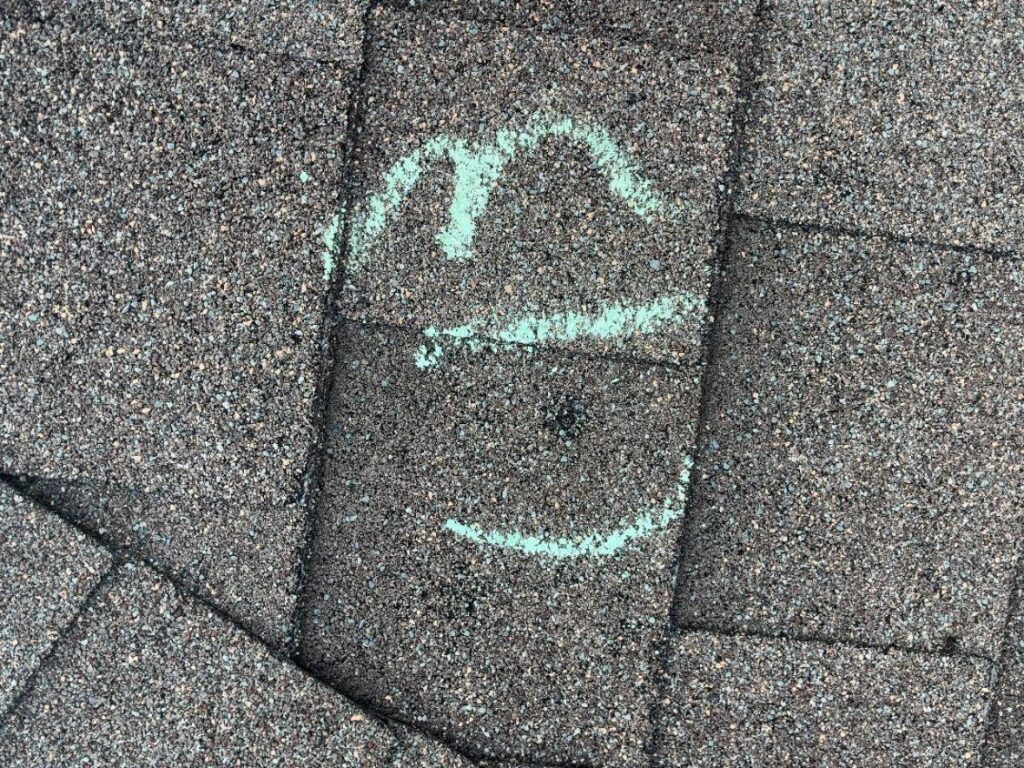
A hail impact is a shallow, low-contrast dish in a rough, mottled surface. In flat daylight a camera frequently cannot see it at all, even when a hand can feel it immediately. Chalk solves a photography problem, and that is the whole of its purpose.
It gets used two different ways.
Outlining. A circle drawn around an impact so the camera records where it is and how large it is.
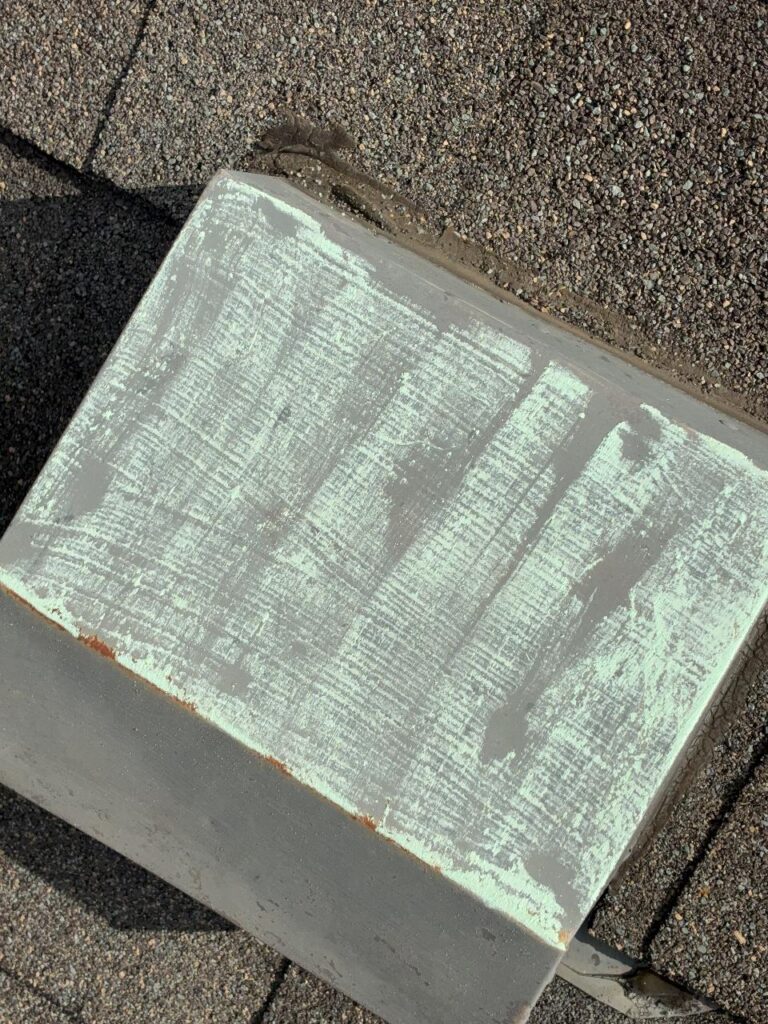
Rubbing. Chalk dragged flat across soft metal, so that it catches on the high points and skips the depressions. Dents appear as interruptions in the chalk.
Counting a Defined Area, Every Elevation
This is the part that separates an inspection from a sales visit, and it is the part that takes the time.
One impact establishes that a stone landed. It establishes nothing else. What carries weight is the count within a defined area, repeated consistently on every slope - because that is the same method the insurance industry uses, and a figure produced any other way is not comparable to the one their adjuster will produce.
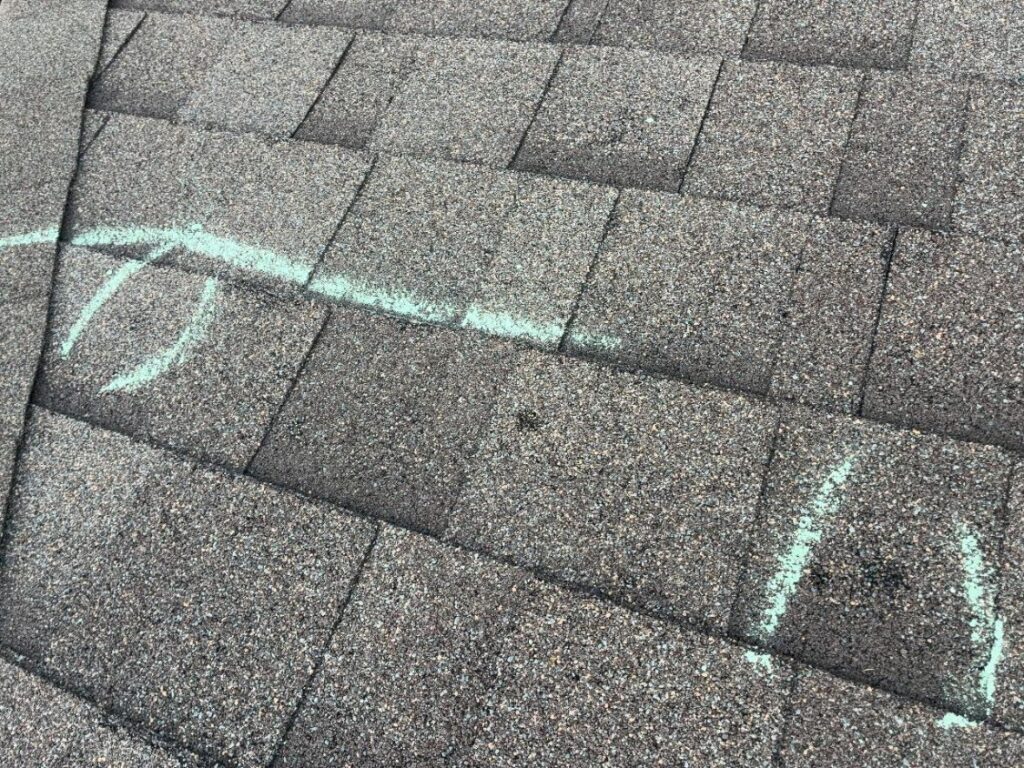
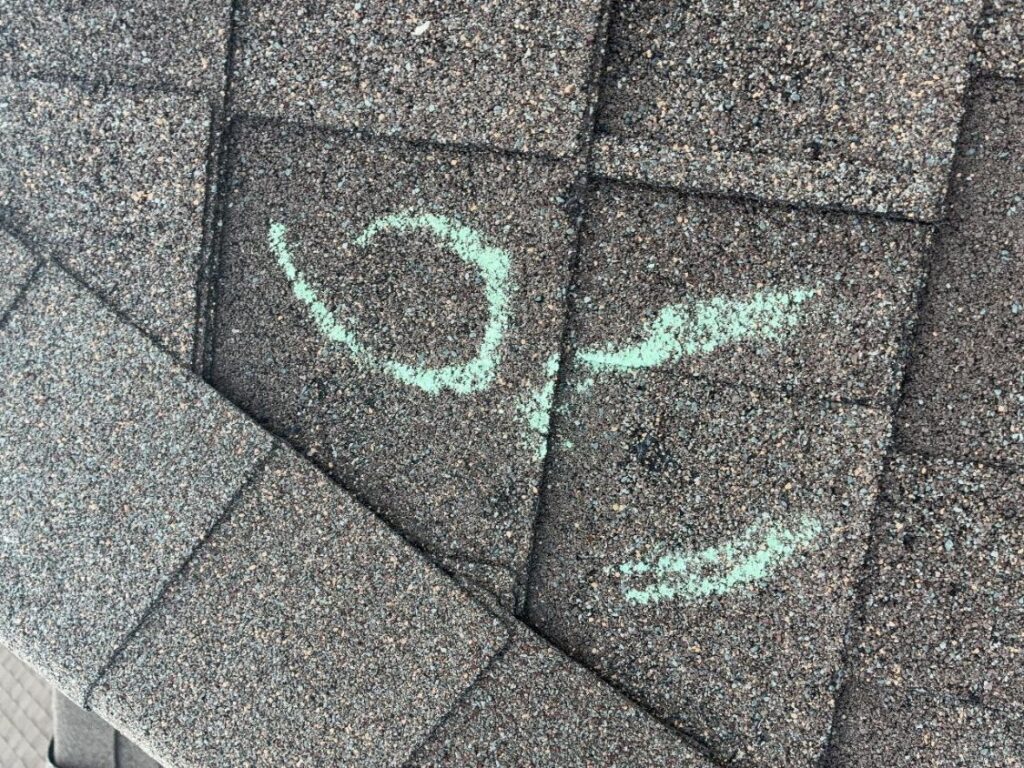
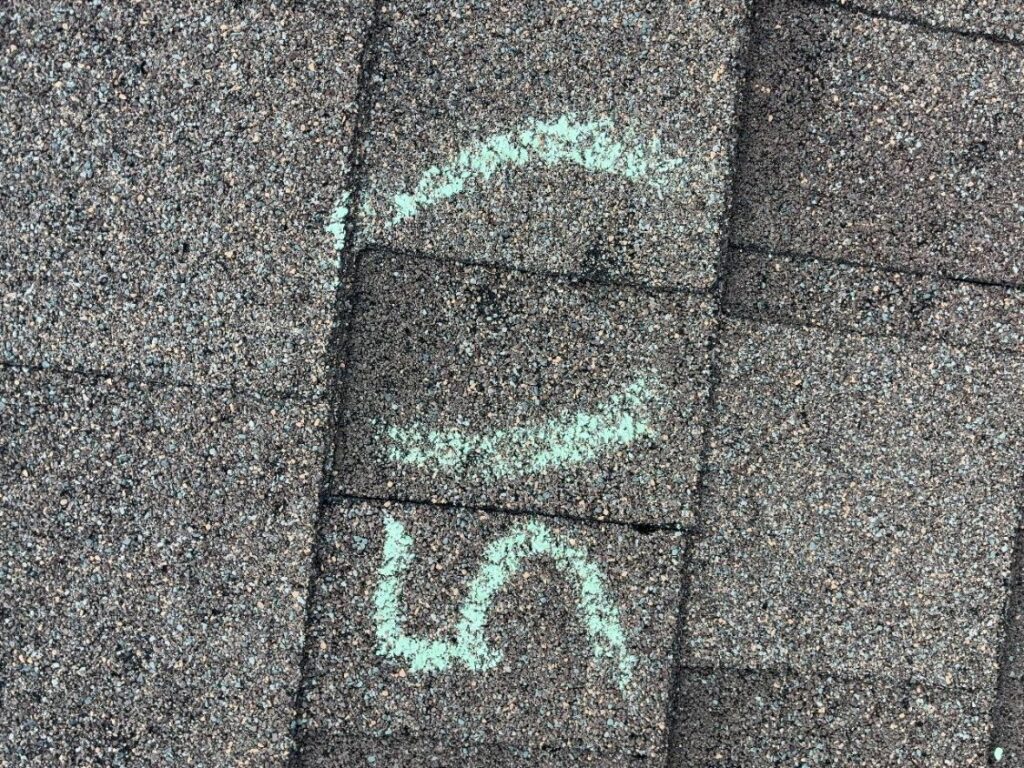
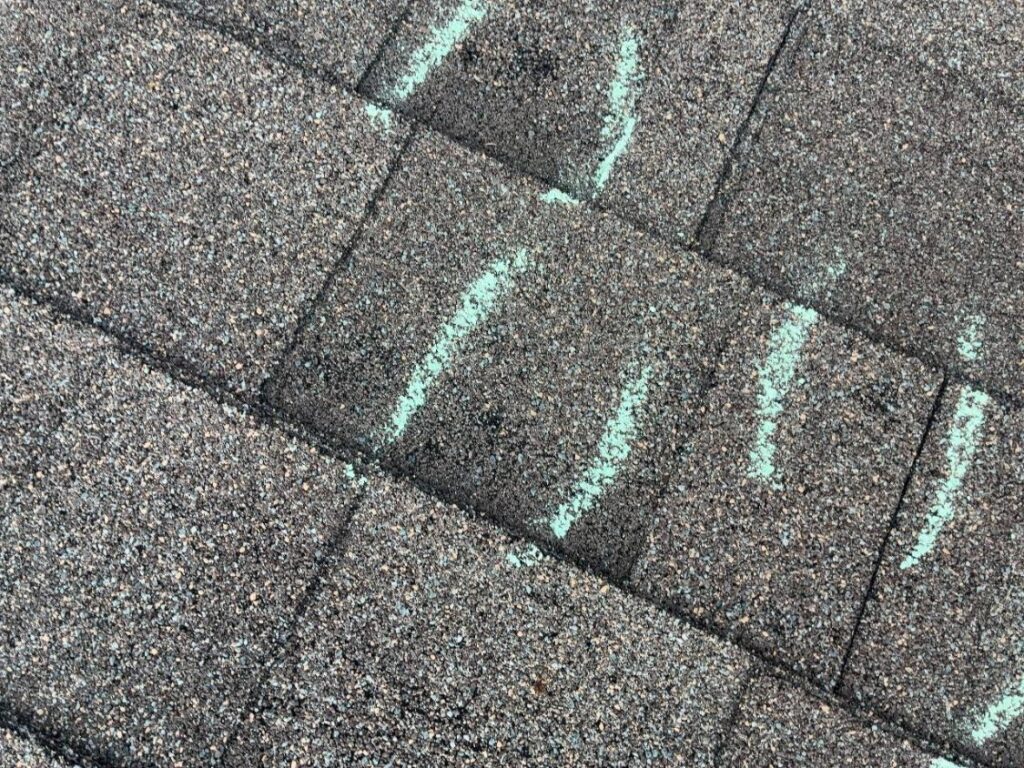
Marked one at a time, across an elevation, it looks like this:
The Soft Metals and the Penetrations
An inspection that only looks at field shingle is an incomplete inspection, and a report built from field shingle alone is the easiest kind to argue with.
Collateral components matter out of proportion to their size, for a simple reason: they are hard to attribute to age. A weathered shingle and a hail-struck weathered shingle can look similar to someone determined to see it the other way. A chip knocked clean out of rigid plastic looks like exactly one thing.
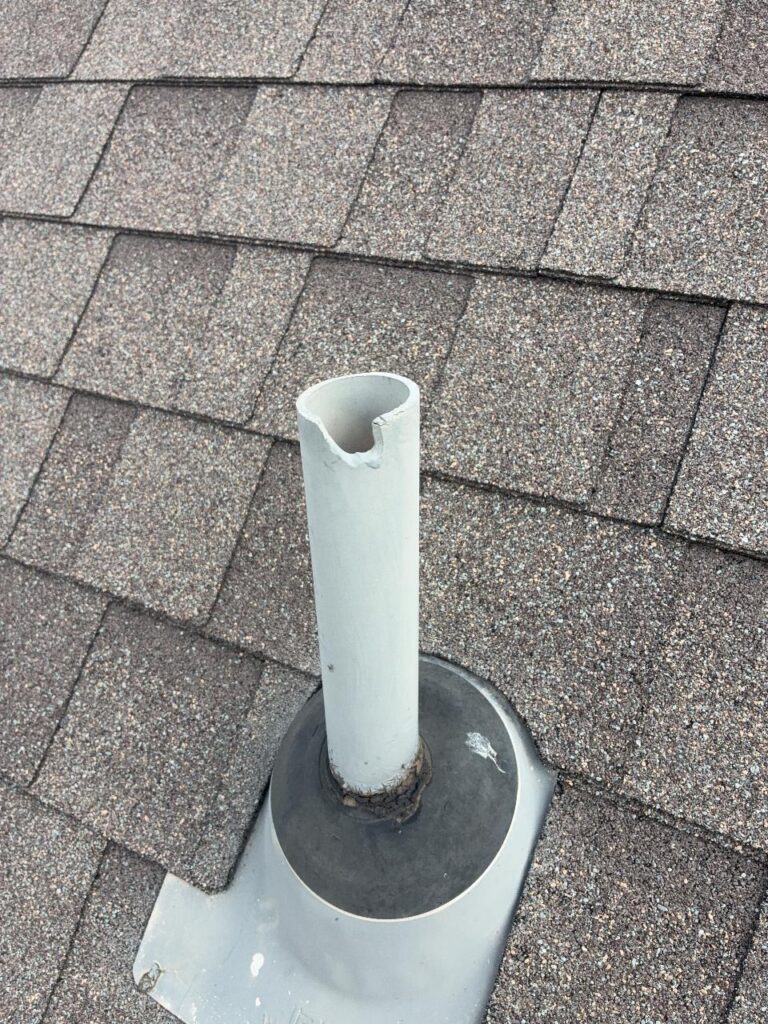
That caption is deliberate. Two conditions are visible in one photograph and they have different causes. Reporting both accurately is what makes the rest of the report credible; sweeping the second into the first is how a scope gets taken apart later.
The full component list we check: pipe and turbine vents, ridge and box vents, all step, counter and valley flashing, drip edge, gutters and downspouts, the chimney chase and cap if there is one, skylights, and the siding and window surrounds immediately below the roofline.
When Another Contractor Has Already Marked the Roof
After a storm this is normal rather than suspicious. Several companies will have knocked, and one of them may well have been up there already.
It does not complicate anything. We assess the underlying surface independently and do not adopt existing marks as findings, in either direction - we neither count someone else’s circles as damage nor assume they were wrong. A previous mark is a note that somebody looked at that spot. What matters is what is actually inside it.
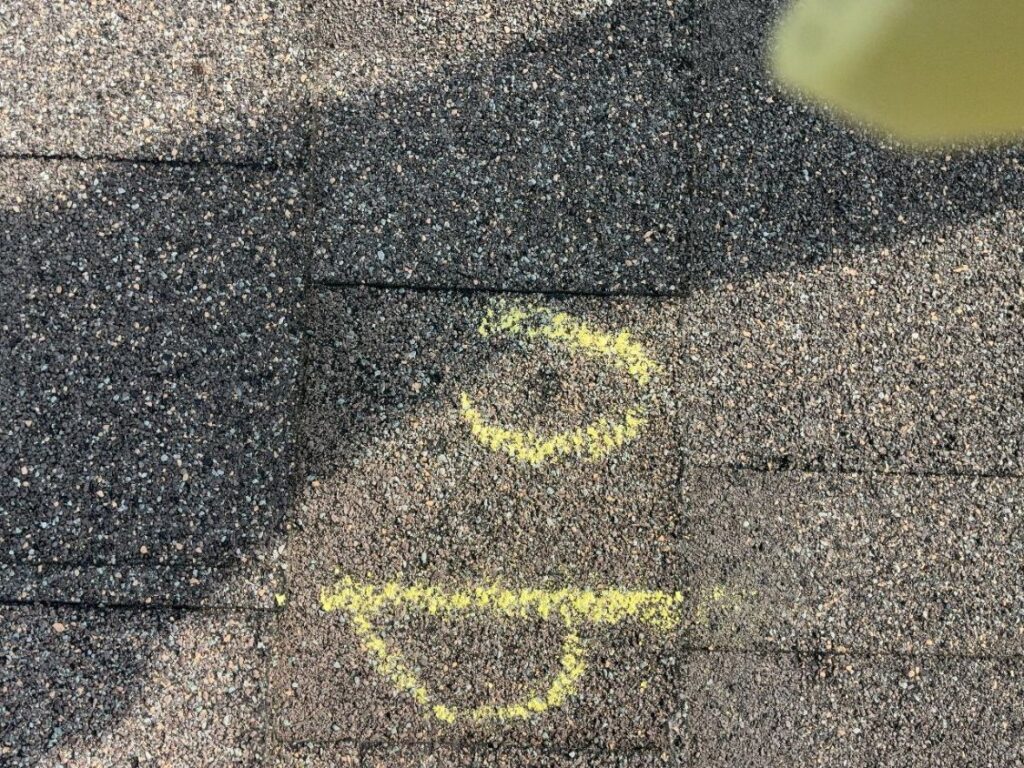
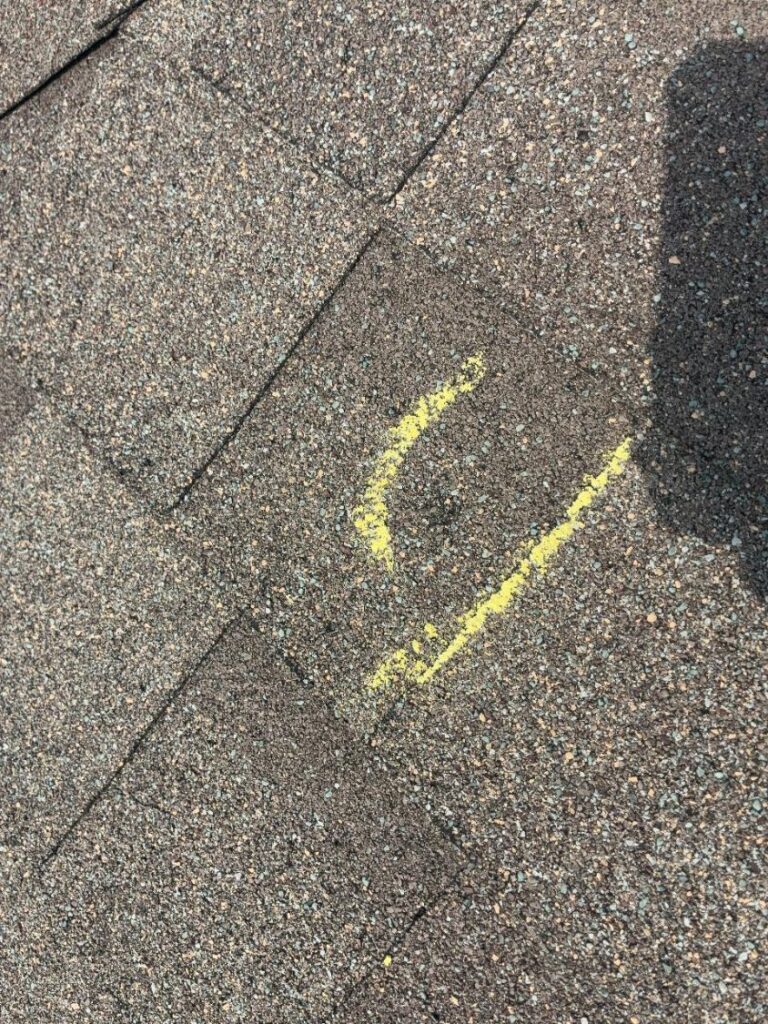
If you have had two inspections and been given two different answers, that is worth resolving rather than tolerating, and it is a reasonable thing to ask a third party to look at. Ask each contractor to stand at a specific mark and tell you what is inside it and why it counts. A good inspector will welcome the question. It is also entirely reasonable to ask us.

Why One Photograph Never Decides Repair Versus Replacement
Every image on this page shows real damage. Not one of them, alone, tells you what should happen to the roof.
That decision rests on the roof as a whole:
| Factor | Why it changes the answer |
|---|---|
| Damage density | Measured consistently by area and repeated on each elevation - not judged from the worst square metre on the roof. |
| Roof age and remaining life | The same impact count means something different on a roof with twenty years left than on one with three. |
| Material | Three-tab, architectural asphalt, Class 4 impact-resistant and metal each take and show hail differently, and are each repaired differently. |
| Whether the shingle can be matched | A discontinued line or a weathered colour that no longer matches can turn a repairable slope into a replacement. |
| Decking and underlayment | What is underneath decides whether a patch is sound or merely cosmetic. |
| Collateral damage | Flashing, penetrations, vents and gutters frequently drive the scope more than field shingle does. |
| Number of slopes affected | One elevation is a different proposition from four. |
Anyone who reaches a replacement conclusion from a single photograph, before walking every elevation, has decided the outcome in advance. That is worth noticing whoever is doing it.
After the Inspection
You get the photo report. It is yours, it is free, and there is no obligation attached to it - including no obligation to file anything.
If there is damage worth claiming, the report is the evidence you use. A few things worth knowing before you make that call:
- Your wind and hail deductible is usually a percentage, not a flat figure, and on many Texas policies it is one or two percent of the dwelling coverage rather than of the claim. Work out the actual number before you file.
- A claim below your deductible pays nothing and still appears on your claims history.
- We cannot tell you whether it will be approved. Coverage is your insurer’s decision, and under Texas Insurance Code §4102.163 a contractor bidding the work may not act as a public adjuster on the claim.
- Nobody can lawfully absorb your deductible in Texas. Texas Insurance Code §707.003. An offer to do so is a reason to end the conversation.
Frequently Asked Questions
What happens during a hail damage roof inspection in Schertz?
We check what can be seen from the ground first - gutters, downspouts, window screens, siding and any visible soft metal - then get on the roof and work elevation by elevation. Impacts are marked, a defined area is counted on each slope, the soft metals and penetrations are checked separately, and everything is photographed. You get the photo report whether or not you hire us.
How much does a hail inspection cost in Schertz?
Nothing. The inspection and the report are free, and there is no obligation attached to either. If your roof does not need work we will tell you so.
Why do roofers mark hail damage with chalk?
Because a hail impact is genuinely difficult to photograph. It is a shallow, low-contrast depression on a textured surface, and in flat daylight it can be invisible in a photograph even when it is obvious to a hand. Chalk outlines the impact so the camera records it, and rubbing chalk flat across soft metal makes dents show up as interruptions in the chalk. It is a visibility aid, nothing more - a chalk circle carries no authority by itself.
How do I know if my Schertz roof has hail damage?
From the ground, look for dents in gutters, downspouts, window screens, and the metal of vents and flashing, and look for granules collecting at the bottom of downspouts. On the roof itself a genuine impact shows a roughly circular area of displaced granules with a bruised, slightly soft mat underneath, usually with consistent directionality across a slope. Do not climb up to check. Steep and wet roofs cause serious injuries, and a trained inspector will see things you would walk straight past.
What should I do after hail damage in Schertz?
Photograph what you can see safely from the ground, with dates. Make any emergency repair needed to stop water entering, and keep the receipt. Get the roof inspected and documented. Then decide about a claim with the report in hand and your deductible in mind. That order matters - filing before anyone has established whether there is damage worth claiming can work against you.
Can you tell me if my claim will be approved?
No. Coverage is your insurer’s decision against your policy, and under Texas Insurance Code §4102.163 a contractor bidding the work may not act as a public adjuster on the claim. We document the roof accurately and give you the evidence. We do not negotiate the claim or promise an outcome, and in Texas it is illegal under §707.003 for a contractor to absorb your deductible.
What if another roofer has already marked my roof?
That is common after a storm and it is not a problem. We evaluate the underlying surface independently rather than adopting somebody else’s marks, because a circle drawn around a scuff is still a scuff. You are entitled to ask any contractor, including us, to explain what is inside a given mark and why it counts.
Author: Driftwood Builders Roofing
Driftwood Builders Roofing is a family-owned residential roofing company headquartered in Manchaca, Texas, serving Austin and the surrounding Hill Country since 2005. The company has delivered 3,700 full roof replacements and 783 repairs across 3,559 different customers over 20 years in business, with 97 years of combined construction experience across the leadership team and 74 years specifically inside Driftwood Builders. The company holds the highest contractor certifications offered by the major shingle manufacturers, including GAF Master Elite Contractor (the top 3% of GAF contractors nationally), GAF Certified Green Roofer, Owens Corning certified, TAMKO Pro Certified Contractor, and a Berridge Roof Installation Seminar Certificate for standing-seam metal roofs. Driftwood is an NRCA member, holds an Angie's List Super Service Award, is BBB Accredited, and is a GuildQuality member for verified customer satisfaction data. James Hardie certification covers the siding side of the business. Services include residential roof replacement, leak and storm-damage repair, tile roof repair, metal roofing, TPO commercial roofing, roof inspections, hail and storm damage inspections with insurance claim assistance, gutter work, and James Hardie siding. The customer-protection policy is straightforward: Only Pay Upon Completion. The company serves 22 cities across the Hill Country and Greater Austin and holds a 5-star rating across Google, GuildQuality, Angi, Nextdoor, Facebook, Thumbtack, and Yelp.