Ridge Vents vs. Box Vents: Which Vent is Better?
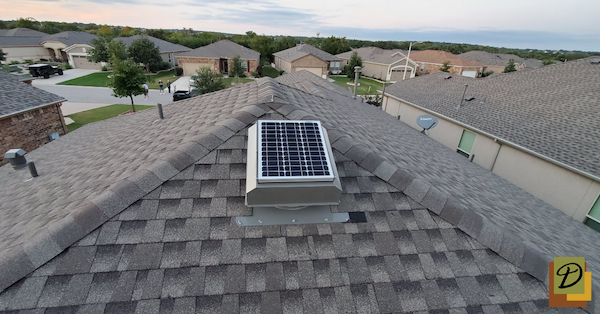
What is the difference between ridge vents and box vents?
In the ridge vents vs box vents comparison, the core difference is shape and placement. A ridge vent is one continuous strip installed along the very top peak of your roof, where trapped heat naturally rises. A box vent is a small, square metal unit set into the roof field, and each one only covers about 150 square feet of attic, so most homes need several.
Both are exhaust vents that release hot, moist air, while fresh air enters through your soffit or intake vents near the eaves. Ridge vents stay nearly invisible under matching shingles or a low-profile cap, while box vents are visible bumps across the roof slope.
- Ridge vent: continuous, runs the length of the peak, very low profile, blends into the roofline.
- Box vent: individual square units, metal, noticeable, and you need many to match one ridge vent.
For a clear picture of your options, talk with an experienced Austin roofing company that can match the vent type to your roof design.
Which vent is more efficient for Austin roofs?
Ridge vents are generally the more efficient option, and that matters in Central Texas. Because a ridge vent spans the entire peak, it releases the hottest air the moment it collects. During an Austin summer, attic temperatures can climb well past 130 degrees, so a continuous exhaust path keeps heat moving instead of building up against your shingles and decking.
Box vents still work, but coverage is limited. Since each unit handles only about 150 square feet, a large or complex roof may need six, eight, or more to match a single ridge vent line. More penetrations also mean more potential leak points during our spring storms.
Good ventilation also fights moisture. Steady airflow reduces condensation, mold, and wood rot in the attic, which extends the life of the entire roof system through Central Texas heat and humidity swings.
How do ridge vents and box vents compare side by side?
The table below summarizes the practical trade-offs homeowners weigh when choosing a roof ventilation system.
| Feature | Ridge Vents | Box Vents |
|---|---|---|
| Best roof type | Simple gable roofs with a long, straight peak | Hip roofs, complex or broken-up rooflines |
| Placement | Continuous along the roof peak | Individual units across the roof slope |
| Exhaust coverage | Spans the full ridge line | About 150 sq ft of attic each |
| Appearance | Nearly hidden, blends into the roofline | Visible square bumps across the slope |
| Number needed | Usually one ridge line | Several units per roof |
| Dependence on soffit intake | High — needs balanced intake to function | High — same requirement applies |
| Installation complexity | Simple on a long, straight ridge | Straightforward per unit; multi-section roofs take more planning |
| Good fit for short ridge lines | No | Yes |
| Good fit for simple gable roofs | Yes | Workable, but usually not the first choice |
| Risk if mixed with other exhaust vents in the same zone | Can short-circuit airflow with box vents sharing the space | Can short-circuit airflow with a ridge vent sharing the space |
| Typical use case | Long, straight-ridge gable roofs | Hip roofs, isolated attic sections, short or broken ridge lines |
Neither vent works in isolation. Both rely on adequate soffit intake for proper airflow, which is why an attic assessment matters more than picking a type off a chart.
Can box vents and ridge vents work together?
In general, ridge vents and box vents should not be mixed as exhaust vents within the same attic ventilation zone. Both are exhaust vents pulling air out of the attic, and when two different exhaust types share one connected attic space, the vent nearest a gap in the system can start pulling air from the other exhaust vent instead of from the soffit intake below. That short-circuits the airflow path the whole system depends on, so the ventilation can end up working worse, not better, even with more vents installed.
That doesn’t mean box vents and ridge vents can never appear on the same roof. On homes with two or more separate, isolated attic sections — a garage attic that isn’t connected to the main attic, for example, or a roof with a detached dormer — it’s fine for one section to use a ridge vent and another to use box vents, since they aren’t drawing from the same air pool.
The better way to think about it is as one balanced attic ventilation system, not a running tally of exhaust vents. Adding more exhaust without matching soffit intake, or mixing exhaust types within one zone, can hurt airflow rather than help it. A roof inspection can confirm whether your current setup is balanced or working against itself.
Watch: How Roof Ventilation Actually Works
When Are Box Vents Better Than Ridge Vents?
Ridge vents get most of the attention because they’re the more efficient exhaust option on the roof shape they’re built for: a long, simple, continuous peak. But that roof shape isn’t universal, and there are several situations where box vents are the more practical — sometimes the only workable — choice.
- Hip roofs with a short ridge line. A hip roof’s peak is often much shorter relative to the home’s footprint than a comparable gable roof. A short ridge simply doesn’t have enough usable length to install a ridge vent that can move the air a hip roof’s attic needs.
- Complex rooflines with multiple isolated sections. Homes with several roof planes, dormers, or attached additions can end up with attic space broken into separate pockets that a single ridge line can’t reach. Box vents let each isolated section exhaust on its own.
- Not enough ridge to hit the required exhaust area. Even on a roof with some ridge, if the total ridge length is too short to provide adequate net free vent area for the attic below it, a ridge vent alone will fall short and box vents can fill the gap.
- Existing roofs where box vents are already the practical fit. On a re-roof where the framing and roofline weren’t designed around a continuous ridge vent, adding box vents in the right locations is often more straightforward than reworking the roof to accommodate one.
None of this makes box vents a lesser option — it just means the right vent depends on the roof in front of us, not a blanket rule. On a straightforward gable roof, ridge vents are usually still the better call; on a hip roof or a roof with a short or broken-up ridge, box vents are often the better call.
How Much Roof Ventilation Do You Actually Need?
The right amount of roof ventilation isn’t about how many vents are on the roof — it’s about how much net free vent area (NFVA) those vents provide relative to your attic’s square footage, split roughly evenly between intake and exhaust.
A common starting point is the 1:300 rule: 1 square foot of net free vent area for every 300 square feet of attic floor space, with half of that area at the intake (soffit) and half at the exhaust (ridge or box vents). Some codes and manufacturers call for a stricter 1:150 ratio in certain conditions, such as when there’s no vapor barrier or the roof pitch is very low, so it’s worth confirming the applicable requirement for your specific roof rather than assuming 1:300 always applies.
Example: A 2,000 square foot attic under the 1:300 rule needs about 6.67 square feet of total NFVA (2,000 ÷ 300), split into roughly 3.3 square feet of intake and 3.3 square feet of exhaust. A continuous ridge vent typically provides somewhere in the range of 12–18 square inches of NFVA per linear foot depending on the product, so a long enough ridge line can clear that exhaust target on its own; a shorter ridge or a hip roof would need to make up the difference with box vents sized to the same target.
Soffit intake matters just as much as exhaust, and it’s the piece homeowners overlook most. A roof can have generous ridge or box vent coverage and still perform poorly if the soffit vents are painted shut, blocked by insulation, or simply undersized for the exhaust above them. Matching intake to exhaust — not just adding more exhaust — is what keeps the airflow working the way it’s supposed to.
How do I choose the right roof vents for my home?
Choosing between ridge vents vs box vents comes down to your roof structure, attic size, and the Central Texas climate. A simple gable roof with a long, straight peak is ideal for ridge venting, while a roof with many short ridges, hips, or unusual angles may need box vents, other types of roof ventilation, or a combination of both.
A few things worth checking before you decide:
- Whether your soffit or intake venting is adequate, since exhaust vents only work with proper intake.
- Your total attic square footage and how it maps to vent coverage.
- Signs of poor ventilation, such as high cooling bills, attic mold, or curling shingles from trapped heat.
- How a new vent layout will hold up against Austin hail and straight-line winds.
Driftwood Builders Roofing has been GAF Master Elite certified since 2005 and serves Austin and Central Texas, including Cedar Park, Round Rock, Leander, Lakeway, Georgetown, Pflugerville, Buda, and Kyle. We provide free estimates and never ask for a deposit. If you are unsure which vent system fits your home, request a free estimate and we will assess your attic and roof design.
Frequently Asked Questions
Are box vents better than ridge vents?
Ridge vents are generally more efficient because they vent continuously along the roof peak where heat collects, while each box vent covers only about 150 square feet and several are needed for full coverage. Box vents can still be a strong choice on roofs with short ridges or complex shapes.
Do ridge vents really make a difference?
Yes. Ridge vents release trapped heat and moisture from the highest point of your roof, which helps prevent mold, wood rot, and premature shingle aging. In an Austin summer, that steady exhaust can also reduce attic temperatures and ease the load on your air conditioning.
Can you have both ridge vents and box vents on one roof?
Not within the same attic zone. Mixing ridge and box vents as exhaust in one connected attic space can cause one vent to pull air from the other instead of from the soffit intake, which works against the airflow instead of improving it. Box vents and ridge vents can be used on separate, isolated sections of a more complex roof, but a roofing professional should confirm your attic sections are actually separated before combining vent types.
How many box vents do I need to replace a ridge vent?
Because each box vent covers roughly 150 square feet of attic, the number depends on your attic size, and it often takes several units to approach the airflow of one continuous ridge vent. An attic assessment gives the most accurate count.
Are ridge vents good for hip roofs?
Not usually as the primary exhaust. Hip roofs often have a shorter ridge line relative to the attic below than a comparable gable roof, so box vents are typically the more practical exhaust option, sometimes paired with a shorter ridge vent section if the roof’s isolated attic layout allows it.
Can you have too much roof ventilation?
Yes, if exhaust and intake fall out of balance. Adding exhaust vents without enough matching soffit intake, or mixing exhaust types within one attic zone, can pull conditioned air from the house or create competing airflow paths instead of the steady, one-directional flow a roof needs.
Which roof vent is best for a hot Texas attic?
For most Austin-area gable roofs, a continuous ridge vent paired with adequate soffit intake handles Central Texas summer heat most efficiently, since it exhausts along the entire peak where hot air collects. On hip roofs or homes with a short or interrupted ridge, box vents sized to the attic’s square footage are the better fit for the same climate.
Do roof vents leak during Austin storms?
Properly installed vents should not leak, but every roof penetration is a potential weak point during heavy spring storms. Ridge vents involve fewer penetrations than multiple box vents, and correct flashing and installation are what keep any vent watertight.

Author: Driftwood Builders Roofing
Driftwood Builders Roofing is a family-owned residential roofing company headquartered in Manchaca, Texas, serving Austin and the surrounding Hill Country since 2005. The company has delivered 3,700 full roof replacements and 783 repairs across 3,559 different customers over 20 years in business, with 97 years of combined construction experience across the leadership team and 74 years specifically inside Driftwood Builders. The company holds the highest contractor certifications offered by the major shingle manufacturers, including GAF Master Elite Contractor (the top 3% of GAF contractors nationally), GAF Certified Green Roofer, Owens Corning certified, TAMKO Pro Certified Contractor, and a Berridge Roof Installation Seminar Certificate for standing-seam metal roofs. Driftwood is an NRCA member, holds an Angie's List Super Service Award, is BBB Accredited, and is a GuildQuality member for verified customer satisfaction data. James Hardie certification covers the siding side of the business. Services include residential roof replacement, leak and storm-damage repair, tile roof repair, metal roofing, TPO commercial roofing, roof inspections, hail and storm damage inspections with insurance claim assistance, gutter work, and James Hardie siding. The customer-protection policy is straightforward: Only Pay Upon Completion. The company serves 22 cities across the Hill Country and Greater Austin and holds a 5-star rating across Google, GuildQuality, Angi, Nextdoor, Facebook, Thumbtack, and Yelp.
