Can You Put New Siding Over Old Siding?
Why Walls Are Different From Roofs
For roofs, the code is direct. The 2024 International Residential Code says "roof replacement shall include the removal of existing layers of roof coverings down to the roof deck," with limited exceptions, and it does not allow a recover over water-soaked or deteriorated roofs. Our guide on putting a new roof over an old roof covers that side.
The wall-covering chapter of the IRC has no matching rule about old siding. Instead, it sets requirements for what goes behind and under any siding: a continuous water-resistive barrier, flashing at openings, and fasteners into specific kinds of support. It also says siding attachment must follow "the wall covering manufacturer’s installation instructions." So for walls, the manufacturer’s instructions carry most of the weight, and that is where to look first.
What James Hardie’s Instructions Allow
James Hardie’s HardiePlank lap siding instructions describe the base the siding goes on: it "can be installed over braced wood or steel studs" spaced up to 24 inches on center "or directly to minimum 7/16 in thick OSB sheathing." Hardie’s Best Practice Guide adds "OSB or equivalent sheathing" and solid foam insulation board up to 1 inch thick. For other layers, the instructions point to Technical Bulletin 19, which covers installing "over non-nailable substrates (ex: gypsum, foam, etc.)" with longer fasteners or furring strips, and is written for continuous insulation and gypsum sheathing.
Existing siding is not on any of those lists. We did not find a James Hardie document that explicitly approves or prohibits an overlay, so the accurate statement is that it is not a listed substrate. The instructions also include requirements an overlay makes harder to meet:
- "HardiePlank lap siding may be installed on flat vertical wall applications only."
- "Irregularities in framing and sheathing can mirror through the finished application. Correct irregularities before installing siding."
- "Whenever a structural member is present, HardiePlank should be fastened with even spacing to the structural member."
- A water-resistive barrier "is required in accordance with local building code requirements" and "must be appropriately installed with penetration and junction flashing."
The warranty is where this becomes practical. James Hardie’s limited product warranty for siding and trim excludes damage from "failure to install the Product in compliance with applicable, published James Hardie installation instructions and applicable building codes," from "improper design and/or construction of the underlying wall assembly," and damage "resulting from water infiltration." An installation over a base the instructions do not describe puts you on the wrong side of those exclusions if anything goes wrong.
What the Building Code Requires Behind Siding
The City of Austin enforces the 2024 IRC. Three of its wall requirements matter for an overlay:
- A continuous water-resistive barrier. Section R703.2 requires at least one layer "applied over studs or sheathing of all exterior walls" so that it is "continuous" behind the siding, terminated at penetrations in a way that keeps the wall weather-resistant. With old siding left in place, the existing barrier stays buried behind it, along with any tears, gaps or failed laps.
- Drainage. Section R703.1.1 requires the wall to prevent "the accumulation of water within the wall assembly" with a barrier and "a means of draining to the exterior water that penetrates the exterior cladding."
- Flashing that reaches the new surface. Section R703.4 requires flashing at window and door openings, sills, trim, deck attachments and roof-to-wall intersections, applied "in shingle fashion," and says "the flashing shall extend to the surface of the exterior wall finish." Adding a layer moves that surface outward, so flashing that worked for the old siding may stop short of the new one.
The IRC’s siding attachment table also lists the supports siding is fastened through: wood or wood structural panel sheathing into studs, fiberboard, gypsum or foam sheathing into studs, or direct to studs. Old siding is not one of the listed supports.
Practical Problems With an Overlay
Even where an overlay could be made to work on paper, these are the issues it creates on a real house:
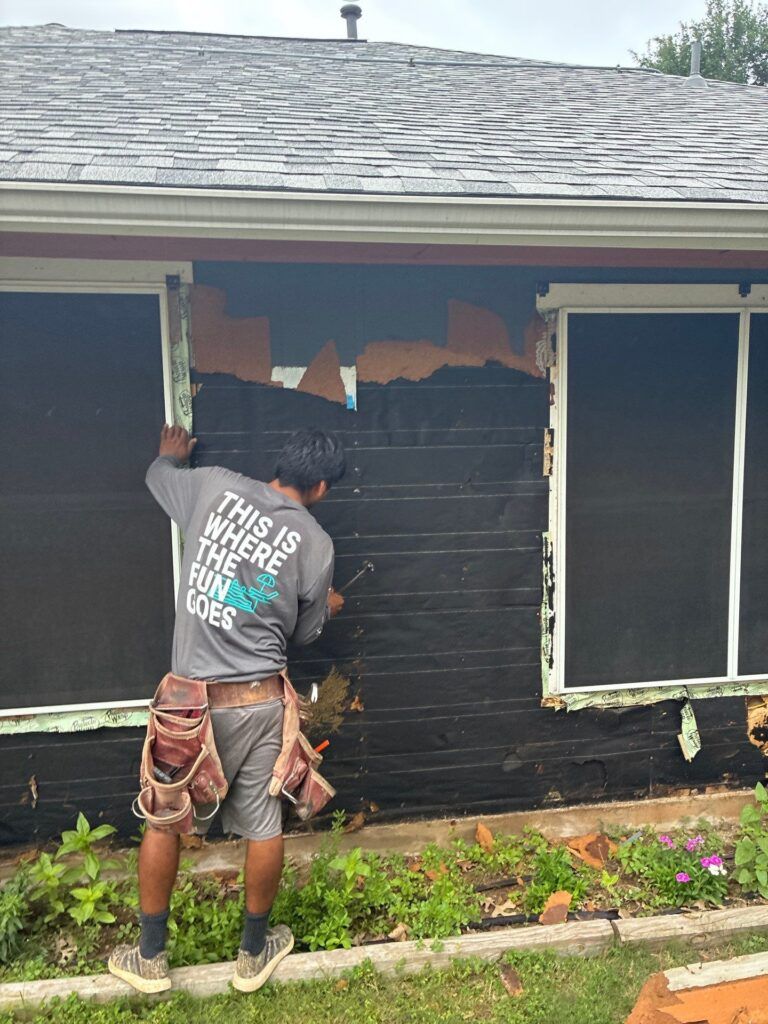
- Hidden rot stays hidden. Siding can look fine from outside while the layers behind it are wet. You only find damaged sheathing by taking the siding off. See what we find behind siding for a real example.
- Window and door trim lose depth. The new siding sits farther out than the old, so existing trim, sills and brick molding can end up nearly flush with or behind the new face. That changes how water sheds at every opening, which is where the code requires flashing.
- Fasteners have to reach structure. Nails have to pass through the old siding and its gaps to reach the sheathing or studs, with the right length and spacing for the wind loads in Hardie’s fastening tables.
- Old problems mirror through. Warped, cupped or wavy siding underneath is the kind of irregularity Hardie says can "mirror through" the new installation.
- Clearances change. Required gaps at the ground, roofs and decks are measured from the new siding. See siding clearance requirements.
Removing the old siding solves all five at once. On our Cherry Creek James Hardie siding replacement, the existing siding was removed first and every exposed wall area was inspected "for hidden moisture, rot, or damage before anything new went up," then a weather-resistant barrier went on before the new siding. If rot is found at that stage, damaged sheathing has to be addressed before new siding goes on. Our guide to siding replacement cost explains how that can change a quote.
When Old Siding Needs Extra Thought
Not every old wall comes apart the same way. Some older homes have panel siding nailed straight to the studs with no separate sheathing. The 2024 IRC lists certain panel sidings, such as hardboard panel siding, among its wall bracing methods (Table R602.10.4), which means that on some walls the old siding may be doing structural work. Before anything is removed from a wall like that, the plan should say how the wall will be braced and sheathed afterward. Ask your contractor to confirm what is behind your siding before the project is priced.
If your existing siding is sound and you mainly want a new look, a repair or repaint may be the better value. Our common siding problems guide covers which issues are repairable and which point to replacement.
Permits and the Wildfire Code in Austin
The City of Austin’s permit-exempt list includes "siding that does not exceed 128 square feet and is not part of a fire-resistance-rated assembly." A whole-house project goes past that, whether the old siding comes off or not, so it needs a permit.
If your home is in Austin’s Wildland-Urban Interface area, the wall materials have to meet the code for your proximity zone, and the City says the WUI rules apply even when no permit is needed. Austin Fire’s approved materials list notes that "siding installed as a rainscreen requires ignition-resistant material or a 1-hour rated wall assembly behind it." If you are in a WUI zone and considering leaving combustible siding behind new cladding, ask the City how that layer is treated before you decide. Our permit and wildfire code guide explains how to check your address.
Driftwood installs James Hardie fiber cement siding as a James Hardie Siding Contractor, and our free estimates start with a look at what is behind your current siding where we can see it. If you are weighing an overlay against a tear-off, we will walk you through what we find.
Sources: James Hardie HardiePlank Lap Siding installation instructions (HZ10, HS11119 12/19), Best Practice Guide (HZ10, version 9.1) and Technical Bulletin 19 (February 2025); James Hardie Siding and Trim Express Limited Product Warranty (effective February 2024); 2024 International Residential Code sections R602.10 and Table R602.10.4, R703.1.1, R703.2, R703.3 and Table R703.3(1), R703.4, R908.3 and R908.4; City of Austin, Work Exempt from Building Permits; Austin Fire, 2024 WUIC Approved Materials List (March 31, 2026). Checked October 2026.
Frequently Asked Questions
Can you put new siding over old siding?
The building code has no rule for walls like the roof rule that requires tear-off, but it does require a continuous water-resistive barrier, flashing that reaches the new wall surface, and fastening into listed supports. James Hardie’s instructions list studs, OSB or equivalent sheathing, and certain foam or gypsum layers as bases; existing siding is not listed.
Can James Hardie siding be installed over existing siding?
James Hardie’s published instructions do not list existing siding as a substrate, and its warranty excludes damage from installation that does not follow those instructions and from water infiltration. Removing the old siding keeps the installation within the published instructions.
Is it cheaper to put siding over old siding?
Skipping tear-off removes one step, but it leaves any rot and the old water barrier in place, and it can require extra work at windows, doors and trim. A quote for each approach, from the same contractor, is the fair way to compare.
What is wrong with siding over siding?
It hides damage in the sheathing, buries the existing water barrier, pushes the wall face out past window and door trim, and can let waves in the old siding show through the new.
Do I need a permit to re-side my house in Austin?
Siding up to 128 square feet that is not part of a fire-resistance-rated assembly is permit-exempt in the City of Austin. A whole-house project is larger than that and needs a permit, with or without tear-off.

Author: Driftwood Builders Roofing
Driftwood Builders Roofing is a family-owned residential roofing company headquartered in Manchaca, Texas, serving Austin and the surrounding Hill Country since 2005. The company has delivered 3,700 full roof replacements and 783 repairs across 3,559 different customers over 20 years in business, with 97 years of combined construction experience across the leadership team and 74 years specifically inside Driftwood Builders. The company holds the highest contractor certifications offered by the major shingle manufacturers, including GAF Master Elite Contractor (the top 3% of GAF contractors nationally), GAF Certified Green Roofer, Owens Corning certified, TAMKO Pro Certified Contractor, and a Berridge Roof Installation Seminar Certificate for standing-seam metal roofs. Driftwood is an NRCA member, holds an Angie's List Super Service Award, is BBB Accredited, and is a GuildQuality member for verified customer satisfaction data. James Hardie certification covers the siding side of the business. Services include residential roof replacement, leak and storm-damage repair, tile roof repair, metal roofing, TPO commercial roofing, roof inspections, hail and storm damage inspections with insurance claim assistance, gutter work, and James Hardie siding. The customer-protection policy is straightforward: Only Pay Upon Completion. The company serves 22 cities across the Hill Country and Greater Austin and holds a 5-star rating across Google, GuildQuality, Angi, Nextdoor, Facebook, Thumbtack, and Yelp.
