Rotted Sheathing Behind Siding: What It Means for Your Siding Replacement
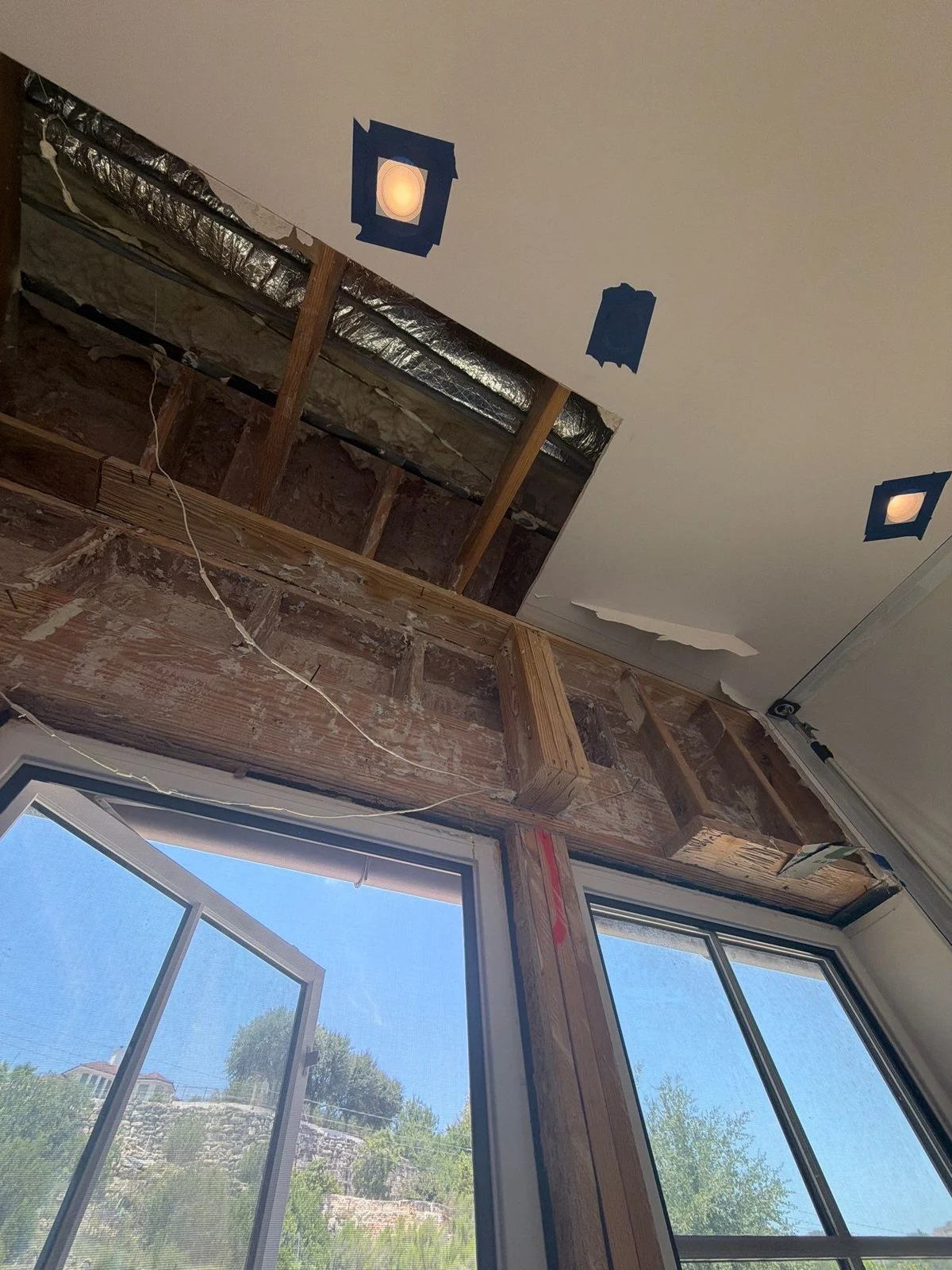
What Sheathing Does Behind Your Siding
Most framed walls have three layers on the outside: sheathing (usually OSB or plywood panels nailed to the studs), a water-resistive barrier such as house wrap or felt, and the siding. The 2024 International Residential Code, which the City of Austin enforces, requires at least one layer of water-resistive barrier "applied over studs or sheathing of all exterior walls," continuous behind the siding. Sheathing is the surface that barrier lies against.
Sheathing also does structural work in many homes. The IRC lists wood structural panel sheathing as one of its wall bracing methods (Table R602.10.4, method "WSP"), with a set nailing pattern at panel edges and in the field. Whether a particular wall's sheathing is part of the bracing depends on how the house was designed, which is one reason sheathing repairs should be treated as more than a cosmetic patch.
For James Hardie fiber cement siding, the sheathing is part of the nailing base. Hardie's HardiePlank instructions say the siding "can be installed over braced wood or steel studs" spaced up to 24 inches on center "or directly to minimum 7/16 in thick OSB sheathing," and add: "Whenever a structural member is present, HardiePlank should be fastened with even spacing to the structural member." The ICC-ES evaluation report for these products also requires horizontal joints to "occur over the solid blocking or wood structural panel sheathing." Soft or crumbling sheathing cannot do any of that.
How Rotted Sheathing Is Found
From the outside, you usually cannot see it. Siding can look normal while the layers behind it are wet. On a Westlake project we wrote about in what we find behind siding, the damage behind the original exterior finish "had never been visible from outside" until the wall was opened for window work.
When the old siding is removed, the sheathing is exposed and can be checked directly. On our Cherry Creek James Hardie siding replacement, the crew inspected every exposed wall area "for hidden moisture, rot, or damage before anything new went up." Signs the crew looks for include:
- Panels that are soft, swollen, delaminated or crumbling at the edges.
- Dark staining or water tracks on the sheathing or the old barrier.
- Fasteners that no longer hold.
- Damage that continues into the studs or the bottom plate.
Where the damage sits helps point to the cause. Damage around one window can point to that opening's flashing. Damage along the bottom of a wall can point toward clearance problems at the ground, a lower roof or a deck. Our common siding problems guide covers the outside signs worth checking before a project starts.
Why Sheathing Rots: Water Management Failures
Siding is not watertight on its own. The IRC requires the wall to prevent "the accumulation of water within the wall assembly" by providing a water-resistive barrier behind the cladding "and a means of draining to the exterior water that penetrates the exterior cladding." Sheathing rots when that system fails and water stays in the wall. The code lists where flashing is required, which is also a list of where water most often gets in:
- Exterior window and door openings.
- Under and at the ends of sills and copings.
- Continuously above projecting wood trim.
- Where porches, decks or stairs attach to the wall.
- At wall and roof intersections.
- Where chimneys or masonry meet frame walls, and at built-in gutters.
The code also requires overlapped flashing to be "applied in shingle fashion," so each upper layer laps over the one below. A barrier that was lapped backward, torn during construction, missing at a transition or simply aged out can let water reach the sheathing for years before anything shows. Two specific details cause a lot of wall rot: missing kickout flashing where a roof edge meets a wall, and siding clearance problems at the ground, roofs and decks. Rot around openings is covered in our guide to window and door trim rot.
What Has to Be Right Before New Siding Goes On
New siding over damaged sheathing would hide the problem and give the new siding a poor nailing base. Before the new siding goes up:
- Damaged sheathing has to be addressed. Replaced sections should be fastened to the framing to the required schedule, and any rot that continues into studs or plates needs its own evaluation. If the damage looks structural, a qualified professional should look at it.
- The wall should be flat. Hardie's instructions warn that "irregularities in framing and sheathing can mirror through the finished application" and say to "correct irregularities before installing siding."
- A continuous water-resistive barrier goes on. Hardie states that a barrier "is required in accordance with local building code requirements" and "must be appropriately installed with penetration and junction flashing."
- The cause is fixed. Flashing at the windows, doors and roof lines that let the water in has to be corrected, or the new sheathing will see the same water.
This matters for your warranty, too. James Hardie's limited product warranty for its siding and trim does not cover damage from "failure to install the Product in compliance with applicable, published James Hardie installation instructions and applicable building codes," from "improper design and/or construction of the underlying wall assembly," or "resulting from water infiltration." In other words, the wall behind the siding is your installer's job to get right, not the manufacturer's. Driftwood's own 2-year workmanship warranty is separate from any manufacturer warranty.
How It Changes Your Scope and Quote
Because nobody can see the sheathing until the siding is off, a fair siding quote treats it as an unknown and says how it will be handled. Our siding replacement cost guide explains why this is the most common reason a final price differs from the estimate. When you compare quotes, ask:
- Is any sheathing replacement included? Some quotes include an allowance; others price it only if needed. Either is fine if it is written down.
- What is the unit price? Ask for a price per sheet or per square foot for sheathing, and a separate line for any framing repair, so extra work is priced the same way on every wall.
- Will you show me before you cover it? Ask for photos of each damaged area with its location before it is repaired and covered.
- Do you need my approval first? The quote should say that work beyond the original scope waits for your sign-off.
- What caused it, and is that fixed in this scope? Replacing sheathing without fixing the flashing that failed leaves you paying for it twice.
Finding rot does not always mean the house needs all-new sheathing. Damage confined to one opening or one wall section is often limited to those panels. Widespread damage, damage into the framing, or damage that keeps appearing wall after wall is a different conversation, and a good contractor will show you which situation you are in rather than assume the worst.
Permits in Austin
The City of Austin's permit-exempt list includes "siding that does not exceed 128 square feet and is not part of a fire-resistance-rated assembly." A whole-house siding replacement goes past that, so it needs a permit. Wall sheathing replacement does not appear on the exempt list, and sheathing can be part of the wall bracing, so if significant sheathing or framing repair turns up, ask whether it changes the permit. If your home is in Austin's wildfire (WUI) area, the City says work must follow the WUI Code even when no permit is needed; the City's rules for roofs are summarized in our permit and wildfire code guide. Outside the City of Austin, check with your own city.
If you are planning a re-side and want to know what you might be dealing with, we offer free inspections and estimates, and we will tell you what we can and cannot see before the siding comes off. Start with our James Hardie siding installation page.
Sources: 2024 International Residential Code sections R602.10 and Table R602.10.4, R703.1.1, R703.2, R703.3 and R703.4; James Hardie HardiePlank Lap Siding installation instructions (HZ10, HS11119 12/19) and Best Practice Guide (HZ10, version 9.1); James Hardie Siding and Trim Express Limited Product Warranty (effective February 2024); ICC-ES ESR-2290, Section 4.2 (revised May 2026); City of Austin, Work Exempt from Building Permits. Checked October 2026.
Frequently Asked Questions
Do you have to replace sheathing when you replace siding?
Not always. Sound, dry sheathing can stay. Sheathing that is soft, delaminated or rotted has to be addressed before new siding goes on, because the siding is fastened through it and the water-resistive barrier is applied over it.
How do you know if the sheathing behind siding is rotted?
Usually only by removing the siding. Outside clues include soft or swollen siding, staining below windows, and rot at trim or roof-to-wall intersections, but the sheathing itself is checked once it is exposed.
What causes OSB sheathing behind siding to rot?
Water that gets past the siding and the water-resistive barrier and stays in the wall. Common entry points are window and door openings, roof-to-wall intersections, deck attachments and missing or reverse-lapped flashing.
Can new siding go over rotted sheathing?
It should not. James Hardie’s instructions call for correcting irregularities in sheathing before installing siding, and its warranty excludes damage from improper construction of the underlying wall assembly and from water infiltration.
How should rotted sheathing be priced in a siding quote?
Ask for a written unit price per sheet or per square foot, a separate line for framing repair, photos of each damaged area, and a requirement that extra work waits for your approval.

Author: Driftwood Builders Roofing
Driftwood Builders Roofing is a family-owned residential roofing company headquartered in Manchaca, Texas, serving Austin and the surrounding Hill Country since 2005. The company has delivered 3,700 full roof replacements and 783 repairs across 3,559 different customers over 20 years in business, with 97 years of combined construction experience across the leadership team and 74 years specifically inside Driftwood Builders. The company holds the highest contractor certifications offered by the major shingle manufacturers, including GAF Master Elite Contractor (the top 3% of GAF contractors nationally), GAF Certified Green Roofer, Owens Corning certified, TAMKO Pro Certified Contractor, and a Berridge Roof Installation Seminar Certificate for standing-seam metal roofs. Driftwood is an NRCA member, holds an Angie's List Super Service Award, is BBB Accredited, and is a GuildQuality member for verified customer satisfaction data. James Hardie certification covers the siding side of the business. Services include residential roof replacement, leak and storm-damage repair, tile roof repair, metal roofing, TPO commercial roofing, roof inspections, hail and storm damage inspections with insurance claim assistance, gutter work, and James Hardie siding. The customer-protection policy is straightforward: Only Pay Upon Completion. The company serves 22 cities across the Hill Country and Greater Austin and holds a 5-star rating across Google, GuildQuality, Angi, Nextdoor, Facebook, Thumbtack, and Yelp.
