GAF Master Elite Contractor | BBB A+ Rated | 5.0 Stars from 265+ Google Reviews | 3,700+ Projects Completed

The September 11, 2026 Schertz Hail Storm: What the Records Show, and What We Found on a Schertz Roof

The September 11, 2026 Schertz Hail Storm: What the Records Show, and What We Found on a Schertz Roof

Short answer. On the night of Friday 11 September 2026 a severe thunderstorm crossed eastern Bexar County. The National Weather Service logged six storm reports across the whole county - five of hail, all of them in and southwest of Converse, and one of a measured 60 mph wind gust at Randolph Air Force Base, just south of Schertz. There is no NWS hail report for Schertz. A commercial forensic hail report for one south Schertz address nonetheless returned an estimated 2.75 inches at 10:02 pm, and we later documented hail damage on a Schertz roof. All three of those statements are true at once, and this page explains why.

What the National Weather Service Actually Logged

These are the preliminary Local Storm Reports issued by the NWS Austin/San Antonio office for Bexar County that night. The full county list is six entries long. Every one of them is below - nothing has been left out to make a point.

LocationReportSize / speedMeasured or estimatedTime (CDT)
3 miles SE of ConverseHail2.50 inEstimated9:59 pm
2 miles S of Schertz (Randolph AFB)Wind gust60 mphMeasured10:04 pm
4 miles SSE of Converse (Paloma subdivision)Hail1.75 inMeasured10:10 pm
2 miles NE of St. HedwigHail1.00 inEstimated10:17 pm
3 miles ENE of KirbyHail1.00 - 1.50 inEstimated10:18 pm
1 mile WSW of China GroveHail1.00 inEstimated10:20 pm

Source: National Weather Service Austin/San Antonio (WFO EWX) preliminary Local Storm Reports, product NWUS54 KEWX, together with Severe Thunderstorm Warning KEWX.SV.W.0170.

Schertz does appear in the warning itself. The 10:10 pm Severe Thunderstorm Warning named San Antonio, Schertz, Cibolo, Converse, Universal City, Live Oak, Randolph AFB, Kirby, St. Hedwig and China Grove in its list of locations impacted, and warned of "hail damage to roofs, siding, windows, and vehicles".

Worth being precise about. A warning polygon is a forecast of where a storm is heading, not a record of what it did. Being named in a warning is not evidence that hail fell on your street, and we are not going to present it as though it were. Equally, not being named in a storm report is not evidence that hail missed you. Both errors are common and both cost homeowners money.

Why There Is No NWS Hail Report for Schertz

This trips people up, and adjusters sometimes lean on it, so it is worth understanding.

Local Storm Reports are reports of opportunity. They are not a survey and they were never intended to be a damage map. The NWS logs what reaches it: a trained spotter who calls in, a public photograph it can verify, an automated station that records a gust. Six reports exist for the whole of Bexar County on a night when a severe storm crossed the most densely populated part of it. That number tells you about reporting, not about hail.

The Randolph AFB entry illustrates the point neatly. It is the only measured report in the county that night, and it exists because an automated weather station sits on the airfield and recorded a gust. There is no comparable instrument in a residential Schertz subdivision. Nobody measures hail in a back garden unless they happen to go outside with a ruler.

So the honest reading of the record is this: the storm was severe, it was over the Schertz and Randolph area at around 10:02 to 10:04 pm, it produced a measured 60 mph gust there, and it produced verified hail of 1.75 to 2.50 inches a few miles southwest. What it did on any individual Schertz roof is not in the federal record either way.

What a Forensic Hail Report Showed for One Schertz Address

Insurance carriers and contractors both use commercial hail-verification services, which model hail at a specific address from radar data and ground reports. We obtained one for a property in south Schertz, ZIP 78154. The address is withheld for the homeowner’s privacy.

FieldValue
ReportStormIntel Verify hail history report, WeatherGuidance Forensics Unit
Search period19 September 2025 to 19 September 2026 (a full year)
Event returned11 September 2026, 10:02 pm
Estimated hail size at the property2.75 in
Maximum within 1, 2, 3 and 5 miles3.00 in at every radius
Any other qualifying hail event in the 12-month windowNone

Three things about that report are worth drawing out.

The timing corroborates the federal record rather than floating free of it. 10:02 pm sits between the 9:59 pm Converse hail report and the 10:04 pm Randolph AFB gust. Three independent sources put the same storm over the same ground within five minutes.

It is the only qualifying event in a full year. The service searched twelve months and returned one date. Where a roof in that area has hail damage, there is only one storm in the past year it can reasonably be attributed to. That single-event picture is unusually clean, and it is the most useful line in the document.

It is an estimate, and we are labelling it as one. The report states its own method: examination of ground-based storm reports and radar-indicated hail detection algorithms. That is a model, not a measured stone. It is the same class of evidence carriers use, which is precisely why it is worth having - but it is not the same thing as somebody catching a hailstone and putting a tape measure across it.

What We Documented on a Schertz Roof

Weather data describes the sky. It does not tell you what happened to your roof. So we went and looked at one.

Everything below was photographed during a Driftwood Builders Roofing inspection in Schertz. To be exact about what these images do and do not establish: they show the condition of a roof. They do not, by themselves, date the damage. Storm timing comes from the weather record above; the photographs show what is on the shingles.

What one hail impact looks like
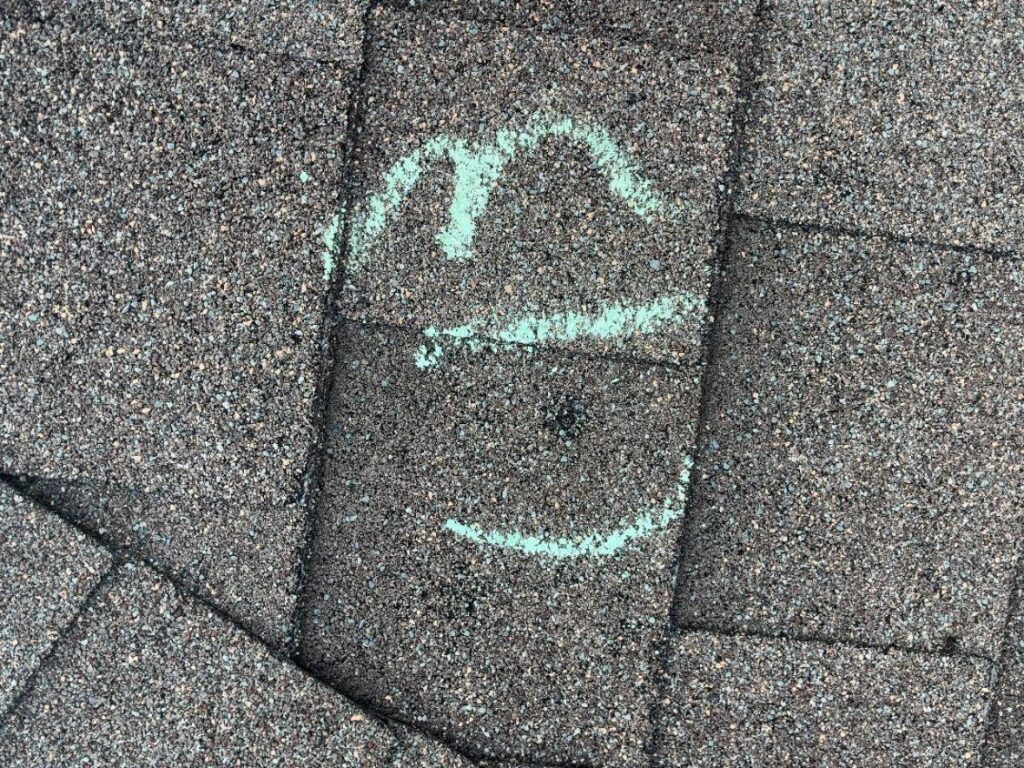
Close-up of a single hail impact circled in chalk on an asphalt shingle, with granule loss visible at the centre of the strike
A single impact, circled. The granule surface has been driven off and the asphalt mat beneath is bruised and soft to the touch. Ordinary weathering thins granules evenly across a whole shingle. It does not produce a dented centre like this one. Observed during a Driftwood Builders Roofing inspection in Schertz, Texas.

What several impacts in a small area look like
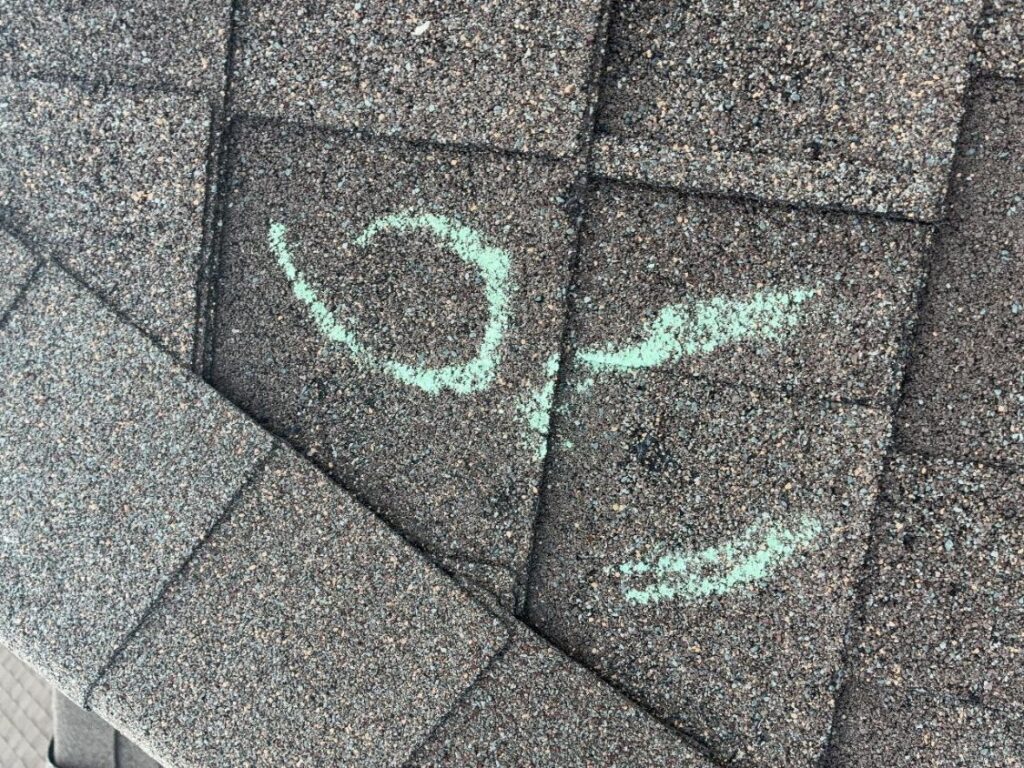
Two chalk-circled hail impacts on adjacent asphalt shingles during a Schertz, TX roof inspection
Two separate strikes on neighbouring shingles. Concentration matters: a roof can show one impact and be perfectly serviceable, while a roof showing this density across an elevation is a different conversation. Observed during a Driftwood Builders Roofing inspection in Schertz, Texas.

What countable damage across a whole slope looks like
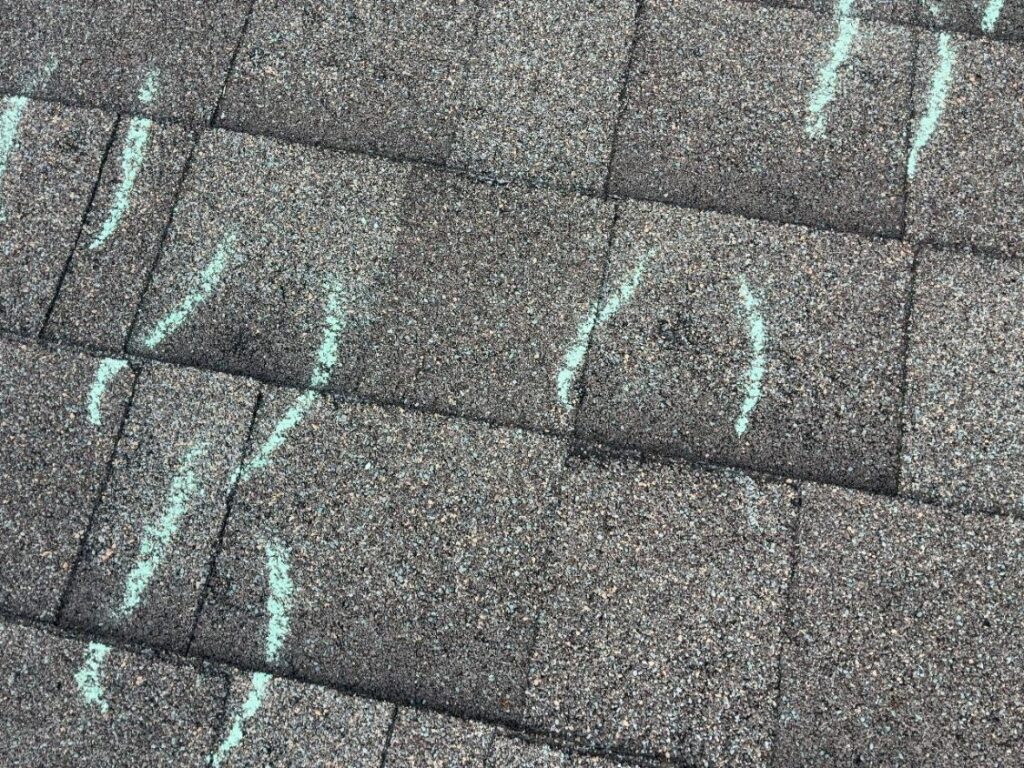
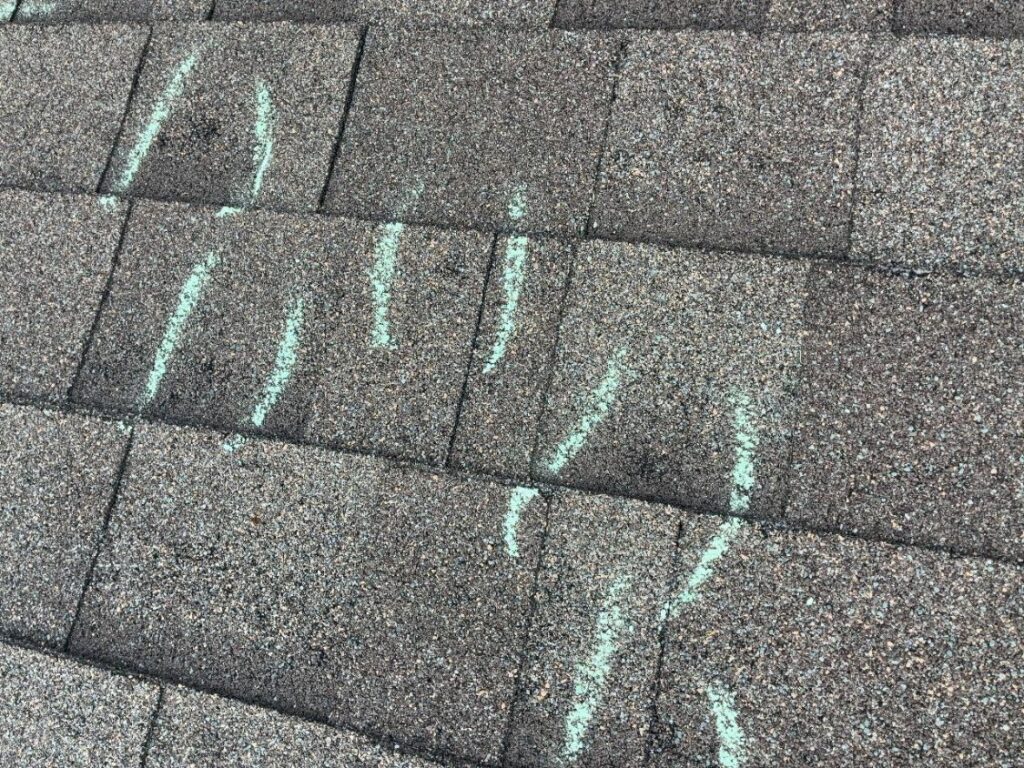
Multiple hail impacts individually marked in chalk across one asphalt shingle slope
Impacts marked individually as they were found, so that every number in the final report traces back to a specific shingle rather than to an opinion. Observed during a Driftwood Builders Roofing inspection in Schertz, Texas.
Chalk marks recording repeated hail strikes across several courses of asphalt shingles
The same slope, further across. What turns scattered marks into a finding is the count per area, repeated consistently over the elevation. Observed during a Driftwood Builders Roofing inspection in Schertz, Texas.

Marks get made in more than one colour on a roof, for ordinary reasons - a different slope, a different day, a different person holding the chalk. The colour carries no meaning of its own:
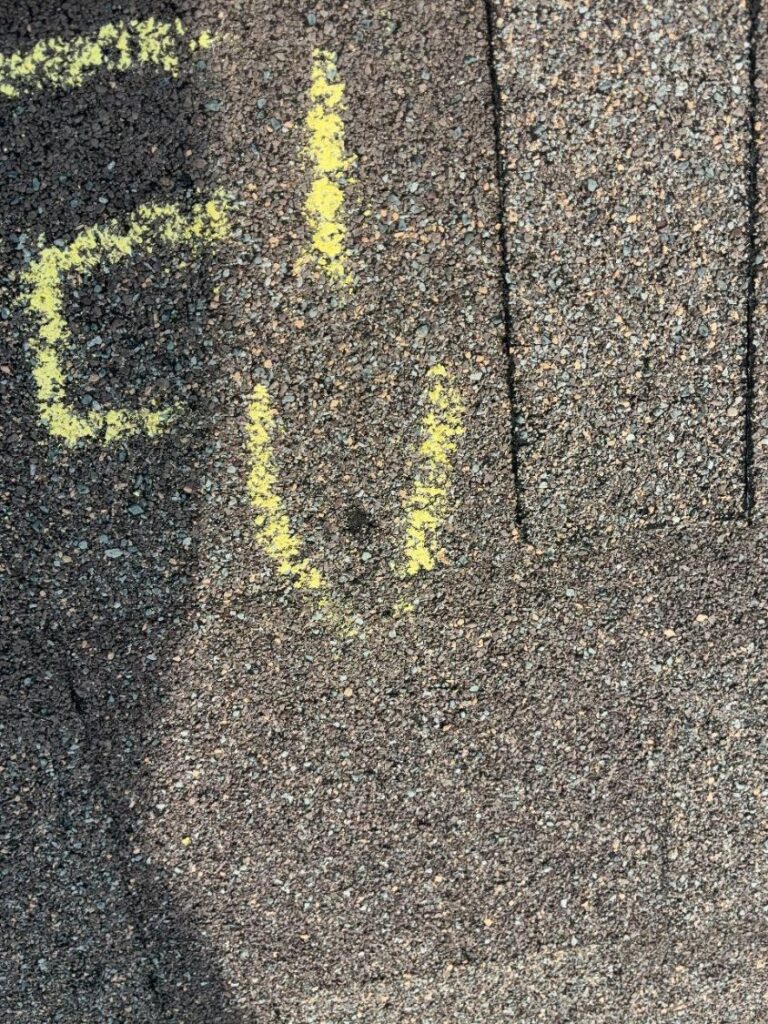
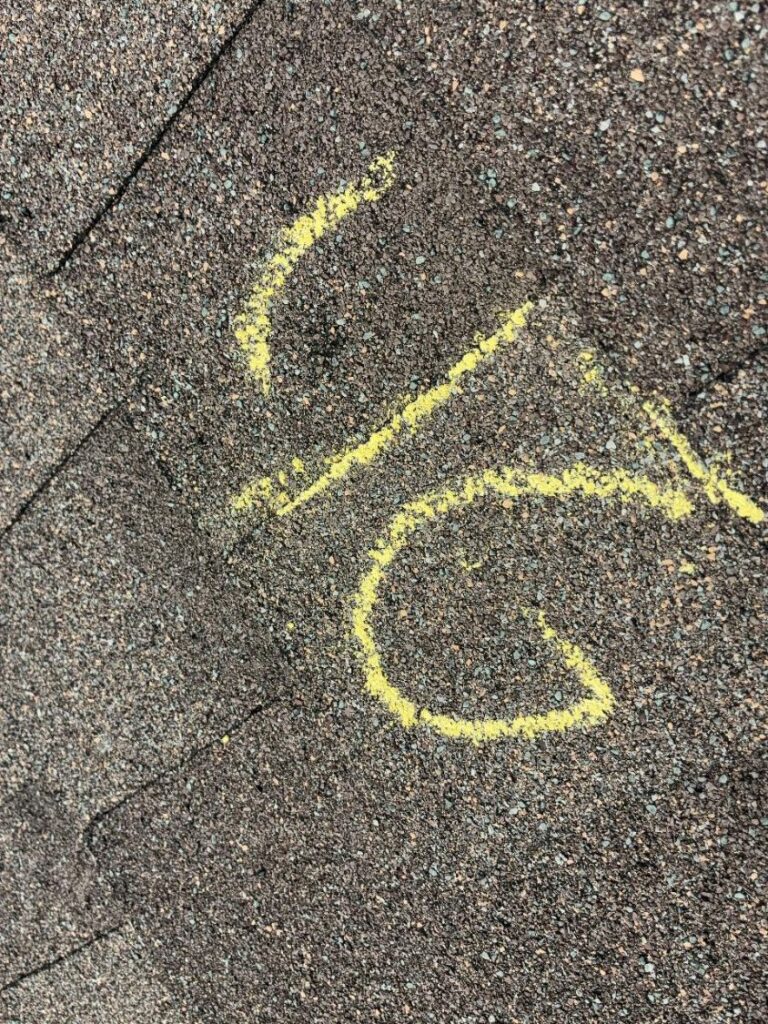
Hail impact marked in yellow chalk on an asphalt shingle, with a darkened strike point visible
An impact marked in a second chalk colour on the same property. What matters is the strike inside the mark, not the colour of the mark. Observed during a Driftwood Builders Roofing inspection in Schertz, Texas.
Hail impact circled in yellow chalk with a tally mark recorded beside it
Another, with a tally recorded beside it. Counting is the point of marking at all - a mark that is never counted into a total does not tell you anything about the roof. Observed during a Driftwood Builders Roofing inspection in Schertz, Texas.

Collateral damage to roof components
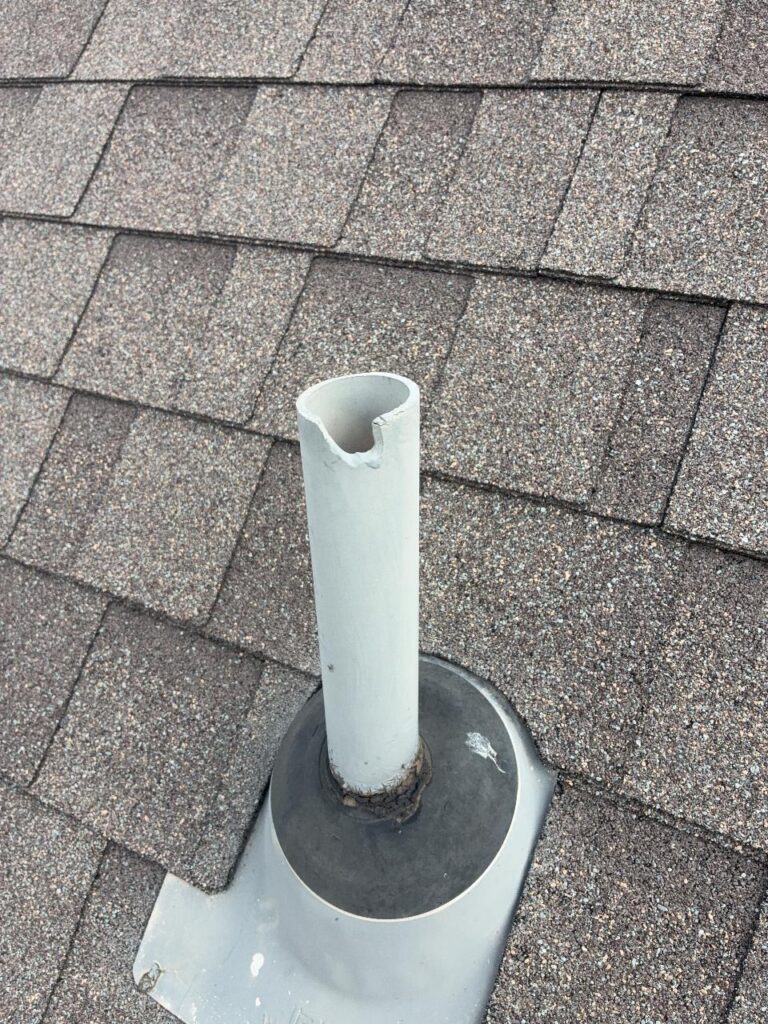
PVC plumbing vent pipe with a chip broken out of its rim, and cracked sealant where the pipe meets its flashing boot
A chip broken clean out of the rim of a PVC plumbing vent, with cracked sealant at the base where the pipe meets its boot. Brittle components like this one record a strike unambiguously - plastic does not chip itself. Observed during a Driftwood Builders Roofing inspection in Schertz, Texas.
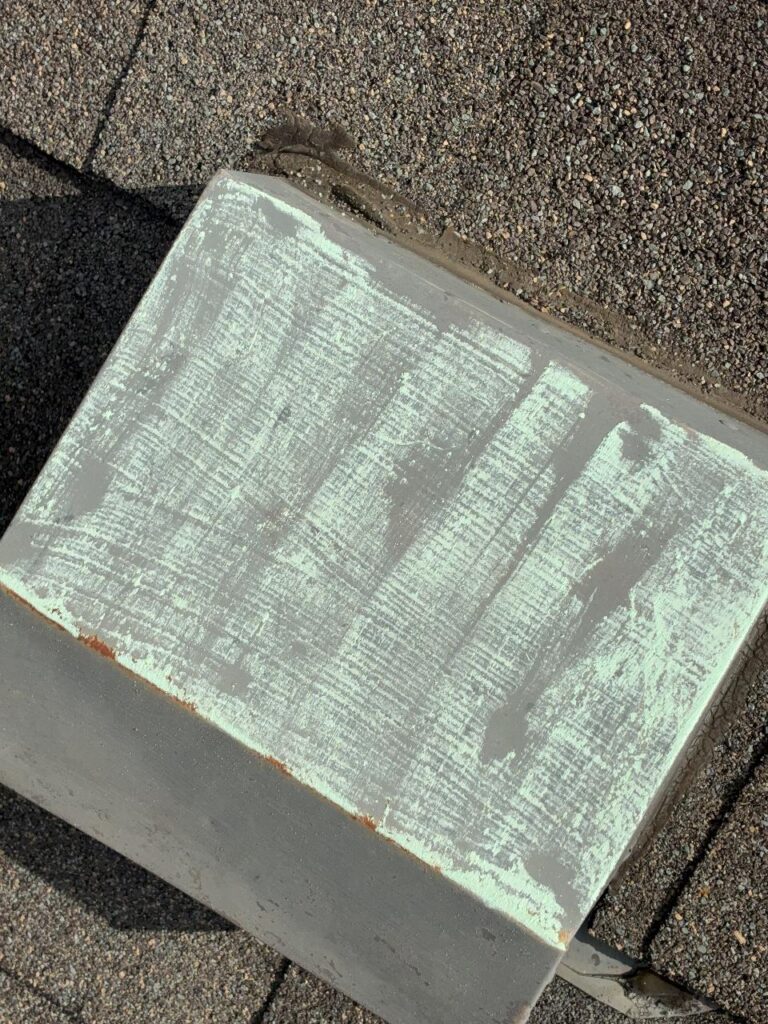
Chalk rubbed across the top of a metal roof vent, revealing scuffed impact marks in the soft metal
The top of a metal roof vent with chalk rubbed flat across it, bringing out impact scuffing that is close to invisible in raw daylight. Observed during a Driftwood Builders Roofing inspection in Schertz, Texas.

Collateral components carry disproportionate weight in an assessment, because they are difficult to explain away as age. A twenty-year-old shingle and a twenty-year-old shingle with hail damage can look similar to an untrained eye. A chipped vent rim looks like exactly one thing.

Isolated Marks Versus Widespread Damage

This is the distinction that decides most Texas hail files, and it is the one most likely to be misrepresented to you in a driveway.

Not every mark on a roof is hail. Foot traffic from a previous trade leaves scuffs. Manufacturing flecks, blister pops, granule shedding from normal ageing and mechanical damage from a dropped tool all leave marks that a person motivated to find hail can find hail in. A genuine hail impact has a recognisable signature - a roughly circular area of displaced granules with a bruised, slightly soft mat underneath, and it tends to appear with consistent directionality across a slope rather than at random.

The step that matters is counting a defined area, then repeating it on every elevation. One impact tells you a stone landed. A consistent count across multiple slopes, together with matching damage to the soft metals and the penetrations, tells you the roof took a storm.

A chalk circle is not proof of anything by itself. Chalk is a tool for making a mark visible in a photograph. It carries no authority. Anyone can draw a circle on a roof, and a circle drawn around a scuff is still a scuff. When we inspect a roof that has already been marked by somebody else, we evaluate the underlying surface independently rather than adopting the previous marks - and a homeowner is entitled to ask any contractor, including us, to explain what is inside a given circle and why it counts.

Does This Mean a Repair or a Replacement?

Neither this page nor any single photograph on it can answer that, and it would be dishonest to imply otherwise.

The decision turns on the whole roof rather than on the worst image of it. What actually goes into it:

  • How widespread the damage is, measured consistently by area and repeated on every elevation, not judged from the worst square metre.
  • The age and remaining service life of the covering. The same impact count means something different on a roof with twenty years left than on one with three.
  • The material. Three-tab, architectural asphalt, impact-resistant Class 4 and metal all respond to hail differently and are all repaired differently.
  • Whether the existing shingle can still be matched. A discontinued line or a weathered colour that no longer matches can turn a technically repairable slope into a replacement.
  • The condition of what is underneath. Decking, underlayment and fastener integrity all bear on whether a patch is sound or merely cosmetic.
  • Collateral damage. Flashing, penetrations, vents, gutters and siding often determine the scope more than the field shingle does.
  • How many slopes are affected. One elevation is a different proposition from four.

A thorough inspection gathers all of that and puts it in front of you. What it will not do is pretend the answer was obvious from a photograph.

What to Do Now, in Order

  1. Check what you can see from the ground first. Gutters, downspouts, window screens, the metal of any vent visible from the yard, and your garden furniture and vehicles. Soft metals dent where shingle hides the same blow. You do not need a ladder for any of this, and you should not get on the roof.
  2. Photograph what you find, with dates. Your own photographs cost nothing and are worth having.
  3. Get the roof inspected and documented by someone who will show you the evidence slope by slope. Ours is free and the report is yours to keep. See the Schertz hail damage inspection page for what that involves.
  4. Then decide about a claim, with the report in hand and your deductible in mind. That order matters. A claim filed before anyone has established whether there is damage worth claiming can work against you.
Free Schertz roof inspection. Full photo report, documented slope by slope, yours to keep whether or not you file anything or hire anyone. Serving Schertz, Converse, Universal City and St. Hedwig.

Elsewhere in the Storm’s Path

Converse took the most thoroughly documented damage from this storm, including the only measured hail report of the night. If you are in or near Converse, the Converse hail and insurance claim guide covers the event and the claims process in considerably more depth.

The verified hail corridor ran southwest from Converse toward Kirby and China Grove, and east toward St. Hedwig. Universal City was inside the warned area but has no confirmed hail report from that night.

Frequently Asked Questions

Did it hail in Schertz, Texas on September 11, 2026?

The National Weather Service did not log a hail report for Schertz that night. Its only Schertz-area entry is a measured 60 mph wind gust at Randolph Air Force Base. However, a third-party forensic hail report for one address in south Schertz (78154) returned an estimated 2.75 inches of hail at 10:02 pm on September 11, and we documented hail damage on a Schertz roof during a later inspection. The absence of an NWS report is not evidence that no hail fell.

How big was the hail near Schertz?

It depends entirely on which source you use and where you stand. The nearest NWS ground reports are in Converse, about five to eight miles southwest: 2.50 inches roughly three miles southeast of Converse, and a measured 1.75 inches in the Paloma subdivision. For one south Schertz address, a StormIntel forensic report estimated 2.75 inches at the property and up to 3.00 inches within a mile. That last figure is a vendor estimate derived from radar and ground reports, not a measured stone.

Why is there no National Weather Service hail report for Schertz?

Because Local Storm Reports are reports of opportunity, not a survey. The NWS logs what someone tells it - a trained spotter, a public social media post, an automated station. If nobody in a given neighbourhood reported hail, or nobody the NWS could verify, no report exists for that neighbourhood. Six reports exist for the whole of Bexar County that night. That is a measure of who reported, not of where hail fell.

My adjuster says there was no hail reported in Schertz. What do I do?

Ask which dataset they are working from. The NWS storm-report record and commercial forensic hail datasets are built differently and routinely disagree at neighbourhood scale. The useful response is not an argument about maps but evidence from the roof itself: dated, located photographs of individual impacts, soft-metal damage and collateral components. That is what an inspection is for.

Do the photographs on this page prove when the hail fell?

No, and we will not claim otherwise. The photographs show hail damage observed on a Schertz roof during an inspection. They do not, on their own, establish the date the damage occurred. Storm timing comes from the weather record; the photographs show condition. We keep those two things separate deliberately.

Does hail damage always mean a full roof replacement?

No. Whether a roof is repaired or replaced depends on how widespread the damage is, not just whether damage exists - plus the age and material of the roof, whether matching shingles can still be sourced, the condition of the decking and underlayment, damage to flashing and penetrations, and how many slopes are affected. A single photograph of a single impact does not settle any of that.

Driftwood Builders Roofing
AUTHOR

Author: Driftwood Builders Roofing

Driftwood Builders Roofing is a family-owned residential roofing company headquartered in Manchaca, Texas, serving Austin and the surrounding Hill Country since 2005. The company has delivered 3,700 full roof replacements and 783 repairs across 3,559 different customers over 20 years in business, with 97 years of combined construction experience across the leadership team and 74 years specifically inside Driftwood Builders. The company holds the highest contractor certifications offered by the major shingle manufacturers, including GAF Master Elite Contractor (the top 3% of GAF contractors nationally), GAF Certified Green Roofer, Owens Corning certified, TAMKO Pro Certified Contractor, and a Berridge Roof Installation Seminar Certificate for standing-seam metal roofs. Driftwood is an NRCA member, holds an Angie's List Super Service Award, is BBB Accredited, and is a GuildQuality member for verified customer satisfaction data. James Hardie certification covers the siding side of the business. Services include residential roof replacement, leak and storm-damage repair, tile roof repair, metal roofing, TPO commercial roofing, roof inspections, hail and storm damage inspections with insurance claim assistance, gutter work, and James Hardie siding. The customer-protection policy is straightforward: Only Pay Upon Completion. The company serves 22 cities across the Hill Country and Greater Austin and holds a 5-star rating across Google, GuildQuality, Angi, Nextdoor, Facebook, Thumbtack, and Yelp.

author avatar
Nicholas Riley

Leave a Comment

Your email address will not be published. Required fields are marked *

Scroll to Top