How Old Is My Roof? How to Find Out in Austin
Start With the Paperwork
A roof does not come with a birth certificate, but the people who paid for it usually kept records. Check these first:
- Contractor invoice or contract. If you or a previous owner replaced the roof, the invoice shows the date and usually the shingle product.
- Warranty documents. A workmanship warranty from the installing contractor, or a manufacturer warranty certificate, can show when the work was done.
- Your home inspection report. If you bought the house with an inspection, the report may comment on the roof's apparent age or condition. Treat any age it gives as the inspector's estimate unless it cites a document.
- Closing and listing documents. Listing descriptions sometimes mention a "new roof" with a year. Ask your agent or title company for copies if you no longer have them.
- The house's construction year. If you can confirm the roof has never been replaced, its age is roughly the age of the house.
If the house changed hands, the previous owner or their agent may still have the roofer's name. A contractor's own job records can confirm a date even when the homeowner's copy is lost.
The Seller's Disclosure From Your Purchase
Texas sellers of previously occupied homes give buyers a written disclosure notice. The Texas Real Estate Commission's current form, TREC No. 55-1, has a line for "Roof Type" and "Age (approx.)," and it also asks whether the seller knows of roof defects or "Previous Structural or Roof Repair."
Look for the disclosure in your purchase file. Keep in mind that the age line is the seller's approximation, based on what they knew. It is a good lead, not proof. If it names a year, try to match it to an invoice or a permit.
If you are on the other side of this, getting ready to sell, see What to Look for in a Roof When Buying a Home for what buyers will be checking.
City of Austin Permit Records, and Why They Are Often Missing
The City of Austin's Austin Build + Connect (AB+C) portal has a Public Search for permits and case history, and the City says it does not require registration. Searching your address can turn up roofing permits, along with other work on the house.
There is an important catch. The City's list of work exempt from building permits includes asphalt shingles that replace existing asphalt shingles, and replacing a roof covering in a way that does not affect the roof structure. Those exemptions do not apply in the Wildland-Urban Interface (WUI) area when 50% or more of the roofing is replaced, and replacing more than 128 square feet of roof decking also falls outside them. So:
- A permit on file is good evidence of when roofing work was done.
- No permit on file does not mean the roof is original. A permit-exempt shingle replacement would not show up.
Outside the City of Austin, each city, and each county for unincorporated areas, keeps its own records and sets its own permit rules. Check with the building department where your home is located. For more on which roof jobs need a permit inside the city, see our Austin roof permit guide.
What the Roof Itself Can (and Cannot) Tell You
Physical clues can narrow things down, but they are rough estimates, not dates. Here is what is worth noticing:
- Shingle type. GAF describes 3-tab shingles as single-layer shingles with "a uniform, flat appearance," cut into three equal tabs, and architectural shingles as multiple laminated layers with "a more three-dimensional look." The type tells you what was installed, not when. GAF still sells both types today, so the style alone does not date the roof. Our guide to dimensional vs. 3-tab shingles shows the difference.
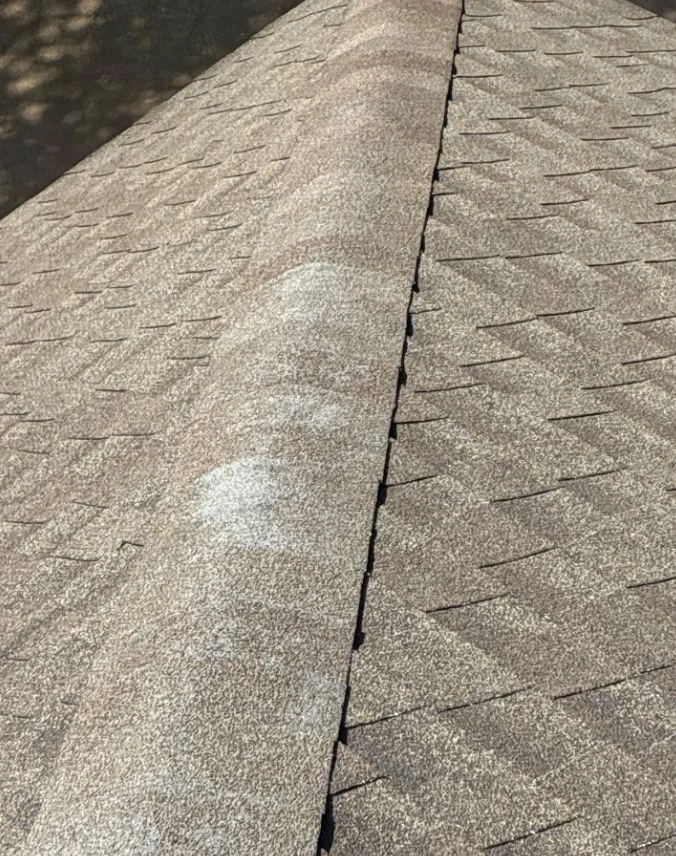
- Wear. Granule loss, curling, cracking and brittle shingles point to an older roof, but heat, hail, ventilation and installation quality all speed up or slow down wear. Two roofs of the same age can look very different. See roof granule loss: when to worry.
- Mismatched sections. Shingles of different colors or styles on different slopes can mean part of the roof was replaced or repaired at a different time.
Appearance alone cannot give you an exact installation date, so be cautious of anyone who tells you a precise age from looks alone. Use these clues to decide whether the paperwork search is worth pursuing, and to judge condition.
When Your Insurer Asks About Roof Age
Roof age questions often come from insurance. In a September 29, 2026 release, the Texas Department of Insurance said insurers cannot decline or nonrenew a homeowners policy based solely on the age of the house or of components such as the roof, but may consider physical condition. The rule is 28 TAC §21.1006, which is in force; TDI has also proposed a clarifying amendment.
That is an underwriting rule, about whether a policy is written or renewed, and it is separate from how a claim is decided. If your insurer has asked for an inspection or sent a letter saying the roof needs replacing, see Insurance Company Says You Need a New Roof? For questions about your policy, the TDI consumer line is 800-252-3439.
Why Condition Matters More Than the Number
Knowing the age helps you plan, but the decision to repair, replace or wait depends on condition. A roof with a single damaged area and flexible, well-granulated shingles is a repair candidate whatever its age. Widespread granule loss, brittle or cracking shingles across several slopes, or repeated leaks in different places point toward replacement. For how long different roofing materials tend to last here, see How Long Does a Roof Last in Austin and Central Texas?, and for the decision itself, repair vs. replacement.
Not sure how old your roof is?
Driftwood Builders Roofing offers free roof inspections. We will look at the roof and, where accessible, the attic, photograph what we find, and give you a photo report you can keep with your house records or share with your insurer or a buyer. Request a free roof inspection, or call (512) 894-0129.
Sources: City of Austin Development Services, Austin Build + Connect (AB+C) page; City of Austin, Work Exempt from Building Permits; Texas Real Estate Commission, Seller's Disclosure Notice, TREC No. 55-1; Texas Department of Insurance news release, September 29, 2026, and 28 TAC §21.1006; GAF, "Types of Roof Shingles for Houses" (RoofViews, June 26, 2026).
Frequently Asked Questions
Can I look up my roof's age by address?
Partly. Inside the City of Austin, the AB+C Public Search can show permits for your address. But many like-for-like shingle replacements in the city are permit-exempt, so they will not appear. Paperwork from the last replacement is usually the better record.
Does no roofing permit mean my roof is original?
No. The City of Austin exempts asphalt shingles that replace asphalt shingles, outside the WUI 50% case, so a replacement may have been done legally without a permit.
Can a roofer tell how old my roof is by looking at it?
Only roughly. Shingle type and wear give clues, but heat, hail, ventilation and installation quality change how fast a roof ages. A good inspector will describe condition and give an estimate, not an exact date.
Where does the seller's disclosure list roof age?
TREC No. 55-1 has a line for Roof Type and Age (approx.). It is the seller's approximation, so try to confirm it with an invoice or permit.
Can my insurer drop me just because my roof is old?
Under the TDI rule described in its September 29, 2026 release, insurers cannot decline or nonrenew based solely on the age of the roof, but they may consider its physical condition. For questions about your policy, contact TDI at 800-252-3439.

Author: Driftwood Builders Roofing
Driftwood Builders Roofing is a family-owned residential roofing company headquartered in Manchaca, Texas, serving Austin and the surrounding Hill Country since 2005. The company has delivered 3,700 full roof replacements and 783 repairs across 3,559 different customers over 20 years in business, with 97 years of combined construction experience across the leadership team and 74 years specifically inside Driftwood Builders. The company holds the highest contractor certifications offered by the major shingle manufacturers, including GAF Master Elite Contractor (the top 3% of GAF contractors nationally), GAF Certified Green Roofer, Owens Corning certified, TAMKO Pro Certified Contractor, and a Berridge Roof Installation Seminar Certificate for standing-seam metal roofs. Driftwood is an NRCA member, holds an Angie's List Super Service Award, is BBB Accredited, and is a GuildQuality member for verified customer satisfaction data. James Hardie certification covers the siding side of the business. Services include residential roof replacement, leak and storm-damage repair, tile roof repair, metal roofing, TPO commercial roofing, roof inspections, hail and storm damage inspections with insurance claim assistance, gutter work, and James Hardie siding. The customer-protection policy is straightforward: Only Pay Upon Completion. The company serves 22 cities across the Hill Country and Greater Austin and holds a 5-star rating across Google, GuildQuality, Angi, Nextdoor, Facebook, Thumbtack, and Yelp.
