Should You Replace Gutters When You Replace Your Roof?
Why Gutters and Roofs Meet at the Same Detail
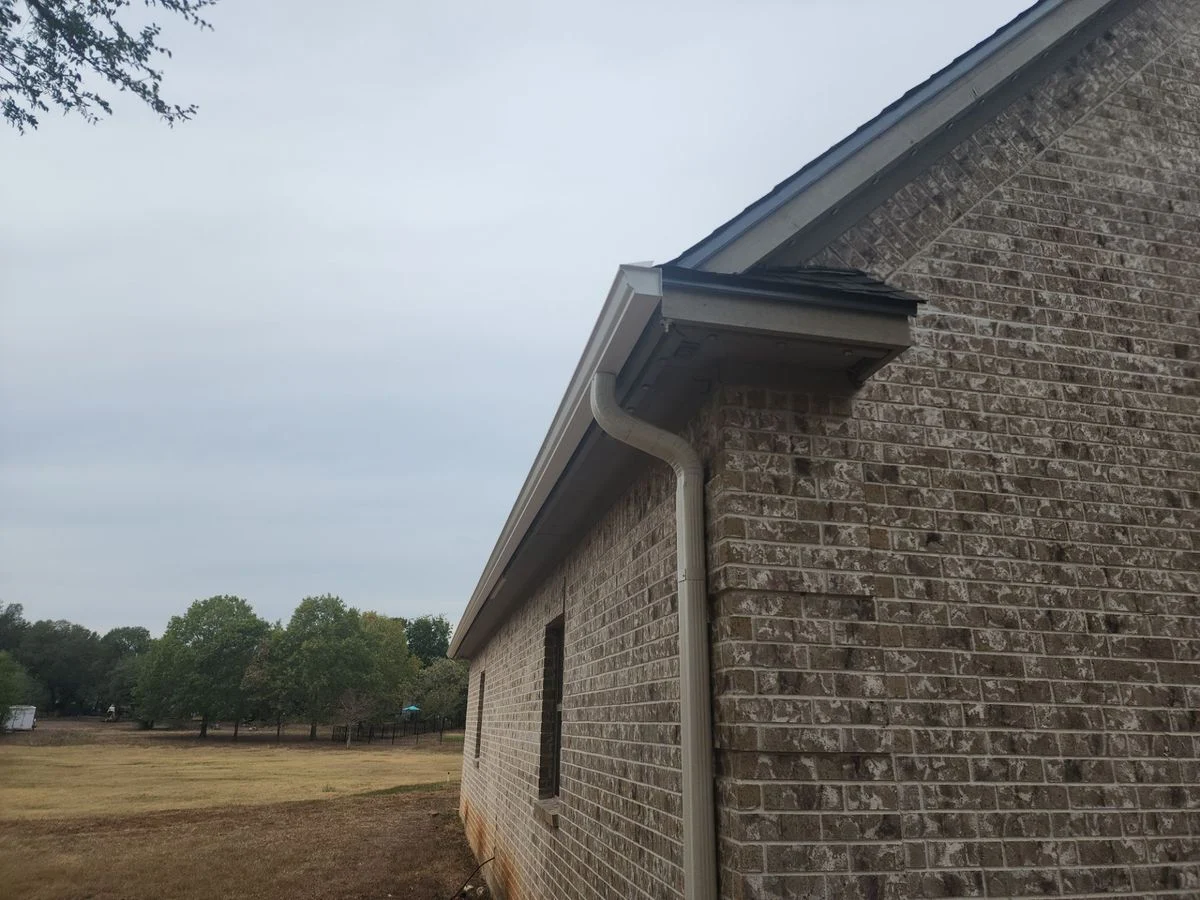
A gutter hangs on the fascia board at the bottom edge of the roof. Directly above it, along the edge of the roof deck, sits the drip edge: a strip of bent metal that carries water off the shingles and past the fascia so it lands in the gutter instead of running back onto the wood. The shingles, the underlayment, the drip edge, the fascia and the gutter all come together in a few inches of roof edge.
That is why gutters come up on almost every reroof. To replace the drip edge and underlayment at the eaves properly, the crew needs clear access to that edge. Depending on how the gutters are attached, they may have to be loosened, removed and rehung, or worked around. Either way, the new drip edge has to end up directing water into the gutter, not behind it.
For more on why this small piece of metal matters, see Drip Edge: The Detail That Costs Roofs Their Warranty.
What the Code Says About Drip Edge
The City of Austin enforces the 2024 International Residential Code, and Austin's local amendments to the roofing chapter cover only wood shingle and shake materials. For shingle roofs, section R905.2.8.5 says: "A drip edge shall be provided at eaves and rake edges of shingle roofs." It also sets the details:
- adjacent pieces overlap at least 2 inches
- drip edge extends at least 1/4 inch below the roof sheathing and at least 2 inches back onto the roof deck
- it is mechanically fastened to the deck no more than 12 inches apart
- "Underlayment shall be installed over the drip edge along eaves and under the drip edge along rake edges."
The eave detail is the one that touches your gutters. The drip edge sits on the deck at the eave, the underlayment laps over it, and the drip edge's lower edge has to hang far enough below the sheathing to drop water clear of the fascia. When gutters are kept, the installer has to make sure the reset gutter sits where that water lands.
When You Can Keep Your Gutters
Plenty of gutters outlive a roof. Keeping and resetting them is reasonable when all of these are true:
- Seams and corners are sound. A few leaking joints can usually be resealed.
- They drain. Sections that hold standing water can often be rehung to the right slope.
- Hangers hold. Runs that have pulled away can usually be re-secured, as long as the fascia behind them is solid.
- They keep up with the roof. No repeated overflow at the same corner or valley during heavy rain.
- No major damage. No hail dents, corrosion, or runs patched again and again.
If the gutters pass, ask your roofer to note in the estimate whether they will be detached and reset, and who is responsible for rehanging them to the right slope.
When It Makes Sense to Replace Them Too
Replacing gutters at the same time as the roof makes sense when:
- They sag or pull away from the house. This is often a fascia problem, covered below.
- They leak along the run, not just at one joint.
- They overflow in the same spot every storm. Sometimes the fix is more or larger downspouts rather than new gutters, and sometimes the run is undersized for the roof area, pitch or valley draining into it.
- They are dented, rusted or split, or have been repaired so often that patching is no longer good value.
- You are changing the roof edge. New fascia, a different drip edge profile, or a new roof line on an addition.
Bigger is not automatically better. A 6-inch gutter moves more water than a 5-inch one, but sizing should follow the roof area draining into each run, the pitch, any valleys, and downspout placement. Our gutter installation page explains how we size runs on site.
Fascia Rot Found Behind Gutters
Gutters hide the board they hang on. When gutters come off during a reroof, the fascia behind them can be seen properly for the first time. Sometimes it has stained, softened or rotted from water held behind the gutter or running past a missing or short drip edge. Rotted fascia cannot hold gutter fasteners, so it has to be repaired before any gutter, old or new, is hung back on it. That is also the main reason a gutter starts pulling away from the house; see Gutters Pulling Away From Fascia.
Inside the City of Austin, replacing exterior trim, fascia and soffit is on the City's list of work exempt from a building permit. For what fascia and soffit repair usually involves, see our soffit and fascia repair guide.
Austin Notes: Drainage, Soil and the Wildfire Code
Drainage and foundations. The 2024 IRC (R801.3) says that where expansive or collapsible soils are known to exist, homes must have a controlled method of roof water disposal that discharges "not less than 5 feet (1524 mm) from foundation walls or to an approved drainage system." Gutters are part of how that water gets moved away from the house. If you have soil movement or foundation concerns, see gutters and foundation problems on expansive clay.
Wildland-Urban Interface (WUI). If your home is in the City of Austin's WUI area, the City's WUI code page says "Gutters and downspouts shall be constructed of non-combustible materials," with non-combustible leaf guards. A roof replacement is a practical time to bring gutters into line, since the crew is already working at the roof edge. Our Austin roof permit and wildfire code guide explains how to check your address.
Questions to Ask Your Roofer
- Will my gutters be removed and reset, and is that included in the estimate?
- What drip edge profile are you using, and how will it sit relative to the gutter?
- What will you do if the fascia behind the gutters is rotted, and how will that be priced?
- Are my gutters and downspouts sized for the roof areas and valleys draining into them?
- If I keep my gutters, who rehangs them and checks the slope?
One contractor handling both the roof and the gutters can plan the whole roof edge as one job. Driftwood Builders Roofing installs roofs and gutters and repairs fascia and soffit, so the drip edge, fascia and gutters can be worked out together.
Planning a new roof?
Ask for a free estimate and we will check your gutters, fascia and drip edge at the same visit and tell you plainly whether your gutters can stay. See gutter installation in Austin or roof replacement in Austin.
Sources: 2024 International Residential Code sections R905.2.8.5 and R801.3; City of Austin Ordinance No. 20250410-040 (building code adoption); City of Austin, Work Exempt from Building Permits; City of Austin Fire Department, Wildland-Urban Interface Code page.
Frequently Asked Questions
Do roofers remove gutters during a roof replacement?
Often the gutters have to be loosened, removed or worked around so the drip edge and underlayment can be installed at the eaves. Ask your roofer whether yours will be detached and reset and whether that is included in the estimate.
Is drip edge required in Austin?
Yes, for shingle roofs. The 2024 IRC, which Austin enforces, says a drip edge shall be provided at eaves and rake edges of shingle roofs, and sets overlap, extension and fastening requirements.
Should I replace gutters before or after a new roof?
If both are being done, the roof edge comes first: fascia repairs, drip edge and underlayment, then shingles, then the gutters are hung on sound fascia. Replacing gutters before a reroof risks having them disturbed when the roof edge is redone.
Can I keep my old gutters with a new roof?
Yes, if the seams are sound, they drain, the hangers hold, they keep up with heavy rain, and the fascia behind them is solid. They then need to be reset so they catch the water coming off the new drip edge.
Do I need a permit to replace fascia in Austin?
Inside the City of Austin, replacing exterior trim, fascia and soffit is on the City's permit-exempt list. Outside the city, check with your own city.

Author: Driftwood Builders Roofing
Driftwood Builders Roofing is a family-owned residential roofing company headquartered in Manchaca, Texas, serving Austin and the surrounding Hill Country since 2005. The company has delivered 3,700 full roof replacements and 783 repairs across 3,559 different customers over 20 years in business, with 97 years of combined construction experience across the leadership team and 74 years specifically inside Driftwood Builders. The company holds the highest contractor certifications offered by the major shingle manufacturers, including GAF Master Elite Contractor (the top 3% of GAF contractors nationally), GAF Certified Green Roofer, Owens Corning certified, TAMKO Pro Certified Contractor, and a Berridge Roof Installation Seminar Certificate for standing-seam metal roofs. Driftwood is an NRCA member, holds an Angie's List Super Service Award, is BBB Accredited, and is a GuildQuality member for verified customer satisfaction data. James Hardie certification covers the siding side of the business. Services include residential roof replacement, leak and storm-damage repair, tile roof repair, metal roofing, TPO commercial roofing, roof inspections, hail and storm damage inspections with insurance claim assistance, gutter work, and James Hardie siding. The customer-protection policy is straightforward: Only Pay Upon Completion. The company serves 22 cities across the Hill Country and Greater Austin and holds a 5-star rating across Google, GuildQuality, Angi, Nextdoor, Facebook, Thumbtack, and Yelp.
