Roof Repair in Converse, TX
If your roof has a specific problem (a leak, missing shingles, damaged flashing, a failed pipe boot, storm damage in one area), this page is about fixing it rather than replacing the roof.
That distinction matters commercially. After a hail event a lot of companies arrive in a market where, remarkably, every roof needs replacing. Plenty of Converse roofs need a repair, and we would rather do a $600 repair well and be the company you call in six years than sell you a roof you did not need.
Driftwood Builders Roofing has worked Central Texas since 2005. GAF Master Elite (roughly the top 3% of roofers nationally), BBB accredited A+, 4.9 stars across 265+ reviews, and no deposit required.
Where Roof Leaks Actually Come From
Almost never the middle of a shingle field. Leaks happen at transitions: wherever the roof plane is interrupted by something else.
- Flashing at walls, chimneys and roof-to-wall junctions. The single most common source, and the most commonly botched repair, because sealant looks like a fix and is not one.
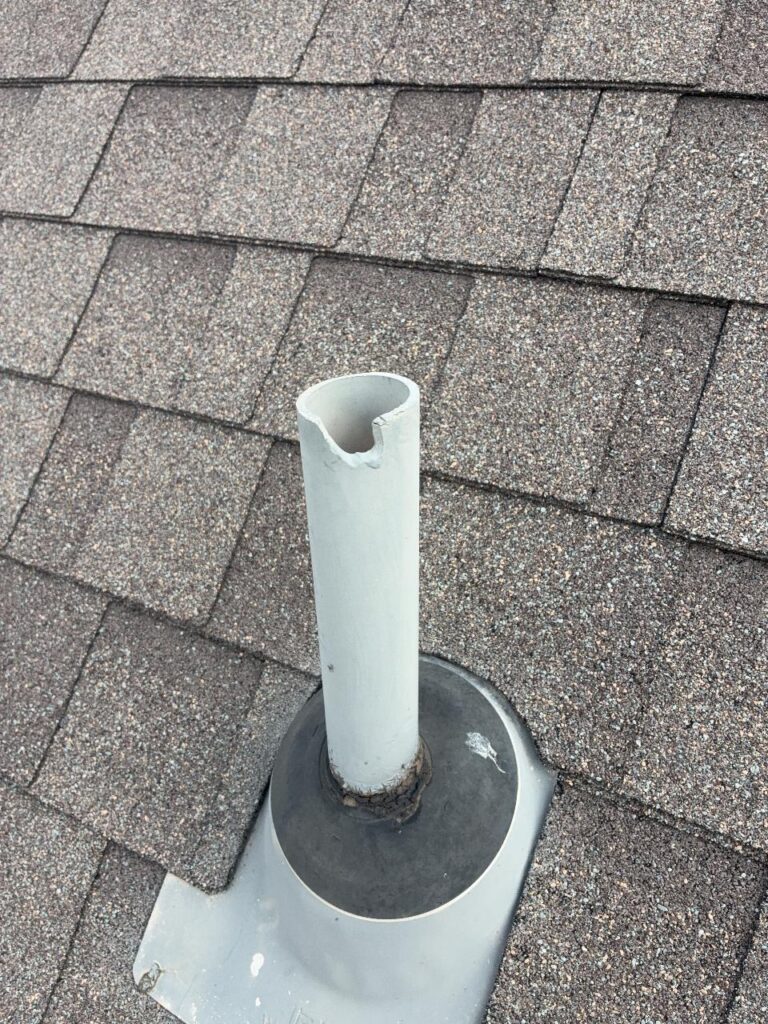
- Pipe boots. The rubber collar around plumbing vents. UV kills rubber faster than it kills shingles, so boots fail at 10 to 15 years on a roof with life left.
- Valleys, where two planes meet and water volume concentrates.
- Skylight curbs. Almost always the flashing or curb, not the glass.
- Vents and turbines, especially where hail has dented the housing or backed out fasteners.
- Drip edge and eaves, where wind-driven rain gets behind the edge.
One thing to know before you start pulling ceilings apart: water travels. It runs along the underside of the deck, along rafters, along insulation, and drops where gravity finally wins. The stain on your ceiling marks the exit, not the entry. Finding the actual breach is the work.
What causes roof leaks around chimneys and vents? Austin, TX: what causes leaks around chimneys and vents, which is where most of them start.
What Is Roof Flashing and Why Is It So Important? | Austin, TX Roofing Tips: what flashing is and why it matters more than the shingles around it.
A Converse Leak Source, Photographed
The section above says that on the tract-built homes that make up most of Converse, leaks start at a penetration rather than out in the open field of the roof. This is one of them, on a local roof.
The Repairs We Do Most Often
| Problem | Usual cause | Proper repair |
|---|---|---|
| Leak near a chimney or wall | Failed or reused step/counter flashing | Rebuild the flashing, not seal over it |
| Ceiling stain under a vent | Cracked pipe boot | Replace the boot |
| Missing or lifted shingles | Wind, or high/improper nailing | Replace and re-nail to pattern |
| Leak in a valley | Debris, failed valley metal | Clear, and re-line if the metal has gone |
| Dented vents and caps | Hail | Replace the housing |
| Recurring leak after prior repairs | The wrong problem was fixed | Full diagnosis before any more work |
| Soft spot underfoot | Rotten decking under an old leak | Open up, replace decking, re-dry-in |
Two failure modes specific to this housing stock. Converse is mostly tract-built homes with a median build year of 2003, which means a lot of roofs are on original or first-replacement coverings with original pipe boots, well past the age where rubber fails. And improper nailing from a previous fast re-roof shows up as lifted or sliding shingles years later. Both are repairable; both get misdiagnosed as “the roof is worn out”.
Why Is My Roof Leaking After Rain? Austin, TX Roofer Finds the Real Cause: tracing a leak that only appears after rain to its real cause.
Storm and Wind Damage Repair
After the September 11, 2026 hailstorm, a lot of Converse homes have damage that is genuinely repairable rather than a full replacement.
Wind damage tends to be directional and concentrated at edges, ridges and rakes: lifted tabs, creased shingles, missing shingles in a line. The Weather Service measured a 60 mph gust at Randolph AFB that night, two miles from Converse. Creasing is the one to catch, because a creased shingle has a broken seal and will fail in the next storm even though it is still in place.
Hail damage is scattered rather than directional: bruised mats, fractured shingles, dented soft metal. Whether it is a repair or a replacement is decided by how widely it is distributed, not by how bad any one impact looks.
The honest framing: hail that is truly confined to one slope is a repair. Hail found consistently in test squares across several elevations is not, and no amount of patching will change that. We set out how that decision should be evidenced in roof repair vs roof replacement in Converse, and the ground-level checks you can do yourself are in spotting hail damage without climbing.
On emergency response: we prioritise active leaks and can tarp to stop water. We deliberately do not advertise a guaranteed response time for Converse. We are based in Manchaca, and publishing a number we cannot commit to for every call would be exactly the kind of promise this industry is full of. Call and we will tell you realistically when we can be there.
How We Diagnose a Leak
- Interior first. Where the stain is, how far it spreads, whether it is active, and what is directly above it.
- Attic, where accessible. This is where leaks are actually solved. Wet decking, rusted nails, daylight, staining on rafters and the trail the water has taken.
- Exterior, working uphill from the interior evidence. Every penetration, flashing run and valley above the suspected area.
- Test squares if hail is involved, so the repair-or-replace question is answered with counts rather than opinion.
- Photograph everything, including what is fine. You get the report either way.
- Written scope naming what failed, what we propose, and what it costs.
If the honest answer is that there is no roof problem (and sometimes it is condensation, a plumbing leak or an HVAC pan), you get told that. Full detail of what a proper inspection covers is on our Converse roof inspection page.
When Repair Stops Making Financial Sense
A repair is the wrong answer when any of these is true:
- The roof is past roughly 18 to 20 years. Brittle shingles crack when lifted, so the repair creates its own damage.
- You have had three or more repairs in a few years. That is a system failure, not a spot failure.
- Damage is distributed across multiple slopes.
- Decking is compromised over a meaningful area.
- Granule loss is widespread with bare mat showing.
The trap is the middle case, and in Converse it is common: moderate hail damage on a roof that was already 18 to 22 years old. Both readings are defensible, which is exactly why the evidence has to be documented rather than asserted. If replacement is where you land, roof replacement in Converse covers the process, and how long a roof lasts here explains why so many local roofs are at this decision point at once.
When Does a Roof Repair Make More Sense Than Roof Replacement? Austin, TX: when a repair genuinely makes more sense than a replacement.
What Repairs Cost, and Whether to Claim
A localised repair is generally a few hundred to a few thousand dollars, depending on what failed, how accessible it is, and whether decking is involved. A full replacement on a typical Converse home starts around $10,000, so the two are not close. Full pricing context is on our Converse roof cost page.
On insurance: most repairs are not worth claiming. Texas wind and hail deductibles are frequently a percentage of dwelling coverage (commonly $4,000 to $8,000 on a $400,000 home), which usually exceeds the repair cost outright. Opening a claim that pays nothing still puts a claim on your record.
Where a claim does make sense, what we can do is inspect, photograph, document, prepare a scope and meet your adjuster to explain what we found. What we cannot do, and no Texas roofer can, is interpret your policy, determine coverage, negotiate your claim, or waive your deductible, which is a criminal offense in Texas. See does homeowners insurance cover hail damage in Converse.
Get it looked at. Free inspection, photographs, written report, no deposit, and an honest answer about whether you need a repair, a replacement, or nothing at all. Request a free inspection, call (512) 894-0129, or see what else we handle as a Converse roofing company.
Frequently Asked Questions
How much does a roof repair cost in Converse?
A localised repair is usually a few hundred to a few thousand dollars depending on what failed and how accessible it is. We price from a measured scope after looking at it, never over the phone. For context, a full replacement on a typical Converse home starts around $10,000, so the two are different orders of magnitude.
Where do most roof leaks actually come from?
Not the middle of a shingle field. Most leaks are at transitions: flashing where the roof meets a wall or chimney, pipe boots, valleys, skylight curbs and vent penetrations. That is why a competent leak diagnosis starts at the penetrations rather than at the stain on your ceiling.
Why is the leak showing up far from where the water gets in?
Water travels along the underside of the deck, along rafters and along insulation before it drops. The interior stain marks where gravity finally won, not where the breach is. Finding the actual entry point is the diagnostic work; patching the stain area achieves nothing.
Can you repair a roof that is 20 years old?
We can, but past roughly 18 to 20 years in Central Texas heat it is often poor value. Shingles that age are brittle enough that lifting them to make the repair damages the surrounding material, and you are spending money to protect an asset with little life left.
Do you offer emergency roof repair?
We respond to active leaks as a priority and can tarp to stop water ingress. We deliberately do not advertise a guaranteed response time for Converse, because we are based in Manchaca and it would not be honest to promise a number we cannot commit to for every call. Phone us and we will tell you realistically when we can be there.
Is a repair covered by insurance?
Sometimes, but frequently it is not worth claiming. Texas wind and hail deductibles are often a percentage of dwelling coverage, commonly $4,000 to $8,000, which usually exceeds the cost of a localised repair. A great many legitimate repairs are simply paid out of pocket, and that is normally the better outcome for you.
What is a pipe boot and why does it fail?
It is the rubber collar sealing where a plumbing vent passes through the roof. UV degrades rubber far faster than it degrades shingles, so boots commonly crack and leak at 10 to 15 years on a roof that otherwise still has life. It is one of the most common and cheapest genuine repairs we do.
Will a repair match my existing shingles?
Rarely exactly. Colour weathers over twenty Texas summers and product lines get discontinued. We get as close as the material allows and will tell you honestly beforehand if the repair is going to be visible from the street.
Do I need a permit for a roof repair in Converse?
Requirements differ between a full re-roof and a minor repair. Converse publishes a specific Re-Roof Permit Application rather than a general roofing permit, so for a small patch it is worth asking the Building Department directly on 210.658.5356 rather than assuming either way.
Can you repair storm damage rather than replacing the roof?
If the damage is genuinely isolated, yes. After hail the deciding evidence is test squares: damage confined to one area on one slope points to repair, while a consistent impact count across several slopes points to replacement. We will show you the counts rather than just giving you a verdict.
What about a leak around a skylight?
Skylight leaks are usually flashing or the curb rather than the glass unit. They need proper step and counter flashing rebuilt, not sealant smeared around the frame. Sealant is a temporary measure that buys weeks, not a repair.
Do you charge for the inspection?
No. Inspections in Converse and northeast Bexar County are free and come with photographs and a written report, including when the report says the roof is fine and no work is needed.
Related Converse Guides
The research behind the decision, written for Converse rather than adapted from generic advice.
- How much does a roof cost in Converse? Published ranges by material and roof size, and what moves the number after tear-off.
- Does insurance cover hail damage here? RCV vs ACV, percentage deductibles, roof age, and what a contractor legally cannot do.
- Best roofing material for hail Class 4, metal and tile measured against the hail sizes this area actually gets.
- Roof repair vs replacement How the decision should be evidenced with test squares rather than opinion.
- How long does a roof last here? Why a thirty-year shingle gives fifteen to twenty in Central Texas heat.
- Hail damage to windows and to siding The two surfaces you can check from the ground.
- The September 11, 2026 hailstorm guide Every storm report the Weather Service logged, the warning timeline, and what to do first.
Sources and Notes
Housing data: U.S. Census Bureau, American Community Survey 2019 to 2023 five-year estimates for Converse city, Texas.
Storm data: National Weather Service Austin/San Antonio, Local Storm Reports and Severe Thunderstorm Warning 0170, September 11 to 12, 2026. The 60 mph gust at Randolph AFB is a measured AWOS observation.
Permits: City of Converse Building Department, 406 S. Seguin, Converse, TX 78109, 210.658.5356.
Deductible and claim-handling law: Texas Insurance Code Chapter 707 and §4102.163; Texas Department of Insurance, Roofing and insurance: Know the law.
Repair cost figures are indicative ranges, not quotes. Every repair is priced from a measured scope after inspection. This page is general information, not insurance or legal advice.

Author: Driftwood Builders Roofing
Driftwood Builders Roofing is a family-owned residential roofing company headquartered in Manchaca, Texas, serving Austin and the surrounding Hill Country since 2005. The company has delivered 3,700 full roof replacements and 783 repairs across 3,559 different customers over 20 years in business, with 97 years of combined construction experience across the leadership team and 74 years specifically inside Driftwood Builders. The company holds the highest contractor certifications offered by the major shingle manufacturers, including GAF Master Elite Contractor (the top 3% of GAF contractors nationally), GAF Certified Green Roofer, Owens Corning certified, TAMKO Pro Certified Contractor, and a Berridge Roof Installation Seminar Certificate for standing-seam metal roofs. Driftwood is an NRCA member, holds an Angie's List Super Service Award, is BBB Accredited, and is a GuildQuality member for verified customer satisfaction data. James Hardie certification covers the siding side of the business. Services include residential roof replacement, leak and storm-damage repair, tile roof repair, metal roofing, TPO commercial roofing, roof inspections, hail and storm damage inspections with insurance claim assistance, gutter work, and James Hardie siding. The customer-protection policy is straightforward: Only Pay Upon Completion. The company serves 22 cities across the Hill Country and Greater Austin and holds a 5-star rating across Google, GuildQuality, Angi, Nextdoor, Facebook, Thumbtack, and Yelp.
