What are the Dark Streaks on my Roofing Shingles?
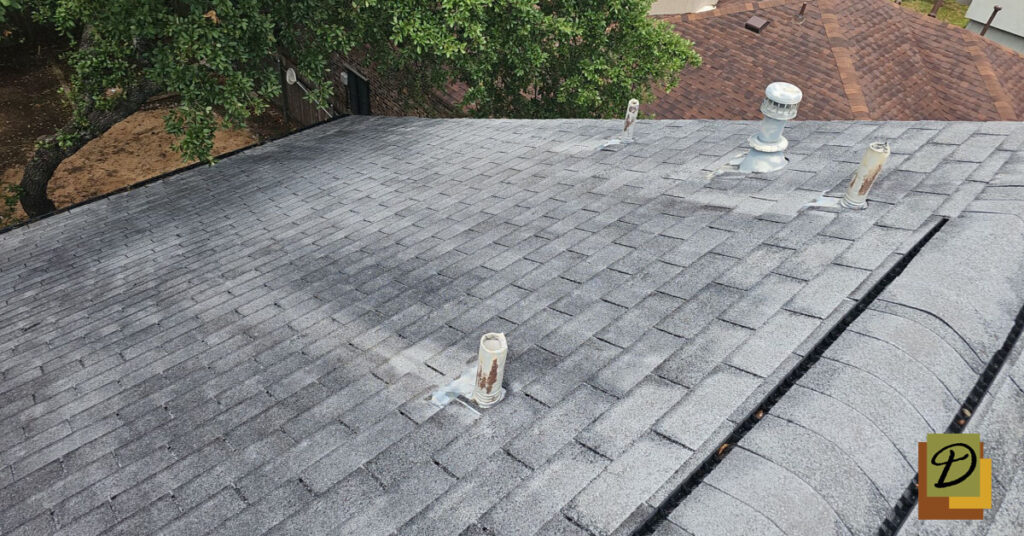
What causes the dark streaks on roof shingles?
The dark streaks on roof shingles are caused by a hardy airborne algae called Gloeocapsa magma. Spores drift onto the roof, and wherever the surface stays damp long enough they establish colonies. The algae is photosynthetic, so it makes its own energy from sunlight rather than eating the roof, but it draws minerals from the calcium carbonate (limestone) filler that manufacturers blend into asphalt shingle granules. That mineral source is why modern asphalt roofs support it so readily, and why a metal or tile roof on the same street can stay clean.
What you actually see is not the algae itself but the dark, pigmented sheath the colonies produce to shield themselves from ultraviolet light. That sheath is why the stain reads as black or charcoal grey rather than green, and why it runs in long vertical streaks: rain carries spores and cells downhill from the ridge, so the colony spreads in the direction the water flows.
Streaks appear first where shingles stay warm and damp for long stretches. In Central Texas our humid spells between storms, heavy spring rains, and dense tree cover give algae exactly the moisture it needs. If you are weighing whether the problem is cosmetic or structural, a trusted Austin roofing company can tell the difference quickly.
Are those black streaks on your roof algae, mold, or dirt?
Almost always algae. Homeowners routinely call the marks mold, and roof-cleaning advertising often encourages that, but true mold is uncommon on an exposed, sun-baked shingle surface. The distinction is worth getting right, because these growths differ a great deal in how much harm they do and in how they should be treated.
| What is on the roof | How to recognise it | How much it matters |
|---|---|---|
| Algae (Gloeocapsa magma) | Flat black or dark grey vertical streaks running down the slope, with no thickness to them | By far the most common cause; cosmetic in its early years |
| Moss | Green, spongy, visibly raised clumps, usually along shingle edges and in valleys | The genuinely damaging one: it holds water and lifts shingle edges |
| Lichen | Crusty grey-green patches that look painted on and cling tightly to the granules | Slow growing, but can pull granules away if scraped off |
| Mold or mildew | Fuzzy and patchy; far more likely in the attic or on shaded siding than on open shingles | Rare on a roof surface; if present, look for a moisture problem underneath |
| Dirt, soot and debris | Grey or brown film, heaviest near chimneys, vents and tree lines | Washes off; no biological growth involved |
| Granule loss | Bare, darker patches showing the shingle mat through the surface, not streaks | Not a stain at all, but a wear signal |
Dark streaks versus dark spots on shingles
Streaks and spots point at different things, and it is worth telling them apart before booking any work. Long vertical streaks that follow the flow of water down a slope are algae. Scattered dark spots or dots on an otherwise clean slope usually are not: more often they are the shingle mat showing through where granules have worn away, blistering, or simple shading variation between shingle bundles on a newer roof.
The practical rule is that streaked means stained, and patchy means worn. If the dark areas are scattered rather than streaked, the real question is about shingle condition rather than cleaning. The section on when cleaning is not enough covers what to look for.
Do black streaks damage shingles, or are they just cosmetic?
Mostly cosmetic at first, and that is the honest answer for the majority of stained roofs we look at around Austin. Algae does not eat asphalt, it does not puncture shingles, and a streaked roof is not automatically a failing roof. Plenty of the streaked roofs we inspect have years of service left in them.
Over a long enough period the picture does change. The dark sheath absorbs heat the granules were designed to reflect, so a heavily stained slope runs hotter and ages a little faster. The colony also holds moisture against the surface, and sustained damp accelerates the granule loss that ages a shingle and shortens its service life. These are slow, cumulative effects measured in years: a reason to deal with staining eventually, not a reason for alarm.
Moss is the growth that genuinely damages a roof. Because it grows thick and holds water like a sponge, it lifts shingle edges and keeps the surface permanently wet, which is a far more direct route to leaks than a flat algae stain. If what you are looking at is raised and green rather than flat and black, treat it as the more urgent problem.
The deciding factor is never the stain itself; it is what the shingles underneath are doing. A sound roof with heavy streaking is a cleaning job. A roof with streaking plus granule loss, cracking or curling has a condition problem, and the staining is incidental to it. If you can see soft spots, exposed shingle mat, or interior signs of water, book a roof inspection rather than a cleaning.
Why do streaks form on north-facing and shaded roof sections first?
Algae needs moisture and shade to take hold, so the north-facing and tree-covered slopes of your roof are usually the first to streak. These sections get the least direct sun, which means morning dew and rainwater linger instead of drying off quickly.
- Heavy tree cover blocks sunlight and traps moisture against the shingles.
- North and east slopes dry slowest and stay damp longest after rain or dew.
- Debris buildup from leaves and twigs holds water in place and feeds growth.
- Low-slope sections shed water more slowly than steep ones, so they stay wet longer.
This is why one slope of a roof can look badly stained while the sunny side stays clean. In Austin neighborhoods with mature live oak canopy the shaded slopes often stain years ahead of the rest of the roof, and homes backing onto greenbelt tend to show it first. The pattern is normal, and it is a useful clue when diagnosing dark streaks on roof shingles.
Why a new roof can streak within a year or two
It catches homeowners off guard, but a roof only a year or two old can start streaking on its shaded side while the rest still looks new. Nothing is defective. Algae responds to how long a slope stays wet, not to how old the shingles are, so a heavily shaded north or east slope under mature canopy can support growth almost immediately while the sunny slopes stay clean for years.
That same mechanism explains why one side of a roof looks markedly darker than the other. It is a difference in drying time, not a difference in materials or workmanship. If a newer roof is streaking unevenly, the useful question is what keeps that slope damp (overhanging limbs, shade thrown by a neighboring structure, or poor attic ventilation) rather than whether the shingles were installed correctly.
How do you remove black streaks from roof shingles?
Roof algae is removed with a low-pressure chemical clean, the method the industry calls a soft wash. A cleaning solution is applied at roughly garden-hose pressure, given time to work, and then rinsed away. The chemistry does the work, not force. Done properly, the streaks are gone in a single visit and the granules stay where they belong. Asphalt shingle manufacturers and the industry association both point to this kind of low-pressure approach rather than mechanical cleaning. Check the cleaning instructions for your specific shingle before any work starts, since they govern your warranty.
What you should not do is pressure wash an asphalt roof. The granules are the shingle’s UV armour, and they are only embedded in the asphalt surface. A pressure washer strips them off, so a roof that looks clean afterwards can be measurably older for it. Scraping, wire brushing and stiff-bristle scrubbing do the same damage. Many manufacturers restrict or void warranty coverage on a pressure-washed roof, and why pressure washing is risky in Texas goes through that in more detail.
Treat the safety side seriously. Roof cleaning is one of the more dangerous pieces of home maintenance there is: it combines a ladder, a sloped surface, and chemicals that make that surface slicker still. A wet, algae-covered slope is slippery in a way a dry one simply is not, and steep or two-story roofs raise the stakes further. If you are not confident and properly equipped, this is work worth handing to someone insured to do it.
Protect what is underneath. Cleaning runoff carries solution off the roof into gutters, downspouts, foundation beds and lawn, and it can damage plantings that have not been pre-wet and rinsed. A competent crew saturates the landscaping before starting, tarps anything sensitive, and keeps rinsing during and after the wash. It is a fair question to ask any contractor how they will handle runoff before work begins.
One expectation worth setting: cleaning removes the stain, but it does not remove the conditions that produced it. Unless the shade, the moisture, or the prevention side is addressed as well, expect the streaks to return within a few years.
When cleaning is not enough: signs the shingles themselves are failing
Stain removal and roof-condition assessment answer two different questions, and it helps to keep them separate. Cleaning restores appearance. It does nothing at all for a shingle that has already worn out. These are the signals that the conversation should be about condition rather than cosmetics:
- Granule loss: bare, darker patches where the mat shows through, or granules collecting in gutters and at downspout outlets. When granule loss is worth worrying about.
- Brittle or cracked shingles that split rather than flex when gently lifted.
- Curling or cupping edges, common on Texas roofs after years of heat cycling.
- Exposed fiberglass mat: the grey or black substrate visible through the surface. This is well past what cleaning can address.
- Widespread deterioration across several slopes, rather than one bad patch that could be repaired.
- Active leaks, ceiling stains, or damp decking and insulation in the attic.
- Age: an asphalt roof well into its second decade in Texas heat may not be worth cleaning if replacement is close anyway.
- Recent hail or wind damage, a separate matter with its own insurance timeline. See how to spot hail damage without climbing on the roof.
A roof showing several of these is a candidate for an inspection, not a wash. A roof showing none of them is very likely just dirty, and cleaning is the right call. Routine inspection and maintenance is what keeps that difference obvious before it becomes expensive.
How do you prevent algae from growing on a roof?
You prevent roof algae by keeping shingles dry, clear, and well ventilated. No single step solves it on its own, but combined and repeated on a schedule, these strategies keep growth from returning.
- Trim trees and vegetation so sunlight and breeze can dry the roof and water does not sit after rain or morning dew.
- Clean gutters once or twice a year to stop debris and standing water from backing up onto the roof line and fascia.
- Improve roof ventilation with ridge, soffit, and box vents so hot, humid air escapes the attic and shingles stay dry.
- Consider copper or zinc strips near the ridge, so rain carries trace metal down the slope. This suppresses algae rather than eliminating it, and the protected band is only as wide as the water actually runs. Zinc strips versus copper strips compares how the two behave.
- Schedule periodic soft-wash cleaning rather than waiting for heavy staining, and never with a pressure washer.
In our climate, ventilation and shade management do the heaviest lifting, since Central Texas humidity gives algae a long head start every year.
Are algae-resistant shingles worth it?
At replacement time, algae-resistant shingles are the most durable prevention available. AR-rated shingles carry copper-bearing granules blended into the surface; as rain moves across them, trace copper is released and suppresses algae before colonies can establish. Every major manufacturer offers an AR line, and on a shaded, humid Central Texas roof the upgrade is usually worth taking.
Two caveats are worth understanding before you rely on it. First, resistance is not permanence: the effect fades as the granules weather, so AR shingles delay staining rather than preventing it for the life of the roof. Second, algae warranty coverage is manufacturer-specific: its duration, its terms, and what counts as a valid claim vary between brands, and the algae warranty is often shorter than the shingle warranty it sits inside. Read the AR terms for the specific product being installed rather than assuming a blanket guarantee, and ask which shingle brands suit your roof and your exposure.
Should you clean, repair, or replace a roof with dark streaks?
Most homeowners arrive at this question worried that black streaks mean they need a new roof. Usually they do not. This is the framework we use when we look at a stained roof in Austin:
| What you are seeing | What it usually means | Sensible next step |
|---|---|---|
| Streaks only: shingles lie flat, granules intact, no leaks | Cosmetic algae staining on a sound roof | Clean or monitor. Streaks on their own are not a reason to replace a roof |
| Streaks plus isolated damage: a few cracked or lifted shingles, one worn area | A fundamentally sound roof with a localized problem | Inspection, then targeted repair. Clean separately if appearance matters |
| Streaks plus widespread granule loss, curling or brittleness on an older roof | The roof is near the end of its service life and the stain is incidental | Replacement evaluation. Cleaning would be money spent on a roof due for replacement |
| Streaks plus active leaks or recent storm damage | A condition problem, and possibly an insurance one | Prompt inspection. Cleaning is not the priority here |
The row you are in is decided by the shingles, not by how bad the staining looks from the driveway. Heavy streaking on a five-year-old roof is a wash. Light streaking on a twenty-year-old roof with granules collecting in the gutters is a replacement conversation.
If you are not sure which row your roof is in, that is precisely what an inspection settles, and it is the difference between spending money on a wash and spending it on a roof that needed replacing anyway. Book a free roof inspection and we will tell you which one you are looking at.
What does it cost to clean or replace an algae-stained roof in Austin?
For most homeowners, professional soft-wash cleaning costs a small fraction of what replacement costs and restores the roof’s appearance in a single visit. Replacement only makes sense when streaking comes paired with real shingle failure, such as widespread granule loss or active leaks. Cleaning is priced per roof rather than off a list, since it depends on size, pitch, access and how heavy the staining is. Our Austin roof replacement cost guide has current figures for the replacement side of that comparison.
| Option | Best for | What it actually does |
|---|---|---|
| Soft-wash cleaning | Cosmetic staining where the shingles are still sound | Removes the stain and restores appearance; no change to roof condition or lifespan |
| Cleaning plus copper or zinc strips | Recurring algae on shaded slopes | Removes the stain and slows regrowth, so the roof stays clean longer between washes |
| Partial repair | Localized granule loss, cracked or loose shingles | Fixes the damaged area and extends the service life of the existing roof |
| Full replacement | Advanced aging, active leaks, failing shingles | Resets the roof entirely, typically 20 to 30 years from new shingles |
Driftwood Builders Roofing offers free estimates and never asks for a deposit, so you can compare cleaning against roof replacement with real numbers for your own home. We are GAF Master Elite certified and have served Austin and Central Texas since 2005, including Cedar Park, Round Rock, Leander, and Georgetown. To get an honest assessment of those dark streaks, request a free estimate and we will tell you whether cleaning or repair is the smarter move.
Frequently Asked Questions
What causes black streaks on roof shingles?
Black streaks are caused by Gloeocapsa magma, a blue-green algae that settles on asphalt shingles and draws minerals from the limestone filler in the granules. The dark protective sheath the colonies produce is what you see from the street, and rain spreads it downhill into vertical streaks.
Are the black streaks on my shingles mold?
Almost never. True mold is uncommon on an exposed, sun-baked shingle surface. Flat black streaks running down a slope are algae. Fuzzy patches are far more likely to be found in an attic or on shaded siding, and green raised clumps on the roof are moss rather than mold.
Do dark streaks damage shingles?
Not in the early years, when the staining is essentially cosmetic. Over a long period the dark layer absorbs heat the granules were meant to reflect and holds moisture against the surface, which can accelerate granule loss. It is a slow effect measured in years, not a sudden threat to the roof.
Can I pressure wash dark streaks off my roof?
No. A pressure washer strips the granules that protect asphalt shingles from ultraviolet light, and many manufacturers restrict or void warranty coverage on a pressure-washed roof. A low-pressure soft wash removes the staining without that damage.
How do you remove algae from roof shingles?
With a soft wash: a cleaning solution applied at roughly garden-hose pressure, left to work, then rinsed. The chemistry does the work rather than force. Because it combines ladders, a slick sloped surface and chemicals, and because runoff has to be managed to protect landscaping, it is usually work for an insured contractor.
Do black streaks mean I need a new roof?
Usually not. Streaking on a roof whose shingles lie flat, hold their granules and show no leaks is a cleaning job. Replacement enters the picture when streaking appears alongside widespread granule loss, curling, brittleness or active leaks, which are signs of age rather than staining.
Why is one side of my roof darker than the other?
Because that slope stays damp longer. North-facing and heavily shaded sections get the least direct sun, so dew and rainwater linger there while sunny slopes dry quickly and resist growth. It reflects drying time, not a difference in materials or workmanship.
Why is my new roof already streaking?
Algae responds to how long a slope stays wet, not to how old the shingles are, so a heavily shaded slope under mature tree canopy can support growth within a year or two while the rest of the roof still looks new. It does not indicate a defect or a bad installation.
Are algae-resistant shingles worth it?
On a shaded, humid Central Texas roof, usually yes. AR-rated shingles carry copper-bearing granules that release trace copper as rain moves across them, suppressing algae before it establishes. Two limits apply: the effect fades as granules weather, so it delays staining rather than preventing it permanently, and algae warranty terms vary by manufacturer and are often shorter than the shingle warranty.
Will the dark streaks come back after cleaning?
They can return within a few years if the slope stays shaded and damp, because cleaning removes the stain but not the conditions that caused it. Trimming back overhanging limbs, improving attic ventilation and fitting copper or zinc strips near the ridge all slow regrowth considerably.
Get a Free Written Roof Estimate

Author: Driftwood Builders Roofing
Driftwood Builders Roofing is a family-owned residential roofing company headquartered in Manchaca, Texas, serving Austin and the surrounding Hill Country since 2005. The company has delivered 3,700 full roof replacements and 783 repairs across 3,559 different customers over 20 years in business, with 97 years of combined construction experience across the leadership team and 74 years specifically inside Driftwood Builders. The company holds the highest contractor certifications offered by the major shingle manufacturers, including GAF Master Elite Contractor (the top 3% of GAF contractors nationally), GAF Certified Green Roofer, Owens Corning certified, TAMKO Pro Certified Contractor, and a Berridge Roof Installation Seminar Certificate for standing-seam metal roofs. Driftwood is an NRCA member, holds an Angie's List Super Service Award, is BBB Accredited, and is a GuildQuality member for verified customer satisfaction data. James Hardie certification covers the siding side of the business. Services include residential roof replacement, leak and storm-damage repair, tile roof repair, metal roofing, TPO commercial roofing, roof inspections, hail and storm damage inspections with insurance claim assistance, gutter work, and James Hardie siding. The customer-protection policy is straightforward: Only Pay Upon Completion. The company serves 22 cities across the Hill Country and Greater Austin and holds a 5-star rating across Google, GuildQuality, Angi, Nextdoor, Facebook, Thumbtack, and Yelp.
